Saturday, March 13, 2021

Ted Nugent - Free For All (1976) + Bonus Live Tracks

 (U.S 1964 - Present)

Ted Nugent's decision to go solo proved wise. By the time of his August '79 cover story, nearly all oi his Epic albums had gone platinum. 1979 alone produced two million-sellers: Weekend Warriors and Double Live Gonzo, one of the most successful concert albums in CBS history. Nugent released four more albums on Epic before signing with Atlantic in 1982 tor Nugent.

Ted Nugent tours a city the way Godzilla toured Tokyo. He plays very fast, very loud. people come to my concerts just to lose weight," he huffs. I tell 'em to sit up real close - makes their ears bleed; it's good for them. One time a pigeon - and this is true - a pigeon flew in front of my speakers and just literally disintegrated - man, it just melted! "

Nugent, a native of Detroit, was born in 1949. For ten years he led his bands - various incarnations of the Amboy Dukes - on legendary marathon concert campaigns, mostly through the Midwest and South. He pushed himself and his musicians to the limit, blitzing town after town and leaving behind him a wake strewn with ransacked auditoriums, shell-shocked audiences, wasted groupies, cackling critics, and disfigured vehicle codes.

Ted's attire for these occasions included loincloths, animal pelts, teeth necklaces, war paint, and feathers. Regular features of the concerts included death-defying leaps from amp stacks, lectures against the hazards of drugs, the exploding of glass globes with his instrument's feedback, and open invitations to local hotshot guitar players to bring their axes up onstage and get slaughtered. Ted is a showman, and his fierce guitar duke-outs with Wayne Kramer (of the MCs), Mike Pinera (lron Butterfly, Blues lmage), and Frank Marino (Mahogany Rush) scored big with concert fans.

Ted is tall, and his lean, muscular physique and wild lion's mane of hair make for an imposing presence, to say the least, even without the snakeskin cowboy boots, the chipped-tooth grin, or the crazed stare. He is an outdoorsman who loves to hunt, and when he's in a wilderness area he often tracks, shoots, guts, and cooks his food. He favours the bow and arrow and decorates his home with the heads and antlers of his kills. He's also a collector of shotguns and a long-time member of the National Rifle Association: "l support everything they stand for," he affirms. He is especially proud of his efforts to help a group of hunters that successfully established new breeding grounds for the now plentiful wood duck, once an endangered species.

Nugent owns several souped-up, off-road vehicles, and he likes to go crashing over war-zone terrain, fusing together the vertebrae of hapless passengers. One four-wheel hot rod has an engine and suspension engineered to his own specs. It's equipped with a two-and-a-half-million candlepower light beam array on top. If I signal to someone to dim their lights," Ted says, 'the son of a bitch better dim them - otherwise l'll fire up those suckers on top and run him off the road. you can't look at those lights; it's like looking at the sun."

Looking at the sun is what Ted Nugent's image is all about. He is not one of the more self-effacing people you'll ever meet, and his descriptions of himself are reminiscent of Mike Fink, a mangy, likeable Disney river rat who once bragged to Davy Crockett that he could outeat, outdrink, outshoot, outfight, outcuss, outrun, and outtalk any man alive. "It is amazing, ain't it?" says Ted groping for undepleted superlative! and referring to his dazzling speed on the guitar. Concerning his phrasing, he beats around no bushes: "l would say I've got the best phrasing of any fucking guitarist in America." And commenting on his songwriting skills, he says, Sometimes I ask myself - have I the right to be this good?"

Nugent stokes himself up with so much hot gas that he threatens at any moment to inflate like a Macy's thanksgiving Day Parade balloon. But like the Cassius Clay of old, he has more than enough talent, savvy, and guts to back up the talk, and enough tongue-in-cheek humour and flair to avoid self-parody.

The weapons, Indian getup, guitar shootouts, howling feedback, dead varmints, and kick-butt concerts all add up to what Nugent describes as a lifestyle that has attracted as much press coverage as his relentless blues-rock boogie music, maybe more. But on more than one occasion Ted has complained that editors often extract all comments from his interviews except those  that heighten his image as a mad-dog guitar savage. "They only want the crazy stuff,', he said in a 'Creem' magazine article. "I'm human. I'm intelligent. I know what's going on."

When Ted travels he takes the time to catch the chauffeur's name, to compliment the waitress, to thank the bellboy. A polite Ted Nugent may appear to be a contradiction in terms, but he is quite capable of transcending his image. He knows all about his reputation - he's been refining it and living it for 15 years. Sometimes he reveals his human side, perhaps articulating newly acquired appreciations of home and kids; other times he chucks huge globs of gonzo-speak at the rock music press, playing the bad hombre role to the hilt and relishing the outrage he causes among "serious" critics. In either situation he chooses his words carefully.


The up-yours cockiness that endears him to his millions of fans also causes some people to assume that he is insensitive, a bore, or unkind. In much the same way, his brain-damage volume levels and let's-boogie stage raps make it easy for critics to overlook his musical talents, which are considerable, or his approach to the onstage manipulation of feedback, which is almost scientific. Besides, he's right about the speed - it is amazing. Though it sometimes sounds like he foregoes a guitar pick in favour of a ball peen hammer, he actually employs a number of innovative techniques, such as bending a string up to one pitch and then sounding a second note by slamming his pick into the string at a certain fret. He constantly and skilfully manipulates the controls on his guitar to increase the dynamic contrasts between volume levels and various tones, or to approximate bowed effects. And aside from the suicide speed runs, he can also play provocative melodies, drawing from influences far more diverse than his usual concert barrages would suggest.

Ted suffers almost total deafness in one ear, a self-inflicted casualty of too many concerts at too-loud volumes ("but it's well worth it, man"). But again, there is more to him than destructo decibelmania. Consider his guitar. Ted's Gibson Byrdrand - a jazz model, of all things - was invented over 20 years ago. It has long been his trademark and is essential not only to his tone, but to his technique as well. Its construction differs substantially from the guitars used by almost every other high-volume rocker. For one thing it has a hollow body, which necessitates a trapeze tailpiece that hinges at the bottom rim, rather than the bolt-on stop tailpiece.

The hollow body helps encourage the feedback for which Ted is famous. And the several inches of string length between the bridge and tailpiece allow him to manipulate the strings behind the bridge, changing the pitches of various notes for the air-raid siren efiects usually associated with the Fender Stratocasters of Jimi Hendrix, Eddie Van Halen, and Ritchie Blackmore. The same technique permits him to embellish arpeggiated chord progressions with melodic note-bendings similar to those of a pedal steel (e.g., the intro to "Alone," on the Stafe Of Shock LP). Ted has demonstrated the Byrdland's suitability for rock, adapting it to things its inventors wouldn't understand and probably wouldn't like. He gets strat-like vibrato effects with no vibrato, and without the tuning difficulties that so many vibrato users seem to complain about. All in all, it's an inspired example of mechanical improvisation.

The Motor City Madman (Photo: Tom Hill)

The Motor City Madman goes way back to the Lourdes, a Detroit group he played with at age 14. He went to Chicago and formed the Amboy Dukes shortly after acquiring his first Byrdland in 1964, returning to his home base in Detroit. From there the Dukes hit the road, slugging it out for 150 or 200 concerts each year for much of the next decade, and recording nearly a dozen LPs, including 'Survival Of The Fittest', 'Call Of The Wild' and 'Tooth, Fang, And Claw' (an album that I'd like to post in the near future).

An indefatigable performer and road stormtrooper, Ted has been playing essentially the same style for 15 years. He was a pioneer of feedback, equipment destruction, playing with his teeth, and other hallmarks of late '60s rock guitar, and it is ironic that worldwide acclaim came relatively late. His early career was marked by assorted ripoffs, financial mismanagement, and little notoriety outside the Midwest and South. His "Journey To The Centre Of Your Mind" made it to #8 on the national charts in 1968 (though Ted earned no money from it), and some of the Amboy Dukes albums crept up toward midpoint on the national Top 100. In 1971 Ted began to make money and bought a farm.

In 1975, Nugent dumped the Dukes, went with new managers and a new record company (Epic), released the selftitled Ted Nugent LP (see previous post), and turned his career around. 'Free-For-All' was released in '76, followed by 'Cat Scratch Fever', which hit it big the following year. 'Double Live Gonzo' came out in 1977, and it was followed last year by 'Weekend Warriors'. All five Epic albums have turned platinum - a million units sold or more. From these LPs came several hits, including "Stranglehold," "Dog Eat Dog," and the huge "Cat Scratch Fever."

Ted increased his touring coverage, performing successful gonzolectomies on Japanese and Hawaiian audiences in '78.  'State Of Shock', released in May 1979, and Scream Dream, 1980 didn't chart as well but were still on the mark.  [Extract from Masters Of Heavy Metal, by Jas Obrecht. Quill Books 1984. p 92-95]

This post consists of FLACs ripped from my pristine vinyl and comes with full album artwork for LP and CD plus label scans.  This is another favourite Nugent album of mine (every track packs a punch) and is a must for any fan. The late 70's was definitely a prolific period in Nugent's career and everything he produced turned to gold. As a bonus I have included live versions of "Free For All" and "Dog Eat Dog", which provide an insight into just how good Nugent was on stage.

Tracklist
01 Free For All 3:21
02 Dog Eat Dog 4:04
03 Writing On The Wall 7:10
04 Turn It Up 3:36
05 Street Rats 3:36
06 Together 5:53
07 Light My Way 3:01
08 Hammerdown 4:08
09 I Love You So I Told You A Lie 3:49
10 Free For All (Bonus Live) 5:14
11 Dog Eat Dog (Bonus Live) 6:20

The Band:
Bass, Rhythm Guitar, Lead Guitar, Vocals – Ted Nugent
Bass – Rob Grange
Drums, Percussion, Backing Vocals – Cliff Davies
Keyboards, Backing Vocals – Steve McRay
Percussion – Tom Werman
Rhythm Guitar, Vocals – Derek St. Holmes


Ted Nugent Link (331Mb)  New Post  01/06/21

Friday, March 5, 2021

Masters Apprentices - Now That It's Over (1974) + Bonus Track

(Australian 1965–1972, 1987–1991, 1994–1997, 2001–2002)

The Masters Apprentices were hugely popular throughout Australia, scored a string of hits and were consistently hailed as one of Australia's best live and recording acts. They started out as an instrumental band, rose to prominence during the mid-Sixties "Beat Boom", moved through psychedelia and bubblegum pop, finally becoming one the first and best Australian progressive/hard rock groups of the early Seventies. They went through many lineup changes, with vocalist Jim Keays being the only constant, and their membership also illustrates the intricate interconnections between so many Australian bands of that era.

By 1971 The Masters' had established themselves as one of Australia's finest progressive music acts. They were living in England in this era and that clearly helped keep them fully abreast of the latest trends. Their Choice Cuts album and "Because I Love You" 45 were both recorded at Abbey Road's No. 2 studio. The 45 gave them a No. 12 National hit.

This collection presents highlights from the Masters Apprentices' Columbia/EMI recordings during the years 1969-1972, widely considered to be this legendary band's most creative and productive period. The album also features seven hit singles including several tracks from the Abbey Road sessions of 1971. It also features my favourite Master's track - "Future Of Our Nation"


Liner Notes
It's about 6:30pm on a humid Sydney evening. l'm sitting in a very Australian lounge room in a very Australian cream brick veneer in a very Australian suburb somewhere west of the harbour.

I'm not alone - Jim Keays and Doug Ford of the Masters Apprentices, whose temporary home this is, and my friend Martin are here too - but the room is strangely silent. Nobody's talking. There is a stifling depression in the room, it's my fault, and the others have, after valiant efforts, resigned themselves to it.

Glen Wheatley (see left) comes in after an afternoon hustling newspaper columnists and disc jockeys. He asks how long we've been there. Jim indicates an empty bottle of Johnny Walker stranded on a coffee table. "Oh, about four hours. We've drunk a bottle of whisky." Jim doesn't drink.

That afternoon was fairly typical of my hung up brung down time in Sydney. A period of frustration (Godard's One plus One started the day after I left, it rained incessantly) and personal and private doubt. Sydney wasn't exercising its usual rejuvenating powers, but the fault, obviously was not in the city, on the stars...

My mood over that period soured many reunions and that afternoon with Jim Keays (see right) was no exception. Jim was the only member of the band I'd met before the Masters left for London last year to record an L.P. at Abbey Road. I had always had a great deal of respect for Jim Keays as one of the very, very few personalities on the local rock scene to project the calculated arrogance, abandon and intelligence that typifies the best international rock singers. I had a great deal of respect for the Masters altogether - Jim, Doug Ford, Glen Wheatley and Colin Burgess. In virtually the last six months many beautiful bands have suddenly appeared, bands like Spectrum, Lipp Arthur, Greg Quill and Country Radio, Sons of the Vegetal Mother and Daddy Cool, bands that are genuinely original and into themselves.

But it certainly hasn't always been so - the Australian pop industry, for that is what it is, was a giant vampire, stalking overseas trends, pouncing, sucking dry and leaving us animate but lifeless imitations. That's a vast, and perhaps not altogether fair, generalisation, but - to me - in all those arid years, apart from noble failures like Procession and Party Machine, only one Australian group consistently interested me. The Masters Apprentices. They are not an Australian band imitating an English band imitating a white American band imitating a South side Chicago band of black blues men in their forties.


The Masters have - until recently anyway - been underrated and misunderstood precisely because they haven't checked out overseas Brands X, Y or Z and then decided to become the local version of aforesaid Brands X, Y or Z. They (and perhaps I really mean Jim Keays, because since he formed the group over five years ago he has hired and fired many group members) have always been themselves, and in being themselves have always been the genuine article, a one hundred per cent rock'n roll band. Young, white and able. Horny poets. The Masters have never compromised themselves - 'Living in a child's dream' was a 'ballad', wasn't even written by the formidable Keays/Ford songwriting team, was
written by Mick Bower, but the Masters take it, make lt into something beautiful and distinctively theirs. They even pull off (just) a commercial piece of campyness like Linda Linda. (Were Parker Tyler alive and well in Australia I'm sure he'd build an article around Jim's extraordinary phrasing and inversion-of-the-obvious colloquial in this particular song...)

Anyway, I met Jim just before the London bit, and I dug him. Very much. A really good guy. So I was saddened that I couldn't manage to be a more gracious guest on that Sydney afternoon - particularly as he and Doug had so many incredible stories to tell. (One in particular, of fascist Panama and four Masters with their hair in pins under hats to avoid police barbers, and encounters with dealers in motor- mower clippings (and exactly that), sick donkeys, lunatic taxi-drivers, bleeding victims of the local authorities, and a wild, unwonderful climax that encompasses mountain tops and pursuing police, is, as told by Jim Keays, a side-splittingly funny nightmare that must sometime be put down and preserved on tape.)

Stories about London, how they've changed, grown, the complete dissolve of ego when 'you're on your own, no direction home, like a complete unknown'. And the development of their music...I've heard the acetate of Choice Cuts, the Abbey Road L.P. (with Lennon alongside, recording his solo album in Studio One) and it's there. It really is. I love it all. But there's a song called "Michael" which haunts me, coming to me in the most unexpected places...suddenly the desolately beautiful chorus is in-my-head. And I've only 'heard' it twice. And there's a song, "Death of King", which postulates the emergence of the Black Panthers as being a direct result of the assassination of Martin Luther King which is 'historically' wrong but emotionally and politically correct. And there's a whole lot of beautiful stuff going on [Notes by the late Howard Lindley].

This post consists of FLACs ripped from my 'out-of-print' CD (sounds better than my vinyl) and includes full album artwork for both media. As a bonus, I have chosen to include a re-recording of their 1970 hit single "Turn Up Your Radio", which was released in collaboration with the Hoodoo Gurus in 1995.  I have their other best of compilation called "Choice Cuts' but I personally prefer 'Now That It's Over' when I need a shot of the Masters. It should be noted that Glenn Wheatley went on to manage and promote John 'Whispering Jack' Farnham in the 80's and used the experiences he had  while touring overseas with the Masters to ensure that the same mistakes were not repeated with Farnham. 

Tracklist
01 Turn Up Your Radio 3:22
02 Because I Love You 4:32
03 Easy To Lie 4:27
04 I'm Your Satisfier 3:15
05 Death Of A King 3:09
06 5:10 Man 2:35
07 Love Is 4:10
08 Rio De Camero 3:19
09 Michael 3:51
10 Future Of Our Nation (Live) 4:27
11 Southern Cross 4:53
12 How I Love You 3:06
13 Think About Tomorrow Today 3:19
14 Thyme To Rhyme 2:28
15 Turn Up Your Radio '95 (Bonus Track)


Masters Apprentices were:
Jim Keays - Vocals
Doug Ford / Tony Sommers / Rick Morrison
Rick Harrison - Lead Guitar
Glen Wheatley / Gavin Webb - Bass
Steve Hopgood / Brian Vaughton - Drums
Peter Tilbrook / Mick Bower - Rhythm Guitar

New Link 01/06/2021

Sunday, February 28, 2021

W.O.C.K On Vinyl: Jacko - My Brain Hurts (1985)


Before things get too serious here at Rock On Vinyl, I thought it might be fun to post a song / album at the end of each month, that could be categorized as being either Weird, Obscure, Crazy or just plain Korny..

With the start of the 2021 AFL season just around the corner, I thought it appropriate to post something 'footy' related for this months WOCK on Vinyl, and who best to feature but one of the craziest yet best loved ex-footy players, turned music celebrity.

Yes, I'm talking about Mark (Jacko) Jackson, a former AFL player for St Kilda, the Melbourne Demons and Geelong and commonly referred to as the 'Clown Prince of Football' - hence Wacko Jacko!  Jackson made a splash outside the field with a few records in the mid-80s. Following his retirement from football, Jacko used his fame to launch a singing career. His first single “I’m An Individual” was a number one hit (see previous post). 

But his not so successful single “My Brain Hurts” (K-9788) didn't do so well, however I think it's worth bringing this Raw Prawn release to your attention, as it ticks all the boxes for this WOCK On Vinyl's posting: Jacko was Wacko and definitely a little Crazy, the song is Oh so Korny and the single is definitely obscure (as it bombed, so there would not be many copies in circulation).


Nevertheless, Jacko went on to greater fame as the guy in the Energizer Battery advertisements, which were a stroke of larrikin genius back in the day, and amused the Americans no end, even though they had no idea about Jacko's footy heritage - he was just a crazy Aussie. Funny how things pan out hey.


Jacko has also appeared in various television sitcoms and movies – one of the most notable as a survival expert "Jetto" in the short lived action-adventure series The Highwayman (1988) and a U.S  TV series called Signal One – as well as being on talk back radio and in various children's programs and talk shows. During 2005, Jackson embarked on a tour with author and renowned criminal Mark "Chopper" Read. In 2014, Jackson was featured on 7mate's Bogan Hunters as a celebrity judge.

Before I close, I think I should warn you that listening to this single repeatably could have the same affect on ya brain as leaving a Raw Prawn out in the Hot Sun!

Included in this post are MP3's (320kps) taken from vinyl (thanks to Ozzie Musicman for the rip) and full artwork, along with select photos (thanks to Clown Prince Facebook Pages) 

Track Listing
01 - My Brain Hurts
02 - Like I Want You


Friday, February 26, 2021

Ted Nugent - Selftitled (1975) + Bonus Track

 (U.S 1964 - Present)

The Motor City Madman was self-styled. when a career with Detroit garage band the Amboy Dukes started to stutter in the early 1970s, Ted Nugent invented a cartoon personality for himself as a wild outdoorsman with guitar chops. He challenged other axe heroes - Wayne Kramer of MC5, Frank Marino of Mahogany - to go mano a mano in electric sparring contests. The caricature, though a gimmick to boost his profile, masked a man of sincerely held beliefs. Most of the rest of the music industry might not have shared them. 

Nugent was a member of the National Rifle Association, he hunted, and disdained drugs and drink - but he wavered not in his convictions: his autobiography was titled God, Guns & Rock 'n' Roll. The music that he captured and skinned was pure bred heavy metal; he was a proponent of the "If it's too loud, you're too old" philosophy. At 50 years and then some, Nugent is still cranking up the volume. [Extract from The Book Of Rock by Philip Dodd, 2001. p322]


Nugent's Guitar
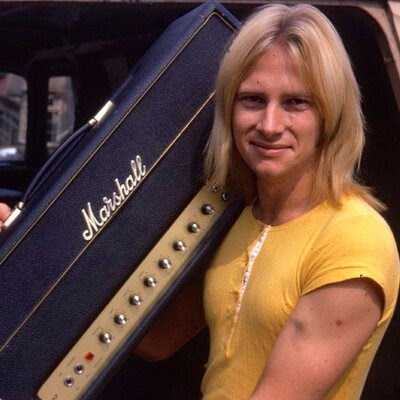
THE SELF-PROCLAIMED "loudest guitarist in history," Ted Nugent plays guitars that would seem totally unfit for high-decibel rock: hollow-bodied Gibson Byrdland archtop electrics.

The model was co-designed by two first-call '50s session players, Billy Byrd and Hank Garland, and was aimed primarily at jazz, country, and dance-band guitarists of the day. In addition to being fully hollow rather than semi-hollow like an ES-335, the Byrdland is also a short-scale design at 23.5 inches, which takes a significant chunk out of the standard Gibson 24.75 inches (or 25.5 inches for many full-sized jazz guitars of the day); it also has a slimmer, narrower neck than usual.

Despite the seeming incongruities in the guitar's design, Nugent applied his '60s Byrdlands to an unholy maelstrom of metalesque exploits. In the late '60s and early '70s the Detroit rocker ramped up the fury with the Amboy Dukes and launched his solo career proper with the Ted Nugent album of 1975. His first real commercial hit single was "Stormtroopin" from this self-titled album, while his best-known hit, "Cat Scratch Fever," appeared on the 1977 album of the same name.

Although Nugent used a little early-'60s tan Tolex Fender Deluxe amp, cranked to the max, to record the single, as Aspen Pittman notes in his The Tube Amp Book, he is known for playing through massive stacks on the live stage, piling up Twin Reverbs in the early days, then Marshalls, and, most recently, Peavey 5150s.

Except for a dalliance with PRS, the Gibson Byrdland has remained a constant with Nugent-and
if we can't find any documentation for the claim of "loudest guitarist on earth," we can probably concede the Motor City Madman the title of "loudest guitarist on a hollow-body archtop" with few reservations. [extract from Star Guitars, 101 Guitars That Rocked the World by Dave Hunter]

This post is very special to me as is my vinyl copy of his debut self-titled album as a sole artist. Side-A is definitely the better side although the B-Side kicks off with "Snakeskin Cowboy" and the popular "Motor City Madhouse" which have been almost signature tracks for Nugent's charisma.  Of course full album artwork is also included with the FLAC audio files. As a bonus I've taken the liberty of including a live rendition of "Stormtroppin' which was recorded for the King Biscuit Flower Hour in St. Antonio,Texas in 1977.
Hope ya enjoy Ted's ripper debut and if your patient, there's plenty more of his albums still to come - a Free For All so to speak  LOL

Tracklist
01 Stranglehold 8:22
02 Stormtroopin' 3:07
03 Hey Baby 3:59
04 Just What The Doctor Ordered 3:39
05 Snakeskin Cowboys 4:30
06 Motor City Madhouse 4:28
07 Where Have You Been All My Life 4:03
08 You Make Me Feel Right At Home 2:51
09 Queen Of The Forest 3:34
[Bonus Track]
10 Stormtroopin' (King Biscuit Flower Hour - St Antonio - TX 1977)


Guitar, Vocals, Percussion – Ted Nugent
Bass – Rob Grange
Drums, Vibraphone [Vibes], Vocals – Cliff Davies
Keyboards – Steve McRay
Percussion – Brian Staffeld, Tom Werman
Rhythm Guitar, Vocals – Derek St. Holmes


Ted Nugent Link  New Link 01/06/2021

Friday, February 19, 2021

Mick Fleetwood's Zoo - I'm Not Me (1983)

(U.K 1963 - Present)

Having played with Peter Green in an early conception of of Fleetwood Mac playing R & B and then later with Stevie Nicks and Lindsey Buckingham in the more contemporary group, Mick Fleetwood formed his own band called  'Mick Fleetwood's Zoo' in 1983 and recorded the LP 'I'm Not Me'. The album featured a minor hit, "I Want You Back", and a cover version of the Beach Boys' "Angel Come Home". A later version of the group featured Bekka Bramlett on vocals and Billy Thorpe on guitar and recorded 1991's Shakin The Cage.

This home-recorded Mick Fleetwood project, is neither a solo effort nor a Fleetwood Mac knockoff — though, admittedly, there are moments when I’m Not Me can sound like his main group. Instead, more often than not, this short-lived quartet has its very own feel — well, a bunch of them, really.

Of course, Fleetwood Mac diehards appreciated the long-awaited reissue on CD in 2012 through Real Gone Music, because it includes “I Want You Back” — a lost minor hit that Lindsey Buckingham co-wrote and shared lead vocals on. Three tunes also feature lead vocals by Billy Burnette, who recorded and toured with the band for eight years during a Buckingham hiatus. “This Love” was co-written by producer Richard Dashut, who worked in a similar role on Fleetwood Mac’s Rumours, Mirage, Tango in the Night and Time — and co-produced a pair of solo projects with Buckingham, as well. Christine McVie also adds background vocals.

The main group, which included Fleetwood, Burnette, guitarist/vocalist Steve Ross (Men at Work,
Beach Boys) and bassist Roger Hawkins (Kenny Loggins, Aretha Franklin) had, in fact, initially
been assembled to back Buckingham during a February 1982 solo appearance on “Saturday Night
Live.” 

Something clicked, and the group repaired to the studio to knock out some tracks. In keeping, “I Want You Back,” arriving as it does between Mirage and Tango in the Night, could have
easily fit into either of those contemporary Fleetwood Mac efforts. But, really, I’m Not Me is far too
layered and complex, too much of its very own thing, to be lumped together with Fleetwood’s more
celebrated work there.

Zoo -  After Performing Live On Saturday Night, 1982

Zoo, in fact, had three of its own credible frontmen — and each of them adds his own texture and
personality to the proceedings: Ross’ sleek take on “You Might Need Somebody,” an amiably
grooving slice of blue-eyed soul, segues into Hawkins’ snarling stadium-rock number “Tonight.”

Burnette’s country-blues title track sits alongside “State of the Art,” a riffy pop-rocker from Hawkins, which is then followed by Burnette’s brawny take on the mid-1950s gem “Tear It Up” — co-written by Burnette’s father Dorsey, an early-rock pioneer.

Burnette’s sensitive rendition of “Angel Come Home,” a tune Dennis Wilson wrote for the Beach
Boys, frames up the album’s low-key vibe perfectly, with its ear-tickling, off-the-cuff combination
of rough rockabilly, soaring So-Cal backing vocals and propulsive power pop. Heck, Ross steals away from his own emotional ballad “I Give” at one point to front a galloping version of Lloyd Price’s “Just Because.” It’s that kind of record — loose and lots of fun. In fact, Fleetwood doesn’t even play on “I Give,” and only adds the lightest of percussion to “Put Me Right,” Hawkins’ album-closing tune. That’s how little ego there was surrounding I’m Not Me.

Unfortunately, this was the only album this quirky, deeply underappreciated quartet ever managed.
Fleetwood Mac resumed a few years later, and when Fleetwood jump started Zoo again in the early 1990s, it was with Billy Thorpe, Bekka Bramlett and Greg Wright, among others.
[extract from somethingelsereviews.com]

Gig Review from 1983

(By Howard Wuelfing November 9, 1983)

A few years ago Mick Fleetwood was playing to sold-out stadiums as drummer of the band named after him, Fleetwood Mac. Last night, however, Mr. Fleetwood's Zoo barely drew enough fans to fill one of the Bayou's two levels.

After what seemed an interminable wait, during which the audience was subjected to an unrelenting string of new wave dross and the testing and retesting of the group's equipment, the band took the stage to understandably ambiguous responses. Within moments, though, the crowd was won over completely by this four-piece outfit's catchy synthesis of blues and folk-rock influences.

The other three members provided tight, tuneful vocal harmonies and impressive, no-nonsense guitar and bass. Fleetwood was content doing what he's done best for so long--supplying supple, sympathetic percussion. When called for, his drumming was punchy and to the point, pure primal stomping Charlie Watts would envy. Whenever possible, though, he added sprays of tubular bells, herky-jerky counterpoint rhythms and Third World beats that made the ordinary tunes sound special and the extraordinary ones seem even more so.

Most of the selections taken from the new album, succeeded exceptionally well, mixing a strong sense of rock tradition with the sort of colorful, crowd-pleasing flair you'd expect from an artist of
Fleetwood's status and caliber. [www,washingtonpost.com]

This post consists of FLACs ripped from Cassette Tape release (plays like a charm without any sound  degradation or speed issues).  Of course, full LP artwork  is included (thanks to the best that DISCOGS can offer) and of course a scan of the cassette cover.  I had to laugh when doing this as i thought there were imperfection marks on my cassette cover until I saw scans of the vinyl equivalent, and released they were part of the design.  Hope you enjoy this 'interlude' in Mick's musical career and find it as refreshing as I did when I first listened to it many, many moons ago.

Track Listing
01 Angel Come Home 4:15
02 You Might Need Somebody 3:26
03 Tonight 3:56
04 I Want You Back 2:51
05 I'm Not Me 3:41
06 State Of The Art 4:04
07 Tear It Up                 3:09
08 This Love  4:16
09 I Give 2:46
10 Just Because 2:38
11 Put Me Right 4:03

Mick's Zoo were:
Drums – Mick Fleetwood
Bass – George Hawkins
Guitar – Billy Burnette, George Hawkins, Lindsey Buckingham, Steve Ross, Todd Sharp
Keyboards – Christine McVie, George Hawkins, Lindsey Buckingham
Rhythm Guitar – Ron Thompson
Lead Vocals – Billy Burnette, George Hawkins, Lindsey Buckingham, Steve Ross
Backing Vocals – Billy Burnette, Christine McVie, George Hawkins, Lindsey Buckingham
Saxophone – Jon Clarke, Vince Denham
Slide Guitar – Ron Thompson
Tenor Saxophone – Don Roberts

Mick Fleetwood's Zoo Link (250Mb) New Link 01/06/2021

Saturday, February 13, 2021

The Manhattan Transfer & Gene Pistilli- Jukin' (1975)

 (U.S 1969 - Present)

The Manhattan Transfer
are one of the more unique and innovative vocal groups of the last several decades, the quartet flitting from genre to genre with even more frequency than Joe Jackson, doing everything from jazz, R&B, and straightforward adult-contemporary pop to doo-wop, swing, and even world music, yet having a trademark four-part-harmony sound that keeps even their most left-field stylistic excursions still very much identifiable as an album from the group. 

Though they peaked commercially in the early Eighties and haven’t scored a major crossover hit since 1983’s “Spice of Life,” sadly rendering them mostly little-known among younger music listeners, they continue to release fabulous discs and they remain highly-respected in the music industry, attracting such high-profile legends on their albums as Stevie Wonder, Ringo Starr, Smokey Robinson, and even the late, great Laura Nyro. They’ve garnered twenty Grammy nominations over the years, winning ten of those trophies, and they’ve also been inducted into the Vocal Group Hall of Fame.


Their first album Jukin’ received little notice, and the group soon dissolved. However, after meeting vocalists Laurel Massé and Siegel, Hauser decided to reform the act. Once mutual friend Paul joined, they relaunched Manhattan Transfer in 1972. A car accident led to Massé’s departure; Bentyne replaced her in 1979, and the lineup remained intact throughout the rest of their careers. While they had some minor hits with Massé (including the gospel tune “Operator”), it was their 1979 vocalese cover of the Weather Report’s “Birdland” that brought them international acclaim.

Album Review

No be forewarned: this debut LP from the group is quite literally the work of almost an entirely different group. Tim Hauser is the only band member here who would go on to appear on any of the albums that would follow, and even he plays a relatively minor role here, the disc serving as more of a showcase for singer/songwriter Gene Pistilli, who had a hand in writing five of the ten tracks and takes most of the lead vocals. Nothing on this album would be kept in the band’s later stage repertoire with the exception of “Java Jive.” 

There’s also little on this LP that qualifies as jazz except for possibly “You’re a Viper.” Instead, the band tries on a variety of styles from the country-rock of “Rosianna,” the pure country of “Fair and Tender Ladies,” and the soft-rock of “One More Time around Rosie” to the doo-wop of “Guided Missiles,” the vaudeville of “Sunny Disposish,” and the Bobby Sherman-like pop of “Chicken Bone Bone.” It’s awfully schizophrenic, and the band doesn’t seem to have any clear idea what they are. Hauser would wisely bring a greater focus to the group upon re-forming it, dispensing with the experiments in country and rock and placing a greater emphasis on doo-wop, pop, and jazz without any of the irony that crops up on this disc, and the change gave the group a much more distinct and unique identity. Naturally, this is an unbelievably strange disc to listen to if you’re already familiar with the group’s later work, but it’s not dreadful – just different. Very different.
[extract from thegreatalbums.com]

Jukin' has been described as "a bit rugged and unpolished but with a sense of humour". It is a collection of eclectic styles (primarily big band swing plus country, rock, pop) featuring a tremendous range of vocals and instrumentation. The production of this album is beyond words. In my opinion, it presents a great opportunity for young musicians to experience music that they would never be exposed to through the normal mediums of radio and video. I'' let you be the judge.

This post consists of FLACs ripped from my vinyl, another amazing find at my local flee market. Although I had heard of this band I'd never really explored their music until now. I'm glad I picked this LP up (for a bargain I might add) as the diversity in musical styles on this album is amazing and so refreshing. If you are looking for something different, then JUKIN' is for you. Full album artwork and label scans included.

Note: Although the album was recorded in 1971, it wasn't released until 1975.

Tracklist
01 Chicken Bone Bone    3:17
02 I Need A Man 3:07
03 You'se A Viper 1:57
04 Fair And Tender Ladies    2:37
05 Rosianna   3:01
06 Sunny Disposish 1:36
07 Java Jive 2:32
08 One More Time Around Rosie   4:18
09 Guided Missiles 3:22
10 Roll Daddy, Roll 2:19

Manhattan Transfer Link (158Mb) New Link 01/06/2021

Saturday, February 6, 2021

The Honeydrippers - Volume One E.P (1984)

 (U.S 1984 - 1985)


Originally formed in Worcestershire by Robert Plant, the Honeydrippers was also composed of fellow former Led Zeppelin member Jimmy Page; Jeff Beck (a former Yardbirds member like Page); close friend Robbie Blunt and others.

The band released only one recording, a 12" E.P entitled 'The Honeydrippers: Volume One', on the 12th November 1984. They performed in a concert at Keele University in 1981. The Honeydrippers peaked at number 3 in early 1985 on the Billboard Hot 100 with a remake of the Phil Phillips' tune "Sea of Love", and hit number 25 with "Rockin' at Midnight", originally a Roy Brown recording and a rewrite of "Good Rockin' Tonight."

With the 12" EP's success, Plant stated that a full album would be recorded, but it never was. The band appeared on Saturday Night Live on 15 December 1984, performing "Rockin' at Midnight" and "Santa Claus Is Back in Town." The band featured Brian Setzer and George Wadenius on guitar, Tom Barney on bass, Paul Shaffer on piano, Buddy Williams on drums, Michael Brecker, Lou Marini, and Ronnie Cuber on saxophones, Jon Faddis on trumpet and Tom Malone on trombone.On 23 December 2006, Plant performed a charity show at Kidderminster Town Hall under the title 'The Return of the Honeydrippers' to raise money for his neighbour Jackie Jennings, who was undergoing treatment for a brain tumor. [extract from live.wdrv.com]

The Honeydrippers - Saturday Night Live

"Revisiting the Day Robert Plant Debuted the Honeydrippers"


Once you’ve been to the mountaintop, where can you go for a follow-up? That’s the question the surviving members of Led Zeppelin had to ask themselves when they disbanded following drummer John Bonham’s death in 1980. After you’ve become the biggest band in the world, defining over-the-top rock stardom, what do you do next?

For a hot minute, it looked like the band’s front line might merge with the rhythm section of another iconic ‘70s band that had come to a fork in the road. Jimmy Page was cozying up to bassist Chris Squire and drummer Alan White of Yes in a band tentatively dubbed XYZ (for Ex-Yes and Zeppelin, of course) – and he wanted Robert Plant to join in.

The leonine lead singer, however, ultimately demurred. It would have been easy for Plant to go from Zeppelin to another big, flashy bunch of arena rockers, but the singer would spend much of his post-Zep career flouting expectations at every opportunity. And that practice began in 1981, when Plant put together the Honeydrippers.

Now, these weren’t the Honeydrippers that most of the world would come to know through the 1984 album Honeydrippers Vol. 1, which contained two Top 40 hits. That all-star outfit – which featured Plant, Page, Jeff Beck, Paul Shaffer and other heavyweights – came into existence at the behest of Atlantic Records chief Ahmet Ertegun, who had caught a concert by the short-lived, considerably less star-studded 1981 lineup.

Reeling from both the death of his longtime friend Bonham, with whom he’d played in the Band of Joy before Led Zeppelin, Plant sought out a place of comfort, both musically and personally. In order to escape his recent past he pursued a more distant, almost mythological past. He began convening with musicians he’d known since he was a schoolboy hanging around Midlands blues clubs, and together they proceeded to jam on the kind of early rock & roll/R&B tunes that Plant loved when he was a kid.

Instead of storming the stage amid lengthy solos and epic tunes, Plant began bopping atop bouncy ‘50s-style jump blues and rockabilly rhythms, and having the time of his life doing it. He first brought guitarists Robbie Blunt (ex-Bronco and Silverhead) and Andy Silvester (formerly of Chicken Shack and Savoy Brown) over to his home at Jennings farm, followed in due course by bassist Jim Hickman, drummer Kevin O’Neill, harmonica player Ricky Cool and saxophonist Keith Evans.

The man who had become an avatar of everything larger-than-life in the ‘70s rock scene was now engaging in a shocking about-face. Ironically, Plant shook off the psychological shackles of the last decade by returning to the same well of post-World War II American music that inspired Led Zeppelin, but instead of amping those sounds up to gargantuan stature, he and his Honeydrippers – whose name came from either from the nickname of bluesman Roosevelt Sykes or the song and backing band of ‘40s R&B star Joe Liggins, depending on who you ask – stuck to the material’s original sonic dimensions.

Plant and his pals worked up a rootsy repertoire that encompassed not only rockabilly romps like Gene Vincent’s “She She Little Sheila,” Carl Perkins’ “Your True Love,” and the Elvis Presley classic “Little Sister,” but old-school R&B wailers like Don Gardner & Dee Dee Ford’s “I Need Your Loving,” blues stompers like Muddy Waters’ “I Can’t Be Satisfied” and Lazy Lester’s “Sugar Coated Love,” and even the Western swing standard “Deep in the Heart of Texas.” And when it was time to take it on the road, the Honeydrippers’ modus operandi was just as lean as their sound.

Starting either at Keele University in Staffordshire on March 3 or at a bar in Stourbridge on March 9, depending on the source, the Honeydrippers hit a string of small venues including pubs, colleges and small clubs, each show unadvertised – and all well clear of London, either in the Midlands or points north. It wasn't just that they took the stage with their amps stacked on beer crates, in stark contrast to the convoy of trucks that hauled Led Zeppelin’s gear around, or that Zep’s outsized hard-rock extravaganzas been replaced by the two-and-a-half-minute wham-bam of classic blues and rock ‘n’ roll tunes. A more symbolic but equally striking alteration had occurred.

Even Plant’s long, curly locks (surely one of the most legendary heads of hair in rock history) had gone under the chopper. Granted, he wasn’t sporting a crew cut or spiky New Wave ‘do, but the sweeping changes he was instituting to put the past behind him clearly extended all the way to his stylist. And in rock ‘n’ roll, of course, image counts as much as anything – maybe even more.

The original Honeydrippers’ lifespan would be brief. By 1982, Plant (with Robbie Blunt by his side), would return to a mainstream rock feel for his first solo album, Pictures at Eleven, but the precedent had been established for the kind of mercurial moves Plant would continue to make throughout his career. From his Alison Krauss collaboration to his repeated refusals to reunite with Jimmy Page and John Paul Jones, no one would ever accuse Robert Plant of resting on his laurels [Article taken from  ultimateclassicrock.com]

This post consists of FLACs ripped from my pristine Vinyl, purchased the same day I heard Sea Of Love being played on my local radio station 3XY in December of 1984. If it were not for the radio publicity, I probably would not have known who the Honeydrippers were and the association with Robert Plant, as the album artwork contains no credits or band details. Needless to say, I was surprised with the musical path that Plant had chosen to take post Zeppelin, but still enjoyed the E.P immensely.
Full album artwork for both vinyl and CD is included along with label scans and alternative covers.

Tracklist:
I Get A Thrill 2:39
Sea Of Love 3:03
I Got A Woman 2:58
Young Boy Blues 3:30
Rockin' At Midnight 5:57

The Honeydrippers were:
Lead Vocals – Robert Plant
Bass – Wayne Pedziwiatr
Drums – Dave Weckl
Guitar – Jeff Beck (tracks: 3, 5), Jimmy Page (tracks: 1, 2), Robbie Blunt ?
Piano – Paul Shaffer
Rhythm Guitar – Nile Rodgers
Saxophone – Keith Evans (tracks: 5)

The Honeydrippers Link (120Mb) New Link 02/09/2025