If it wasn't released on Vinyl or as a bootleg / soundboard recording - then you won't find it here.
If you believe that any postings breach copyright laws then please leave a comment and I will remove the posting.
(Australian 1969 - 84) . Sherbet was Australia's top pop group in the 1970s, with a fan base largely made up of teenage girls. They were the first band to reach AUS $1M in record sales in Australia; pioneered the concept of massive regional tours; and turned its merchandising into a huge industry.
Sherbet were formed in Sydney in 1969 by guitarist Clive Shakespeare with members of his former band Downtown Roll Band. Initially they started out as a soul band doing Motown material. They released their first single "Crimson Ships" the following year. In 1971 they won Australia's prestigious national rock band contest Hoadley's Battle of the Sounds. In the same year they had their first hit with the Ted Mulry song "You're All Woman" and from then on they had a string of hits. They became the darlings of Australia's teenyboppers and did regular appearances on the top TV pop show Countdown.
During the seventies no act was more popular on Countdown than Australia’s premier pop band, Sherbet. Sherbet made more appearances on Countdown than any other band in the program’s 13 year history.
Sherbet had a clean-cut boys-next door image; a big contrast to the bad boy persona favoured by their peers. There were often scenes of screaming, shirt-ripping and general girl-fan mayhem on the Countdown set when the band appeared. Sherbet’s first Countdown appearances coincided with their 'Slipstream album', which earned them five gold records. 'Slipstream' reached Number 5 in October 1974 in the Australian Charts and went on to sell over 100,000 copies. 'Life is for Living' and a greatest hits album soon followed [extract from www.countdown.com.au]
For the better part of the Seventies, Sherbet were the Kings of Pop in Australia. By mid-decade they were undisputed rulers of the Australian charts and stages, and only with the appearance of the mighty Skyhooks was Sherbet confronted with its first serious rival.
Michael Gudinski (Skyhook's Manager) is quoted as saying "Like the Beatles and the Stones, despite the public rivalry, privately, the bands were good mates". He recalls - "Funnily enough, we got on really well with Sherbet. Roger Davies (Sherbet's Manager) and I were already friends and we stayed good friends. Both bands used the rivalry thing to their advantage. People used to think 'Oh, they hate each other' and the fans would be fighting. Yet Sherbet actually helped us out. The first gig Skyhooks ever did in Sydney was at the Opera House with them, and we did quite a few shows together. But there'd be radio polls where listeners would vote for their favourite, either Skyhooks or Sherbet. It was an exciting time, a great era for Australian music" (Taken from Ego Is Not A Dirty Word: The Skyhooks Story by Jeff Jenkins, 1994, p 60)
Davies, vigorously marketed Sherbet as a teen-oriented singles band, producing some polished, highly commercial pop/R&B. In terms of teen adulation (especially with girls), they were the true successors to The Easybeats, with lead singer Daryl Braithwaite unquestionably the most popular male performer of the period. Their popularity reached Beatle-esque heights, with regular riots, mobbings and scenes of crowd hysteria. Exposure to a national television audience on Countdown vastly increased their popularity across the country. Sherbet avoided some of the excesses of glam, such as heavy make-up, but were partial to satin, velvet and custom-made bomber jackets.
.Although sometimes criticised (at the time) as lightweight, they were a classic pop band whose success was solidly founded on great musical ability and sheer hard work, not just marketing hype. Sherbet remains one of the best-selling and most successful bands in Australian music. They produced some great original material and enjoyed a record-breaking string of hits, with an amazing run of sixteen consecutive Top 40 singles between 1971 and 1977. They also hold the unique honour of being our first band to score an overseas hit with a song written, recorded and produced entirely in Australia - "Howzat".
In concert, Sherbet were outstanding. As their live recordings attest, they were tight, disciplined, consistent and highly professional. They were also one of the hardest working bands in the business. They kept up a punishing touring schedule throughout their career and visited almost every part of the country at one time or another, completing around 20 national tours. In an industry well-known for tantrums and "no shows", Sherbet missed only one gig in fifteen years of touring, according to Sandow! Sherbet was also the first Australian band to be able to maintain a large-scale, permanent touring operation which included "specially-designed stage clothes, 3 1/2 tonnes of stage equipment, a 2000-watt amplification system, and an integrated light show which included ... pyrotechnic effects." [extract from Milesago.com.au] .
.
[Thanks to Debbie Krugger for the 'Live Photos' above]
.
Sherbet had the best tour books of any group around in those days, local or international. The "On Tour" book, written about the band's "Around Australia in 80 Days" tour, sold at newsagents and apparently was the biggest selling book on a pop group in its day.
In 1977 Sherbet went back overseas and – other than a quick trip home over Christmas/New Year to see family and do free concerts for 2SM and 3XY — stayed away for a year. When they returned, Daryl had a beard, Tony had tamed the afro, and the music sounded all grown up. The "Another Night on the Road" tour was in smaller venues than previous tours, and more musically satisfying, although the guys seemed frustrated that the fans still wanted to scream and hold up signs saying "DARYL U SPUNK" rather than listening to the lyrics of songs that they had sweated over in Canada and California. [extract from DebbieKruger.com]
From 1978, the band spent several years attempting (without success) to make an impact in the United States. The last studio album from 1978 'Sherbet' was issued in the United States under the name Highway and titled 'Highway 1'. After making little headway in the US market the band broke up for a short period before reconvening with new wave sound as The Sherbs and releasing 'The Skill' which made the US Top 100, 'Defying Gravity' and the mini-album 'Shaping Up'. Harvey James left towards the end of 1982 to be replaced by Tony Leigh. They decided to call it a day in 1984, reverting back to the Sherbet moniker for a farewell tour and final single "Tonight Will Last Forever". Following the group's break-up, lead singer Daryl Braithwaite went on to a successful solo career in Australia, and Garth Porter became a successful record producer.
The improved rip provided here was taken from CD in FLAC and includes full album artwork (thanks to Brett from Midoztouch for the artwork).
Some choice photos of the band in the 70's are also included. As a bonus, I have also added a videoclip of Sherbet performing 'Slipstream' on the Paul Hogan Show in 1974.
The one track that first attracted me to this album when it first came out was "Wild Love", a real funky, hard base line 12 bar blues - but I would never have admitted this in front of my mates at the time! The title track "Slipstream" and "Freedom" (not the same track that Hendrix did by the way) were also personal favourites, but as a whole the album is probably one of their best releases. Something to watch out for (and it only took me 35 years to notice) is the teeny bopper track 'Handy Mandy' which contains some rather interesting lyrics!
NEW IMPROVED RIP !
Track Listing
01 - Slipstream 02 - Endless Place 03 - Wild Love 04 - Another Hustler 05 - What's It All About 06 - Freedom 07 - Silvery Moon 08 - Handy Mandy 09 - When the Sunshine Turns to Grey 10 - Earthquake in My Head 11 - So Glad You're Mine .
Band Members: Daryl Braithwaite (Vocals) Clive Shakespeare (Guitar, Vocals) Tony Mitchell (Bass) Garth Porter (Keyboards, Vocals) Alan Sandow (Drums) .
Another interesting Infinity records compilation, mainly famous for featuring some great singles that were never on an album at the time. It is still the only LP where you can find Blackfeather's delicate, acoustic "Find Somebody To Love", or the marvelous "Song For A Blindman" by cult Sydney outfit 'Stafford Bridge'.
The Glyn Mason (ex-Chain) led version of 'Copperwine' is also here. Other tracks are duplicates of "The Stars Of Sunbury" LP (eg Warren Morgan, Country Radio, Billy Thorpe), but this is still a fine colection of rare/rare-ish classy Oz artists of the early 1970's. It retailed for $3.99 back in 1972.
It's a pity about the cheap, slapdash generic cover which has no relevance to the music whatsoever. But, as the saying goes: 'Never judge a book by its cover'. This is a great compilation of early 1970's Aussie Rock, I hope you enjoy it.
Blackfeather
Blackfeather were an Australian rock group which formed in April 1970. The band has had numerous line-ups, mostly fronted by founding lead singer, Neale Johns. An early heavy rock version recorded their debut album, At the Mountains of Madness (April 1971), which peaked at number seven on the Go-Set Top 20 Albums chart. It provided the single, "Seasons of Change" (May 1971), which was co-written by Johns with lead guitarist, John Robinson. In July 1972 a piano-based line-up led by Johns issued an Australian number-one single, "Boppin' the Blues"/"Find Somebody To Love", which is a cover version of the Carl Perkins' 1956 single.
Blackfeather formed in April 1970 in Sydney by Leith Corbett on bass guitar, Mike McCormack on drums, and John Robinson on lead guitar (all from the Dave Miller Set), plus lead vocalist, Neale Johns. Robinson recalled meeting Johns, "a small guy with a huge voice, Neale was very taciturn. He was into the blues and had excellent range." Their name was derived from two found suggested in a book, "Whitefeather" and "Heavyfeather". Corbett and McCormack left soon after, replaced by Robert Fortesque on bass guitar and Alexander Kash on drums. Corbett subsequently reunited with singer Dave Miller to record a duo album, Reflections of a Pioneer. Johns and Robinson wrote or co-wrote the band's original material.
Glyn Mason
Copperwine
Following the departures of first Wendy Saddington, then Jeff St John, the remaining members of Copperwine recruited former Chain/Rebels singer/guitarist Glyn Mason to join as new front man All seemed to be business as usual when the band issued this fine debut single in 1972, a pioneering effort in the then emerging country rock field. Glyn did have mighty big shoes to fill & judged on talent alone, he certainly had the song writing ability & the voice but sales were not as might have been expected so the band disbanded soon after.
Glyn went onto become one of our most respected journeyman musos, returning to Chain briefly for a 2nd live album before forming his own band Home who issued to fine country/blues LPs.
From there he joined Mike Rudd in Ariel, the combination of their songs working a treat, with Glyn writing one of their most popular songs "It's Only Love". Later on Glyn lent his name to the popular Stockley See Mason Band alongside two other great Aussie journeymen Sam See & Chris Stockley, and to this day Glyn can still be seen around Melbourne with Sam, now calling themselves The Pardners.
Meantime bassist Harry Brus, has gone on to forge a sterling career of his own, being the bassist of choice for both Kevin Borich & Renee Geyer, both of whom he has worked with for many years, as well as a who's who of Australian music.
Phil Manning (Pilgrimage)
Philip John "Phil" Manning (born 1948) is an Australian blues singer-songwriter and guitarist. Manning has been a member of various groups including Chain and has had a solo career. As a member of Chain, Manning co-wrote their January 1971 single "Black and Blue" which became number one on the Melbourne charts and also Judgement, which reached number two in Sydney. The related album, Toward the Blues followed in September and peaked in the top 10 albums chart.
Manning left Chain in July 1971 to work with Warren Morgan (ex-Chain, Billy Thorpe & the Aztecs) on keyboards in a band called 'Pilgrimage'. They issued a single, "Just For You / Walk In The Light" in November 1971 and supported United Kingdom progressive rock group, Pink Floyd, in September and pop artist, Elton John, in October. The B-Side "Walk In The Light" was written by Manning and you can see him performing it below.
Sherbet
Sherbet were Australia's most popular pop group of the 70s with 20 consecutive hit records and 17 album, accounting for 10 platinum and 14 gold disc awards. In 1969 the Sydney entertainment scene was almost totally geared towards satisfying the money-rich comfort-starved American Vietnam troops who came for official Rest And Recreation.
Sydney's nightclubs gave them what they wanted - R&B, soul, funk, good-time rock - and these influences spilled over into the pop group Sherbet, formed without singer Daryl Braithwaite, but completed by his falsetto-capable vocals.
In January 1972, Sherbet's 'classic line-up' was in place when Tony Mitchell replaced Worrall on bass guitar: the band now consisted of lead vocalist Braithwaite, keyboardist Porter, drummer Sandow, bassist Mitchell and guitarist Shakespeare.
They were the archetypical 70's girl fodder pop band - groomed hair, colourful satin stage outfits. "You're All Woman" b/w "Back Home" charting at #13 was a single taken from their debut 1972 album 'Time Change... A Natural Progression' which also charted reaching #66 on the Kent Music Report.
Also that year the band were voted 'Most Popular Australian Group' by readers of Go-Set in their annual pop poll and were also the winners of The Battle Of The Sounds.
Billy Thorpe and the Aztecs
Billy Thorpe and the Aztecs were an Australian pop and rock group dating from the mid-1960s. The group enjoyed success in the mid-1960s, but split in 1967. They re-emerged in the early 1970s to become one of the most popular Australian hard-rock bands of the period.
Billy Thorpe openly acknowledged that his new 1970's 'heavy' version of the Aztecs owed much to 'guitar hero' Lobby Lloyde. Lloyde had a cult following due to his stints in two of the most original Australian bands of the Sixties, The Purple Hearts and Wild Cherries. This track "Good Morning Little School Girl" is from 1970 and certainly features the beginnings of that heavier sound that was to 'boom' throughout the 70's.
It's a blues-rock interpretation of the classic blues standard originally written by John Lee "Sonny Boy" Williamson in 1937.
The song features a bluesy harmonica, resonant bass lines, and a hard rock edge, drawing inspiration from other interpretations by artists like Ten Years After and the Yardbirds.
These changes also extended into Thorpe’s physical appearance as he grew his hair that was sported into a braided tail. He also fashioned a more casual wardrobe than what he used to wear previously.
Stafford Bridge
"Song For A Blind Man" was an obscure Australian progressive rock/pop from 1972 by Stafford Bridge. The band's only released material were two singles on the infinity label. A Sydney band Stafford Bridge made the grand-finals representing NSW Country in Hoadley's National Battle Of The Sounds.
Band members were Peter Gordon - Sax and Flute, David Kay - Guitar and Flute, Gary Riley - Drums, Terry Riley - Organ, Guitar, Ross Sanders - bass and Jim Willebrandt - Vocals. Jim Willebrandt fronted a number of bands including Daisy Roots, Clapham Juntion, Toby Jug and Hot Cottage.
The only footage of Stafford Bridge that I know of can be seen HERE. (Right at the end of this clip - last 20secs ! )
Stafford Bridge
Country Radio
Greg Quill formed the original line-up of Country Radio (also seen as Greg Quill's Country Radio or Greg Quill and Country Radio) in June 1970. Other members were Agostino, Blanchflower, Walsh and Dave Hannagan on percussion and backing vocals. The group started as an acoustic act but from 1970 to 1971 its musical style evolved into electric country rock, a style then gaining popularity through the influence of albums like The Band's Music from Big Pink (1968), The Byrds' Sweetheart of the Rodeo (1968), and Bob Dylan's Nashville Skyline (1969). 1971 saw the release of "Listen to the Children" b/w "Last Time Around" on Infinity .
With the "classic" line-up of Quill, Tolhurst, Bird, Bois, Bolton and Blanchflower, Country Radio recorded their second and most successful single, "Gyspy Queen", with producer John French, in Melbourne in April 1972. It was co-written by Quill and Tolhurst, and featured a string arrangement by session musician, Peter Jones (who later worked on Quill's solo album, The Outlaw's Reply). Released in August, the single spent 13 weeks in the Go-Set National Top 40 and peaked at No. 12.
Greg Quill & Country Radio
Warren Morgan (Pilgrimage)
Warren Morgan was a bit of a journeyman spending a lot of his early years moving between 2 bands Chain and the Aztecs he started out in his first band the Beat 'n' Tracks along with future Chain member Phil Manning. Beat 'n' Tracks eventually morphed into Chain who recorded "Chain Live"(1970) from there Warren would be asked by Billy Thorpe to join the Aztecs he wold feature on the ground breaking "The Hoax Is Over" (1970) album.
After a falling out with Billy, Warren moved on to form Pilgrimage which he formed with Phil Manning and they released "Just For You / Walk In The Light" in Nov, 1971. After not making much money, they decided to split Phil going on to Band of Talabene and Warren reforming Chain and recording "Chain Live Again" (1971). The A-Side "Just For You" was written by Morgan.
After the Aztecs played Sunbury, Warren was again asked to join them and accepted. In 1973 he and Billy would record "Thump'n Pig and Puff'n Billy" a guest on the album would be Chain alumnus Phil Manning. He would later go on to be a member of Gerry and The Joy Band and also a member of the All Stars who backed Stevie Wright and then later John Paul Young.
Jeff St John & Copperwine
Jeff St John unveiled his new band, Copperwine (aka Jeff St John's Copperwine), in early 1969 with low-key dates in Perth, before returning to Sydney. Copperwine soon commanded a rabid following in that city's fast-developing 'head' scene.
Around the time of the new band's formation, guitarist Ross East was also invited to join the revised Masters Apprentices line-up by Jim Keays, but he turned it down, opting to stay with Jeff. Aided by East and Peter Figures, plus Alan Ingram on bass and keyboardist Barry Kelly (from Marty Rhone's Soul Agents), St John wowed punters at the Ourimbah "Pilgrimage For Pop", Australia's first major outdoor rock festival, hedl at Ourimbah, NSW at the end of January 1970.
The band's dynamic repertoire mixed quality prog-flavoured group originals with powerful renditions of Sly & the Family Stone's funk classic "Sing A Simple Song" (a stage fave for many Australian acts of the time including Southern Comfort and The Affair), a storming version of The Temptations' psych-soul masterpiece "Cloud Nine" and Blind Faith's "Can't Find My Way Home."
Another single, issued on Spin in November 1970, fared extremely well. The smoothly confident, organ-led cover of Rotary Connection's "Teach Me How To Fly" (featuring a berserk guitar solo from East, and some very tasty bass-drums interplay) propelled the band to #12 in Melbourne and a very encouraging #3 Sydney chart placement. St John's dazzling vocal performance on this record is probably the main reason why. The band toured relentlessly during 1971 and appeared with the Melbourne Symphony Orchestra plus they supported The Hollies on their Australian tour in 1971.
They also released another single, the delicate "Hummingbird"/"Keep On Growing". By late 1971 friction had emerged between Jeff St. John and Copperwine. He left them early in 1972 to form his own band and pursue a solo career.
Glenn Cardier
Sydney singer/songwriter Glenn Cardier was a popular solo performer on the early 1970s scene. In much the same vein as James Taylor, Doug Ashdown and Ross Ryan, Cardier played a brand of gentle and reflective acoustic folk and soft rock that gained him a strong cult following.
Cardier actually started out playing lead guitar in Brisbane acid-rock band The Revolution before taking to the road as a folkie. He signed to Festival's progressive Infinity label, with which he issued two albums and four singles: `Every Wounded Bird'/`The Juggler' (July 1972), `Ulysses'/`Minstrel' (February 1973), `Oh Dear Saint Peter'/`I Am the Day' (July 1973) and `I See a Comedy'/`Lovers Alias Fools' (June 1974).
Never content to be seen as just a sensitive folkie, Cardier toured with rock bands like La De Das, Country Radio, Sherbet and Daddy Cool.
He also made an appearance at the 1972 Sunbury Festival, and supported overseas visitors Frank Zappa and Manfred Mann's Earth Band. In 1974, Cardier became one of the first musicians in Australia (along with Rob MacKenzie from MacKenzie Theory and Greg Quill from Country Radio) to receive a travel grant from the Australia Council for the Arts (under the auspices of Gough Whitlam's Labor government). He travelled to England where he toured for several years, recording the Glenn Cardier album and a single `Till the Fire Dies'/`Christopher Columbus' (June 1976) for Interfusion along the way.
On his return to Australia in late 1978, Cardier recorded `Establishment Blues' under the psuedonym of Sydney Hill. The song appeared as the B-side to the Mojo Singers' #1 hit `C'mon Aussie C'mon'. Cardier's 1979 band, the Bel-Aires, comprised Brad Alick (lead guitar), Eddie Parise (bass, who later joined Baby Animals) and Vince Crae (drums). Cardier issued the single `Expectations'/`I Saved Annette from Drowning' in February 1980. He has also recorded the Christmas track `Reindeers on the Rooftops' under the alias Riff Raff.
* It should be noted that the B-side "I Am The Day" included on this compilation was lifted from Glenn's first LP "Days Of Wilderness" which was released in 1972.
Wendy Saddington
Wendy Saddington was one of Australia's premier soul/blues singers of the late 1960s/early 1970s (in the Etta James/Aretha Franklin mould). Because she was under-recorded, however, Saddington can only claim one single and one album to her credit.
Saddington first came to prominence in soul/psychedelic bands like The Revolution and the James Taylor Move, and the original version of blues band Chain. In May 1969, she joined pop paper Go-Set as a staff writer and later joined Copperwine as co-vocalist with Jeff St John. Her stay of ten months (March 1970–February 1971) motivated many changes in Copperwine's musical direction, with much of the soul-copying being replaced by a more purist blues-oriented sound.
That change was heard on the album Wendy Saddington and the Copperwine Live which had been recorded at the Wallacia Festival during January 1971. Saddington scored her only hit single when the Warren Morgan-penned and Billy Thorpe/ Morgan-produced `Looking Through a Window'/ `We Need a Song' reached #22 in September 1971. In 1972, Festival reissued the live album, retitled it Looking Through a Window and simply added the track `Looking Through a Window'. The single was reissued in 1977 but was not successful.
In March 1973, Saddington appeared as the Nurse in the local stage production of The Who's rock opera Tommy. Other cast members included Billy Thorpe, Daryl Braithwaite, Colleen Hewett, Broderick Smith, Doug Parkinson, Jim Keays, Ross Wilson and Keith Moon. Saddington worked with a variety of bands during the mid-1970s, including Shango and Blues Assembly.
She worked with the Jeffrey Crozier Band in New York during the late 1970s. In 1983, she formed the Wendy Saddington Band which initially comprised jazz pianist Bobby Gebert, Harvey James (guitar; ex-Ariel, Sherbet, Swanee), Billy Rylands (bass) and Chris Sweeney (drums). The 1987 line-up comprised Rose Bygrave (keyboards; ex-Goanna), Mick Liber (guitar; ex-Python Lee Jackson), Angelica Booth (bass) and Des McKenna (drums).
Chain 1972
Chain
Chain recorded 'Toward The Blues' at Melbourne's TCS Studios with engineer/producer John Sayers. The album announced, upon its release in late '71, the matured essence of Chain in its acknowledged classic configuration of Phil, Matt and the two Goose-Barrys. The album made the number 6 position on the national album charts and remained a strong Top 40 seller for four months (it still sells in respectable quantities to this day!).
It was supported by significant and valuable airplay, mainly on "alternative" radio programs like future Double-J presenter Chris Winter's seminal national ABC radio show, Room To Move. It was the sort of record that seemed to already be on the turntable whenever you stepped into a Saturday night party in those days. In short, it was one of those albums, along with Spectrum's Milesago or Tamam Shud's first, or maybe Co. Caine's debut opus, that any self-respecting aficionado of quality Oz Rock would consider essential for a well-rounded record collection!
Led by the single "Judgement", an aggressive, multi-faceted bluesy showcase for each band member, and notable for Phil's singular wah-wah guitar filigrees, 'Towards The Blues' proved an early pinnacle that Chain struggled to surpass later in their career, if, indeed, they themselves ever wanted or needed to.
Chain's credo, like that of most of their contemporaries, generally eschewed such crass or quaint notions of career longevity or quick riches. Instead, Aussie punters were presented with one of the finest and most well-rounded LPs of the era. Other gems include an inspired version of Robert Johnson's "32/20", followed by the supreme swing and swagger of their version of Junior Wells' "Snatch It Back And Hold It", delightfully re-appropriated here in true Aussie ratbag fashion as "Grab A Snatch And Hold It!"
Many other highlights abound, such as "Albert Goose's Gonna Turn The Blues Looses", a vehicle for Harvey to unleash a fierce drum solo. Side Two ends with Taylor's wailing blues harmonica featuring on the signature tune, the full version of "Black & Blue", which became Chain's most iconic and requested song at live gigs.
* Note - the featured tack "32 / 20" was never released as a single, and was lifted off their 'Towards The Blues' LP.
This post consists of FLACS ripped from Vinyl (thanks to Sunshine) and includes full album artwork and label scans. Although a majority of the tracks present on this compilation were released as B-Side singles, they could just have easily been A-Sides.
This is one of my favourite Go-To Aussie Compilation Albums and my copy has been played more times than I can remember.
Track List:
1. Blackfeather - Find Somebody to Love
2. Copperwine - Golden Angels
3. Phil Manning - Walk In The Light
4. Sherbet - Back Home
5. Billy Thorpe - Good Mornin' Little School Girl
6. Stafford Bridge - Song For A Blind Man
7. Country Radio - Last Time Around
8. Warren Morgan - Just For You
9. Jeff St. John & Copperwine - Keep On Growing
10. Glenn Cardier - I Am The Day
11. Wendy Saddington & Copperwine - Backlash Blues (Live)
(Australian 1969-84) . Between 1971 and 1978, Sherbet released 15 albums and 30 singles. Among these were Australian pop classics such as "You've Got The Gun", "Slipstream", "Howzat, "Life", and "Summer Love". Their earlier singles and albums were produced by Festival house producer Richard Batchens, but in 1975, with Batchens increasingly concentrating on Richard Clapton, Sherbet's production was taken on by Richard Lush, the former Abbey Rd alumnus and engineer on many of the The Beatles' later recordings, including the Sgt Pepper's LP. Braithwaite also branched out with a solo career, releasing several singles under his own name -- "Old Sid", "Love Has No Pride", "Afterglow" (a cover of the Small Faces classic) and his solo No.1 hit version of the Cilla Black hit "You're My World".
One of the most celebrated images of the band was created in at the height of their fame in 1974, when the group posed nude -- although discreetly draped in detergent suds -- for a series of photos by renowned photographer Lewis Morley for a feature on the group in the magazine Pol, published in October- November 1974.
From 1974, lead singer Braithwaite also maintained an active solo career alongside Sherbet, with Sherbet members often playing on Braithwaite's solo singles. .
Beginning in 1975, Sherbet's records were produced by Richard Lush who had begun his career in the UK as a trainee engineer at EMI's Abbey Road Studios, where he helped to engineer a number of Beatles' recordings including Sgt. Pepper's Lonely Hearts Club Band. Porter also began to take an occasional lead vocal on Sherbet singles. His vocals can be heard on "Hollywood Dreaming" and "A Matter of Time".
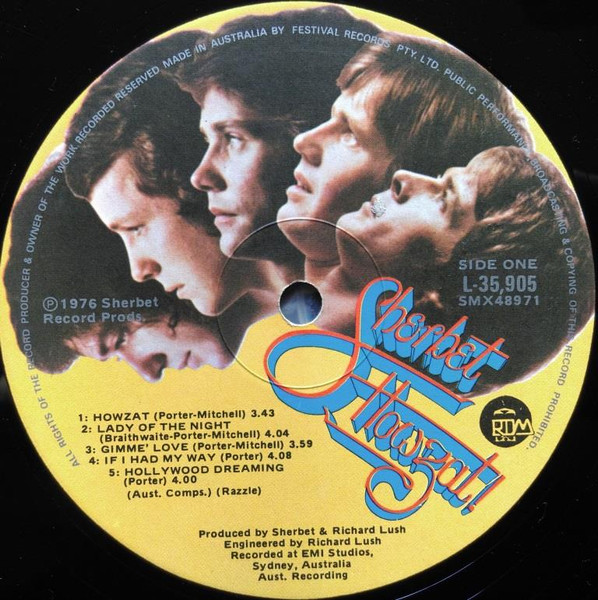
The high point for Sherbet came in 1976, with the release of their hit single "Howzat". Ironically, this breakthrough came hot on the heels of press predictions that Sherbet's demise was imminent. Just prior to recording the new single and album, founder member Clive Shakespeare left the band. Shakespeare was finding the growing pressure less and less easy to bear and by 1976 he had decided it was time to quit: Shakespeare was eventually replaced Harvey James (ex Ariel).
The inclusion of Harvey into the band saw their music move towards a heavier feel than anything previously released, and he adds some great guitar licks to nearly every track on the album. Around this same time, bassist Tony Mitchell stepped up to join Porter as Sherbet's new main songwriting team. The Porter/Mitchell duo was responsible for penning "Howzat" (1976), the band's only international hit, and a song which was inspired by the sport of cricket. The song's success lead to an extensive international tour in 1976-77. "Howzat" went to #1 in Australia, and was a Top 10 hit through most of Europe, South Africa, several Asian nations and parts of the Middle East -- but it failed to reach the American Top 40, stopping at #61 in the Billboard Hot 100. As well, while the Howzat album also made #1 in Australia, it failed to chart in the U.S. altogether. .
For those of you who enjoy a little trivia, you might be interested to know that Sherbet and their hit single "Howzat" were acknowledged by Australia Post in 1998. Sherbet, AC/DC and the Easybeats were among 12 Australian bands to feature on a set of stamps issued by the Australian post office in 1998. The set of 12 stamps were issued on the 26th May and were withdrawn on the 30th October 1998. The stamps were issued to celebrate the contribution that Australian has made to the Rock and Pop world from the 50's to mid 70's. . The rip for this posting includes FLACs taken from CD and contains both CD and LP artwork, along with label scans. As a bonus, I have included a live version of "Howzat' which was taken from their "Caught In The Act - Live" album from 1977.
IMPROVED RIP ! . Track Listing
01 - Howzat 02 - Lady Of The Night 03 - Gimme Love 04 - If I Had My Way 05 - Hollywood Dreaming 06 - Dancer 07 - Blueswalkin' 08 - Motor Of Love 09 - The Swap (You Can Get The Lot) 10 - Can't Find True Love 11 - I'll Be Coming Home 12 - [Bonus Track] Howzat (Live)
Band Members: Daryl Braithwaite (Lead Vocals, Tambourine) Harvey James (Guitar, Vocals) Tony Mitchell (Bass, Vocals) Alan Sandow (Drums) Garth Porter (Keyboards, Vocals) . Sherbet Link (302Mb) New Link 1/09/2025 .
This EMI compilation from the mid 70's has always been a long standing go to album of mine, partly because it features some of my favourite tunes, like ACDC's "Baby Please Don't Go", Ralph McTell's "Streets Of London", Steve Harley's "Make Me Smile " and Ross Ryan's "Blue Chevrolet Ballerina". But for some reason, the album cover has also been an attraction to me - even though its nothing special - but maybe its the 3D masonry lettering on top of the vibrant red background that has always caught my attention. Of course, there are other great tracks featured on this album, like Pilot's "January", Sherbet's "Summer Love" and Pete Shelley's "Gee Baby", but even the obscure selections by Pepper Box, Al Martino and Gilbert Becaud eventually grow on you after lots of plays.
So, even if you haven't heard some of these tracks, I suggest you give this LP a spin, and hey; maybe this collection of tracks will become your Explosive Hits of 75' as well. And now, some light reading while you listen to this comp:
1. John Paul Young - Yesterday's Hero
John Paul Young became well known when working with producers/composers Harry Vanda and George Young. In March 1975 Alberts released John Paul Young’s recording of Vanda & Young's Yesterday's Hero, a song about the fleeting nature of pop stardom. The record hit the national charts in April, reaching #1 and staying at #1 on the Melbourne charts for six weeks. "Yesterday's Hero" sold strongly in the USA and reached #42 on the Cashbox top one hundred. A key factor to "Yesterday's Hero" success was the film clip made to promote it, which enabled the song to be given exposure on Countdown (following the official start of colour TV broadcasting March 1, 1975. The Hero LP reached #20 on the charts in November 1975 and became a gold record.
2. Bay City Rollers - Bye Bye Baby
The Bay City Rollers are a Scottish pop rock band known for their worldwide teen idol popularity in the 1970s. They have been called the "tartan teen sensations from Edinburgh" and are one of many acts heralded as the "biggest group since the Beatles". The group's line-up had many changes over the years, but the classic roster during its peak in popularity included guitarists Eric Faulkner and Stuart Wood, singer Les McKeown, bassist Alan Longmuir and drummer Derek Longmuir.
Their debut album, Rollin' debuted atop the UK Albums Charts and spent a combined total of fifty-eight weeks on the UK Albums Chart. Their follow album studio album Once Upon a Star continued this success, again, debuting a top the UK Albums Chart. The album yielded the successful singles "Bye, Bye, Baby", which topped the charts in the United Kingdom, Ireland and Australia, and "Keep On Dancing". "Bye, Bye, Baby" was the best selling single in the United Kingdom in 1975.
3. Peter Shelley - Gee Baby
Peter Shelley (alas Peter Southworth) was a British pop singer, songwriter, and music business executive. As a performer in the 1970s, he had UK hits with "Gee Baby" and "Love Me Love My Dog". He also originated the persona of Alvin Stardust, writing, singing and producing the first single released under that name, "My Coo Ca Choo".
Gee Baby is a well constructed, if not slow paced, ‘bubblegum pop’ track that was a hit in the U.K. in 1974.
This was easily the then 32 year old singer/songwriter’s most successful solo release in Australia and, in January 1975, it peaked at the national #3 position published by the ‘Kent Music Report’ (the forerunner of today’s ‘ARIA Charts’)
4. Gary Glitter - Goodbye My Love
Paul Francis Gadd, better known by his stage name 'Gary Glitter', was an English former singer who achieved fame and success during the 1970s and 1980s. He became known for his energetic live performances and glam rock persona of glitter suits, make-up, and platform boots.
The Glitter Band were a British glam rock band, who started out as a backing band for Gary Glitter from 1973.
The Glitter Band were: John Rossall (trombone and musical director), Gerry Shephard (lead guitar and vocals), Pete Phipps (drums and keyboards), Tony Leonard (drums), John Springate (bass and vocals) and Harvey Ellison (saxophone).
While backing Gary Glitter, they showcased their ability to create catchy, glam-infused rock 'n' roll that resonated with audiences around the world.
Their live shows were a spectacle to behold, featuring synchronised dance routines, flamboyant costumes, and an electric atmosphere that left fans begging for more.
But the Glitter Band's success wasn't just about the glitz and glamour. Behind the scenes, they were talented musicians, crafting their unique 'Glitterbeat' sound that blended pounding drums, catchy guitar riffs, and infectious melodies.
As they toured extensively, their fan base grew, and they became a household name in the glam rock scene. Their music and performances had an undeniable impact on the cultural landscape of the time.
"Goodbye My Love" was released in 1975 and was the band's highest charting single at number 2 in the UK Singles charts.
Interesting fact: Gerry Shephard did the lead vocals on "Goodbye My Love" and not Gary Glitter
5. Linda Ronstadt - You're No Good
Linda Ronstadt had her first hit single, “Different Drum,” in 1967 as a member of The Stone Poneys, then had a series of solo albums in the early 1970s following the group’s breakup. But it wasn’t until November 1974, 50 years ago this month, with the release of her album 'Heart Like a Wheel', produced by Peter Asher, and its lead-off single, “You’re No Good,” that the singer landed squarely at the top of the charts, a place she would find herself many times throughout the rest of her career.
"You're No Good" was originally sung by Dee Dee Warwick in 1963, however the song was made more popular by Linda Ronstadt in 1974.
Ronstadt began performing "You're No Good' to close her live shows in early 1973, after her band member Kenny Edwards suggested it to her. She first included it in her setlist while opening for Neil Young. Ronstadt gave an early televised performance of 'You're No Good' on an episode of The Midnight Special, broadcast Dec 21, 1973.
When finally recorded, Ronstadt's version went to number 1 in the United States, number 7 in Canada, number 15 in Australia, number 17 in the Netherlands and number 24 in New Zealand.
6. AC/DC - Baby Please Don't Go
"Baby, Please Don't Go" is a traditional blues song that was popularized by Delta blues musician Big Joe Williams in 1935. Many cover versions followed, leading to its description as "one of the most played, arranged, and rearranged pieces in blues history". In my opinion, the best cover was done by the UK heavy rock band 'Budgie' in 1973, however AC/DC's version comes a close second.
In November 1974, Angus Young, Malcolm Young, and Bon Scott recorded it for their 1975 Australian debut album, High Voltage but Albert Productions decided to issue it as a B-side single. However, the A-side "Love Song (Oh Jene)" was largely ignored and "Baby, Please Don't Go" began receiving airplay. The single entered the chart at the end of March 1975 and peaked at number 10 in April. AllMusic critic Eduardo Rivadavia called the song "positively explosive", while music writer Dave Rubin described it as "primal blues rock".
On March 23, 1975, one month after drummer Phil Rudd and bassist Mark Evans joined AC/DC, the group performed the song for the first time on the Australian music program Countdown (this performance would also be repeated on April 6 and 27, which is why there is often conflicting dates for this performance) And to this day, this performance remains as one of the most epic and most watched Countdown clips.
7. Al Martino - To The Door Of The Sun
"To the Door of the Sun (Alle porte del sole)" is a 1975 hit single by Al Martino and the title track of his LP.
Al’s renditiuon was an English language treatment of the Italian song “Alle porte del sole,” recorded in 1973 by Gigliola Cinquetti.
In early 1975, "To the Door of the Sun" reached number 17 on the U.S. Billboard Hot 100. It spent four months on the chart, equaling the chart run length of Martino's greatest hit, "I Love You Because" (#3, 1963).
It was Al Martino's biggest Top 40 hit in Australia, peaking at #2 in mid-1975, and also became his biggest hit of the 1970s.
Interesting fact: Apart from singing, Martino was also an actor and played the role of Johnny Fontane in the 1972 film The Godfather, as well as singing the film's theme, "Speak Softly Love". Martino had been told about the character by a friend who had read the eponymous novel and felt Martino represented the character of Johnny Fontane. Martino contacted producer Albert S. Ruddy, who initially gave him the part. Martino was stripped of the part, however, after Francis Ford Coppola came on board as director and awarded the role to singer Vic Damone. Martino, in turn, went to Russell Bufalino, his godfather and a crime boss, who then orchestrated the publication of various news articles that claimed Coppola had been unaware of Ruddy having given Martino the part.
Damone eventually dropped the role because he did not want to provoke the Bufalino crime family. Ultimately, the part of Johnny Fontane was given back to Martino. He played the same role in The Godfather Part III and The Godfather Trilogy: 1901–1980 (the television miniseries that combines The Godfather and The Godfather Part II into one film).
8. Peppers - Pepper box
The Peppers was a French male instrumental group who had a hit single in 1975 with "Pepper Box". The song reached number 6 in the UK Singles Chart, was a minor hit on the US Soul and Hot 100 charts and hit #25 in the Australian Charts.
As with several other pop hits of the early 70's, notably instrumentals, this mega hit started life as a TV commercial soundtrack. The producer Roger Tokarz, however, recognized it's potential early on and instead of the recording being given to the client, held back the tune for a commercial release. Taking inspiration from another 70's instrumental hit called "Popcorn", Tokarz recruited noted musicians Pierre Alain Dahan and Matt Camison (also to be found on Trunk Records recently released production library anthology) to expand on his theme at the Bagatelle Studios (home of the publishers of Serge Gainsbourg). Pepper Box went on to sell over 3.5 million units world wide! Not bad for a commercial jingle.
9. Pilot - January
"January" was sung by Scottish rock band Pilot. Written by the band's guitarist and singer David Paton and produced by Alan Parsons, it was released by EMI Records in January 1975 as the follow-up to the band's breakthrough single, "Magic". "January" gave Pilot their only number-one single in the UK, Ireland and Australia.
In 1973, Paton (singer and bass player), formed Pilot with a former Bay City Rollers member, keyboard player Billy Lyall and soon recruited drummer Stuart Tosh and, a few months later, guitarist Ian Bairnson. Their band name is derived from P(aton), I(an), L(yall) and T(osh) and added an O in for good measure and came up with Pilot.
"January" was actually released in the second week of January 1975, and two weeks later it was number one, had it been released a week earlier, it might have made number 1 whilst still in January, but, no, it peaked in the first week of February. It probably didn’t bother them at the time because it song wasn’t actually about a month.
“My wife was reading a book and the main character was called January, ” Paton explained. “She said, ‘January is a nice name for a girl don’t you think?’ and it just stayed in my head and I wrote the chorus with that in mind. The verse and the chorus are totally unrelated; the verse is about how I felt at the time with the success of our first single "Magic". I didn’t actually write the song in January, it was in October, just after the release of Magic. It was quickly recorded as the next single. We were recording the album, 'Second Flight', in Air Studios in London when January got to number one. I didn’t know the song was number one until I arrived at the studio where I was greeted with handshakes and congratulations.”
10. Ross Ryan - Blue Chevrolet Ballerina
Australian singer / songwriter (moved here from US as a young boy) grew up on a farm in Western Australia. He started writing songs at 14 eventually landing a record deal in 1970. His 1st major success was "I Am Pegasus" which made No. 2 in 1973. One of the most original singles of 1975, "Blue Chevrolet Ballerina" was released in March that year receiving widespread airplay but only charting at No. 38. The song appeared on Ryan's 'After The Applause' LP.
'Blue Chevrolet Ballerina' brings together the banjo feel of Neil Young's 'For The Turnstiles' (from 'On The Beach') and Jeanie C. O' Reilly's 60's hit, 'Ode To Billy Joe'.
I personally think that this is one of Ryan's best songs, and should have received the same success as his first hit "I Am Pegasus".
11. Guys and Dolls - There's A Whole Lot Of Loving
"There's a Whole Lot of Loving" is a song written by Christian Arnold with lyrics by David Martin and Geoff Morrow, released under the name of Guys 'n' Dolls. The song was a number-two hit in both the United Kingdom and Ireland and became the biggest hit for the group. The song also reached number 15 on the US Billboard Easy Listening chart and number 17 on Canada's RPM Pop Music Playlist. Elsewhere, the song reached the top 20 in Belgium, the Netherlands, and South Africa.
The song was originally recorded in 1974 by a group of session singers (including Tony Burrows and Clare Torry) for a TV advertisement for McVitie's biscuits. Guys 'n' Dolls were formed to cash in upon the popularity of the jingle and to present it as a single. However, the group was not ready in time to record an entirely new version for the single's hasty release, so the voices of the session singers remained on the single.
12. Steve Harley & Cockney Rebel - Make Me Smile (Come Up And See Me)
"Make Me Smile (Come Up and See Me)" is a song by British rock band Steve Harley & Cockney Rebel, released as the lead single from the band's 1975 album The Best Years of Our Lives. It was written by Harley, and produced by Harley and Alan Parsons. In February 1975, the song reached the number-one spot on the UK chart and received a UK Silver certification. It spent nine weeks in the Top 50. The track marked Harley’s first Number 1 hit single, entered the Top 10 in 15 countries and has sold around 1.5 million copies to date.
“People keep asking me, did I know at the time how successful Make Me Smile would become?,” Harley told Official Charts.com. “I was 23 years old and wouldn't have been considering the long-term future.
“But we all knew, in number two studio at Abbey Road, after we'd re-mixed it, that something special might just be in the air.”
“Alan Parsons, my co-producer and engineer, did a fantastic job,” he continued. “Which is why the record sounds so fresh and bright on the radio to this day, a full 40 years on!"
13. Ralph McTell - The Streets Of London
"Streets of London," was the third song that Ralph McTell ever wrote yet he deliberately left it off his debut album as he didn't think it was anything special. However, at his producer's insistence, he included it on his second album for Transatlantic, 'Spiral Staircase'. After the song was re-recorded in 1974 as a single for Reprise/Warner Bros it became a huge world-wide hit. The song reached number two on the British charts, and in Germany, there were four different versions of the song on the charts at one point, three by McTell and one by a German singer.
Produced by Gus Dudgeon and first released in the UK in 1969, "Streets of London" has become McTell's signature tune. I personally heard this track for the first time, having purchased 'Explosive Hits '75 when the single was re-released by EMI records (which earned him an Ivor Novello Award), and it has been my favourite Folk Song ever since.
14. Sherbet - Summer Of Love
Released in March, 1975, this was another pop classic by Sherbet and their first single to be released in England. It reached the National top five in Australia and became their first number-one hit on the Australian Kent Music Report Singles Chart.
Interestingly, it was their only release on EMI. Sherbet had signed a one-off deal for "Summer Love" with EMI – rival to their regular label Festival Records. This was a ploy to gain leverage when negotiating a more favourable contract. After "Summer Love" peaked at No. 1, Sherbet re-signed with Festival which issued their subsequent material on the group's own Razzle and Sherbet labels.
The song was promoted on the newly aired ABC TV pop series, Countdown, which gave it wide exposure. From early 1975, the group made more appearances on the show than any other band in the programme's history. Through late April and most of May of 1975, Sherbet’s Summer Love spent four weeks at the coveted No.1 spot, which meant that four consecutive Countdown episodes ended with the velvet tones of Gavin Wood declaring that our boys were the biggest and best in the land. For one whole month we had statistical proof that our love for Sherbet was like no other love.
In October, at the King of Pop Awards, "Summer Love" won the Most Popular Australian Single, the band won Most Popular Australian Group and their lead singer, Daryl Braithwaite, won the King of Pop award.
15. Franki Valli - My Eyes Adored You
"My Eyes Adored You" is a 1974 song written by Bob Crewe and Kenny Nolan. It was originally recorded by The Four Seasons in early 1974. After the Motown label balked at the idea of releasing it, the recording was sold to lead singer Frankie Valli for $4000. After rejections by Capitol and Atlantic Records, Valli succeeded in getting the recording released on Private Stock Records, but the owner / founder of the label, Larry Uttal, wanted only Valli's name on the label. It is from the album Closeup. The single was released in the US in November 1974 and topped the Billboard Hot 100 in March 1975. "My Eyes Adored You" also went to number 2 on the Easy Listening chart. Billboard ranked it as the No. 5 song for 1975.
The single was Valli's first number 1 hit as a solo artist on the Billboard Hot 100, but only remained there for one week. Ironically, the success of "My Eyes Adored You" triggered a revival of interest in recordings by The Four Seasons. he band was subsequently signed to Warner Bros. Records as Valli's follow-up single "Swearin' to God" was climbing to number 6 on the Hot 100.
16. Gilbert Bécaud – A Little Love And Understanding
The closing track on this 1975 compilation, this cute little recording by French legend Gilbert Becaud actually starts to grow on you (His cute little 'he he' & 'ha ha's are what give this record its quaint charm). 'A little love and understanding' came half way through Gilbert's 50 year career, and provided his only British chart hit, and a number one selling single in Sydney; while strangely making only #19 nationally. Evidently Gilbert did not receive much airplay elsewhere Down Under!
1975 was a turning point in pop culture, as some of the balladeers and superstars of the era were about to be flung aside as disco and novelty pop records became the mainstay of the upper echelons of the hit parade. Around this time, hits by crooners like Joe Dolan, Al Martino, Telly Savalas and Gilbert Becaud were still hitting the charts, but not for long (thankfully).
This post consists of FLACs ripped from my Vinyl (I actually have 2 copies - this one's near mint condition) and includes full album artwork along with label scans. This compilation is a must for your collection.
Track Listing:
A1John Young –Yesterday's Hero3:41
A2Bay City Rollers –Bye Bye Baby2:37
A3Peter Shelley –Gee Baby2:50
A4The Glitter Band –Goodbye My Love3:44
A5Linda Ronstadt –You're No Good3:25
A6AC/DC –Baby Please Don't Go4:50
A7Al Martino –To The Door Of The Sun3:18
A8The Peppers –Pepper Box2:18
B1Pilot –January3:28
B2Ross Ryan –Blue Chevrolet Ballerina3:56
B3Guys & Dolls –There's A Whole Lot Of Loving3:13
B4Steve Harley & Cockney Rebel –Make Me Smile (Come Up And See Me)3:30
B5Ralph McTell –Streets Of London4:20
B6Sherbet –Summer Love3:30
B7Frankie Valli –My Eyes Adored You3:09
B8Gilbert Bécaud –A Little Love And Understanding3:23





 Sherbet was Australia's top pop group in the 1970s, with a fan base largely made up of teenage girls. They were the first band to reach AUS $1M in record sales in Australia; pioneered the concept of massive regional tours; and turned its merchandising into a huge industry.
 Sherbet had a clean-cut boys-next door image; a big contrast to the bad boy persona favoured by their peers. There were often scenes of screaming, shirt-ripping and general girl-fan mayhem on the Countdown set when the band appeared. Sherbet’s first Countdown appearances coincided with their 'Slipstream album', which earned them five gold records. 'Slipstream' reached Number 5 in October 1974 in the Australian Charts and went on to sell over 100,000 copies. 'Life is for Living' and a greatest hits album soon followed [extract from www.countdown.com.au]
 He recalls - "Funnily enough, we got on really well with Sherbet. Roger Davies (Sherbet's Manager) and I were already friends and we stayed good friends. Both bands used the rivalry thing to their advantage. People used to think 'Oh, they hate each other' and the fans would be fighting. Yet Sherbet actually helped us out. The first gig Skyhooks ever did in Sydney was at the Opera House with them, and we did quite a few shows together. But there'd be radio polls where listeners would vote for their favourite, either Skyhooks or Sherbet. It was an exciting time, a great era for Australian music" (Taken from Ego Is Not A Dirty Word: The Skyhooks Story by Jeff Jenkins, 1994, p 60)
 Although sometimes criticised (at the time) as lightweight, they were a classic pop band whose success was solidly founded on great musical ability and sheer hard work, not just marketing hype. Sherbet remains one of the best-selling and most successful bands in Australian music. They produced some great original material and enjoyed a record-breaking string of hits, with an amazing run of sixteen consecutive Top 40 singles between 1971 and 1977. They also hold the unique honour of being our first band to score an overseas hit with a song written, recorded and produced entirely in Australia - "Howzat".
 .
. The improved rip provided here was taken from CD in FLAC and includes full album artwork (thanks to Brett from Midoztouch for the artwork).


.jpg)




_45.jpg)


