Showing posts with label Galapagos Duck. Show all posts

Thursday, January 2, 2025

Galapagus Duck - The Voyage Of The Beagle (1983)

 (Australian 1969  - Present)

Based in Sydney back in the 70's, Galapagos Duck was an integral part of the foundation and success of the Jazz Club 'The Basement'. The band continuously performed in the club as it's primary 'house band' for 16 years - during which time 'The Basement' became known as one of the greatest Jazz Clubs in Australia and around the world. 'The Duck' also toured extensively all throughout Australia, visiting the capital cities and - on many occasions - performed in country areas including the remote areas of Western Australia and the Northern Territory.

In the period until Voyage of the Beagle, released in 1983, they made an astonishing 9 albums starting with Ebony Quill in 1974-- bear in mind that these are stuffed with cover versions and sometimes jazzed-up of really obnoxious songs like Grazing in the Grass.

'Voyage of the Beagle is of great interest to me as it's a thoughtfully composed concept album about Charles Darwin's explorations, so you can certainly imagine the creative and evocative potential of the subject matter that went into its creation. Note also the dramatic difference in CD and LP covers as shown above and below.

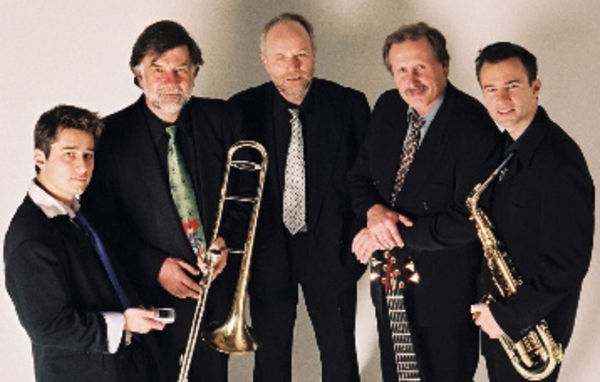
By 1983, Tom Hare was the only founding band member from Galapagos Duck's first line-up with Greg Foster the next in line. Other band members were John Conley, Bob Egger, Mal Morgan and Mick Jackman (who does most of the vocals).  Irrespective, all band members are accomplished jazz musicians, each skilled in multiple instruments and song writing. 

The Voyage Of The Beagle
(Album Liner Notes)

The origin of the species known as the Galapagos Duck has little real relevance to Charles Darwin or his theories but rather is related to the writings of another eminent, more contemporary Englishman, Mr Spike Milligan.

One steamy night many years ago in the heart of deeper Sydney-town the members of a certain jazz band wailed away the hours with Spike, a long-time friend, drinking and joking in the tavern where the band performed. It was this late-night session which prompted the adoption of the band's curious name, now a household word among jazz followers, the Galapagos Duck.

Apart from its name and the fact that it features very significantly in the evolution of the jazz idiom in Australia, the Galapagos Duck has little to do with the life and work of the father of Evolution. However, because of the name the members of the band feel a certain empathy with Darwin and have more particularly developed a fascination with his epic voyage which took him through that part of the world from which the basis of many jazz forms and indeed most of modern popular music finds its roots.

This recording, which is a selection of original compositions by the members of the band, attempts in musical terms to trace the Beagle's voyage.


After having been twice driven back by heavy south western gales, Her Majesty's ship Beagle, a ten-gun brig, under the command of Captain Fitzroy, RN, sailed from Devonport on the 27th of December, 1831.' And so The Voyage Begins

Its primary mission was to survey the poorly known coastal areas of South America. On board was a young naturalist, Charles Darwin, who undertook the voyage without pay partly to put off his intended vocation. His father felt it was high time his son settled into some suitable career such as the ministry.

The outstanding outcome of this five-year voyage was the most revolutionary change that has ever occurred in man's view of himself . In 1837, Darwin began developing a theory to explain how species evolve and after almost twenty years of thoroughly working through his ideas he produced his masterpiece 'Origin of Species'.


It was Darwin's visit to the Galapagos Islands in the Pacific west of Ecuador, and his examinations of gigantic fossil bones at Punta Alta in Argentina, that chiefly stimulated his speculations as to how the diverse species of the earth might have come about.

'The Archipelago is a little world within itself . . . the different islands to a considerable extent are inhabited by a different set of beings.' Life on the Archipelago

At Punta Alta in Argentina Darwin wrote, '...the remains of these nine great quadrupeds and many detached bones were found embedded on the beach, within the space of about 200 yards square. It is a remarkable circumstance that so many different species should be found together.' The Skeletons of Punta Alta


In July of 1832 somewhere off the coast of Uruguay, Darwin observed a natural phenomenon which has been experienced by many sea travellers down through the ages. He found it worthy of note in his diary'...we witnessed a splendid scene of natural fireworks; the masthead and yardarm-ends shone with St Elmo's light... St Elmo's Fire

He was fascinated by the life in the lush forests of South America: 'the elegance of the grasses, the novelty of the parasitical plants, the beauty of the flowers, the glossy green of the foliage, but above all the general luxuriance of the vegetation, filled me with admiration.' In a Brazilian Forest

Throughout Darwin's diary during his South American travels there are many references to the splendour of the Cordillera range'... From some high land we hailed with joy the white summits of the Cordillera, as they were seen occasionally peeping through their dusky envelope of clouds'. Cordillera

After leaving the Galapagos Archipelago the Beagle travelled to Tahiti and then on to New Zealand and in his writings Darwin compares two races of Polynesians, the civilized, peaceful Tahitians and the savage, ferocious New Zealanders. The Tattooed Warriors: 'I should think more warlike race of inhabitants could not be found in any part of the world.'

From New Zealand the voyage continued on to Australia where Darwin observed some of the traditional dances of the Aborigines. 'The natives . . . were persuaded to hold a 'corroboree' or great dancing party .. .

The dancing consisted in their running either sideways or in Indian file into an open space, and stamping the ground with great force as they marched together . . .

there was one called the Emu dance, in which each man extended his arm in a bent manner, like the neck of that bird . . .' The Emu Dance

The Beagle left Australia for the Keeling Islands, the coral atolls in the Indian Ocean nearly one thousand kilometres from Sumatra. Darwin described the idyllic setting of one of these: 'Excepting near the lagoon, where there is some sand, the land is entirely composed of rounded fragments of coral . . .' Coral Island

On October 2 the voyage came to end upon the Beagle's arrival back in England. '. . . and at Falmouth I left the Beagle, having lived on board the good little vessel nearly five years.' The Voyage Ends

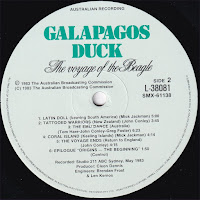
This post consists of FLACs ripped from my newly acquired vinyl. Although the outer cover is ripped the vinyl is in excellent condition and still has its original liner note insert, which outlines the story of the Beagle's Voyage (as above).  Label scans and artwork are also included for both vinyl and CD releases. 

As mentioned above, the CD release comes with a totally different cover (see right) which in my opinion is horrible and I much prefer the more relevant and colourful vinyl cover, but I'll let you be the judge.  Anyhow, enjoy this masterpiece folks.

Track Listing:
A1 The Voyage Begins (Leaving England 1831)  4:04
A2 St Elmo's Fire (Uruguay) 3:54
A3 The Skeletons Of Punta Alta 4:15
A4 In A Brazilian Forest (Brazil) 3:55
A5 Cordillera (Chile) 5:27
A6 Life On The Archipelago (Galapagos Islands)  3:36
B1 Latin Doll (Leaving South America) 5:00
B2 Tattooed Warriors (New Zealand) 3:45
B3 The Emu Dance (Australia) 6:23
B4 Coral Island (Keeling Islands) 4:14
B5 The Voyage Ends (Return To England) 4:15
B6 Epilogue 'Origins-The Beginning' 1:50

Members:
Bass Guitar, Guitar, Didgeridoo – John Conley
Flute, Trumpet, Flugelhorn, Saxophone – Tom Hare
Keyboards – Bob Egger
Keyboards, Vibraphone, Marimba – Mick Jackman
Trombone, Harmonica, Didgeridoo – Greg Foster
Drums – Mal Morgan

The Voyage Of The Beagle Link (262Mb)


Friday, January 31, 2020

Galapagos Duck - St James (1976)

(Australian 1969 - Present)
.
This is a fantastic jazz-funk LP from Australia featuring Oz jazz legend Don Burrows on clarinet.
Continuing the series of rare mid-70s Australian jazz albums (also see my previous "Crossfire" posts), this is the third album from Sydney-based band Galapagos Duck from 1975. Formed in 1969, they were initially the house band at "The Basement", the city's main jazz venue. I used to come across them in my teens, often playing at outdoor festivals. This album features guest woodwinds player Don Burrows, something of a stalwart in the jazz scene of the time. The album was produced by Horst Liepolt for his 44 Records label - Liepolt seems to have been behind most of the city's jazz releases, festivals and venues in the 60s and 70s.

Some parts are funky as hell. It features the ubiquitous rhodes and wah-wah woodwinds of the period and has a good loose, live feel on most tracks, with little overdubbing. Strange mix of tracks as an overall album, though - sometimes it's riffing on contemporary forms,  then suddenly lurches back to trad New Orleans, particularly when Burrows is on clarinet. Reading between the lines, this was a band that had to please many audiences to maintain a working lifestyle in a city that was just starting to develop  a jazz scene that went beyond the ageing of classic forms - so there's still a bit of crowd-pleasing going on here. Nevertheless, enough good stuff here to make it worthwhile, and I like McNamara's work on keyboards in particular. [thanks to Simon666]


The long “St James Infirmary” has a very funky part with wild breaks ! Hypnotic bass lines, then drum break (several bars) then electric piano. Terrific. And damn funky.! The Latin jazz “Hey Timbales” is wild too. Almost batucada jazz. But the best here is “Squeelers and Grunters”, a masterpiece of funk from Australia. Listen to the bass, drums, buzz flute, and punchy horns. Hope you enjoy it!

Review (by DR Kinetic)
44 Records was arguably the most important Australian Jazz record label operating in Australia during the 1970s. Owned and operated by the renowned Jazz aficionado Horst Liepolt, it released dozens of albums and also re-released some important albums form the 1960s. Amongst the label's releases are some of the best jazz and jazz-fusion releases Australia ever produced, namely Peter Boothman – For the Record (1975), David Fennell and Powerpoint – Alternate Route (1976) and of course Galapagos Duck - St. James.

To my ears, I prefer this album to their more rated The Removalists. It’s more consistently listenable in my opinion. The title number St. James’ Infirmary is a great long jazz number with a number of compelling changes. It begins with the tune of ‘house of the rising sun’ played by sax in a traditional jazz mode before dropping into a 2 minute bass solo. When the bass finally cools down the drums kick in and the jazz-funk fest begins. I used this bit in my ‘Aussie Funk’ mix. There are a few hokey jazz numbers, a few fusion cuts and another great sinister funky cut that rounds the album out: Squealers and Grunters, with a dark piano-led intro that’s pretty ripe for sampling, and a nice quirky flute solo halfway through. Finally, their cover of JJ Walker's "Mr Bojangles" is commendable.
.
This post consists of FLACs ripped from my super clean vinyl and of course includes full album artwork and label scans.  Can't have enough of the 'duck' I say, so grab a copy now, before it flies away.
.
Tracklist
01. 'St James Infirmary' (Trad, arr. Galapagos Duck)
02. 'Flutin' ' (Galapagos Duck)
03. 'Ivory Moss' (Tom Hare, Chris Qua, Marty Mooney)
04. 'For Elizabeth' (Galapagos Duck)
05. 'Hey Timbales' (Marty Mooney, Tom Hare, Chris Qua ) 
06. 'That Particular Model' (Paul McNamara)
07. 'What Am I Doing Here' (Paul McNamara) 
08. 'Teo' (Paul McNamara) 
09. 'Mr Bojangles' (J. J. Walker)
10. 'Squeelers and Grunters' (Galapagos Duck)

The Duck were:
Tom Hare - trumpet, drums, saxaphones, flugelhorn
Don Burrows - clarinet, baritone sax, 5 key school flute, cabasaMarty Mooney - tenor sax, flute, clarinet
Paul McNamara - electric piano, acoustic piano
Chris Qua - bass, bass violin, flugelhorn
Willie Qua - drums, flute, electric flute

Galapagos Duck FLAC Link (214Mb) New Link 17/07/2020


Monday, February 25, 2019

Galapagos Duck - The Removalists (1974)

(Australian 1969 - Present)
.
Galapagos Duck is an Aussie Jazz Band that's been around since the late 1960's. This, their 2nd album is the soundtrack to the film of the same name, a classic Australian movie based on the play of the same name written by David Williams. Here's a review I found on the internet that sums it up nicely:

"Let’s call this record one of the Australian standards in record collecting. I say that because it’s one of those records you find out about very easily. Galapagos Duck albums aren’t overly hard to find in Australia, but after coming across the crappy ones, someone’s bound to tell you that this is the one to look out for. A soundtrack to the play of the same name (see description below), this album is considered by most to be the best and funkiest of their half a dozen or so LPs. It sounds like a soundtrack, but it also sounds like a jazz funk record. 'Removalists Suite' has a great, happy vibe to it, with clapping and sax soloing. The best moment is when it changes up and kicks back into a nice piano–led jazz funk number.

The other great cut on here is the 'Removalists Theme' that starts with percussive piano stabs and a hokey brass line before pausing and then dropping into a pounding mix of fast, heavy drums and electric bass solo. The bass soon moves over while the drums get in on the soloing action themselves. But the groove doesn’t leave for long, and once things are locked back in the groove there’s a great sax solo as well. A great record by a band that held residency at Australia’s premier jazz club during the 70s."

To me the album, released late in 1974, is best described simply as a fusion of late 1960's jazz and early 1970's funk. I think it's great and I now understand why VG+ copies of the LP can go for well over AU$60!

L-R: Willie Qua, Tom Hare, Chris Qua, Marty Mooney, Dave Levy
About this transfer
Despite looking remarkably clean, my copy has its share of surface ticks. This seems more a reflection of very flimsy mid-1970's vinyl quality rather than anything else. Visually, the LP looks perfect; not a mark, scuff or scratch on the very shiny surface. Anyway, after a medium Click Repair and manual tick removal, all that's left is just the slightest amount of surface noise that is only noticeable in the quiet passages, or with headphones.

Further, I found that the highs appeared a bit rolled off. Having not heard another copy (at over AU$60 each I don't intend to), I don't know whether this is due to the original mastering (there are plenty of overdubs which could explain it) or some other factor related to my particular pressing (such as ageing stampers). In any event, I decided to do what I very rarely do and tweak the sound just slightly to add some definition to the upper mid frequencies. This had the effect of removing the murkiness and bringing the percussion a bit more forward into the mix, while still maintaining a nice warmth and depth. I hope you approve of this mastering decision - I certainly think it's a subtle change for the better. [notes by Jae from Midoztouch]


About The Movie
The film was based on David Williamson's stage play, first performed at La Mama in Melbourne in 1971 (press reports suggest that the very first season was seen by only a modest 1200 people but it quickly became a cult theatrical hit).
Williamson is Australia's best known playwright, who has also done a substantial number of screenplays for film and television. He is listed at 'AustLit', with a relatively short biography and some 166 works.

When Marilyn Carter (Jacki Weaver), at the urging of her sister Kate (Kate Fitzpatrick), goes to the cops to report that her husband Kenny (Martin Harris) has beaten her, the police arrange for a removalist (Chris Haywood) to help her remove her furniture from the flat.
Constable Ross (John Hargreaves), fresh from training school and reporting for his first day of work at a suburban police station, settles in with cynical long-serving Sergeant Simmons (Peter Cummins), and after checking Marilyn's bruising, they go to Kenny's flat.
The removalist strips the flat, and then Kenny, handcuffed and vulnerable, finds himself alone at the mercy of the police ... and then the simmering tensions erupt ...
.
This post was ripped to MP3 (320kps) format from vinyl (thanks to Jae at Midoztouch for the rip) and includes full album artwork and label scans. Considered to be the Duck's best album, I would encourage you to take a listen to this one if you haven't heard their material before.
.
01 -  Removalists Suite
   a) In The Making
   b) Marilyn's Rest  
02 -  Removalists Theme
03 -  Carter
04 -  Kate Did
05 -  Self 'Bloody' Control

Credits
Bass Guitar – Chris Qua (tracks: A1, A3, B1)
Bells – Tom Hare (tracks: A1, A3)
Clarinet [Electric] – Marty Mooney (tracks: A3, B2)
Double Bass – Chris Qua (tracks: A2, B2, B3)
Drums – Tom Hare (tracks: A1), Willie Qua
Electric Piano [Fender Rhodes] – Dave Levy (2) (tracks: A3)
Electric Piano [Wurlitzer] – Dave Levy (2) (tracks: B1)
Flugelhorn – Chris Qua (tracks: A1, A3)
Flute – Willie Qua (tracks: A1, A3)
Percussion – Chris Qua (tracks: A1), Dave Levy (tracks: A1), Marty Mooney (tracks: A1), Willie Qua (tracks: A1, B1)
Piano – Dave Levy (tracks: A1 to A3, B2, B3)
Saxophone [Baritone] – Tom Hare (tracks: A3)
Saxophone [Soprano] – Tom Hare (tracks: A2, B3), Willie Qua (tracks: A1, A3)
Saxophone [Tenor] – Marty Mooney (tracks: A1, A3 to B3), Tom Hare (tracks: A1, A3 to B2)
Triangle – Dave Levy (tracks: A3)
Trumpet – Tom Hare (tracks: A3)
Vocals – Chris Qua, Dave Levy, Marty Mooney, Tom Hare, Willie Qua

The Removalist MP3 link  (101Mb) New Link 12/05/2020

Saturday, February 2, 2019

Galapagos Duck - Right On Cue (1978)

(Australian 1969 - Present)
.
Based in Sydney back in the 70's, Galapagos Duck was an integral part of the foundation and success of the Jazz Club 'The Basement'. The band continuously performed in the club as it's primary  'house band' for 16 years - during which time 'The Basement' became known as one of the greatest Jazz Clubs in Australia and around the world. 'The Duck' also toured extensively all throughout Australia, visiting the capital cities and - on many occasions - performed in country areas including the remote areas of Western Australia and the Northern Territory.
.
How the ‘Duck’ got its name
I’ve heard a few versions of the story, but this was told me by Tom Hare and John Connelly during a radio interview in the 1980s in Townsville. The “Duck Flies North” tour was to promote their “Endangered Species” album, sponsored by the Australian Wildlife Society : ‘In the early days at “The Basement” in Sydney the band shared the stage with an assortment of props for various functions. Alongside the old paraphernalia was a large wheel with a clapper that produced a loud clacking-quacking sound when it was spun around the numbers on the outer edge, giving rise to much humour in dull moments.

The DUCK
Around this time general conversation was rife about the discovery of the last giant tortoise left on the Galapagos Islands, nicknamed “Lonely George”. Spike Milligan was a firm follower of the band, often sitting in on trumpet and when a visitor to the club asked him the name of the band, in his own peculiar habit of zany humour, Spike told him: “it sounds like a Galapagos Duck”.
The following week the new chum was heard telling his friends loudly, “Oh, they’re the Galapagos Duck”. The name stuck. It is often miss-spelt, but seldom forgotten, and followers agree the band will never become an 'endangered species'.


And so, it is no surprise to see the band pay tribute to their ring in' trumpeter by naming one of the tracks on this 1978 release - "Blues For Spike" and another named after their beloved 'Jazz Club' - "Basement Blues" [from Bundaberg-Jazz-Waves-Newsletter-Issue 25-February-2015, Editor: Valerie Brown]

Sahibs, Herren, or Guys?
Galapagos Duck will always remember 1978 as the Time of Travel, embracing three overseas tours, Asia, Europe and USA (Miami, Florida). Naturally, with such a band, the social history of these tours is rich in anecdote, but we are concerned with only random thoughts here.

The humidity and hospitality of Jakarta, riotous scenes at Bombay's jazz Yatra Festival, where the band was still on stage at 1.00am, and the humour, in retrospect, of the Poona concert. Thence to Colombo, where Gordon Tytler wrote - "I found they didn't swim like ducks at all. No: they floated like the swans they really are. I felt genuinely sorry for the hordes of 'pop' fans in this little island of ours who have never had the opportunity of listening to really good jazz - as distinct from that half-baked stuff that comes over the air-waves day-in and day-out. If you were there you'd have enjoyed a rare musical treat'!
The bustle of Hong Kong - the long awaited trip to Peking which is another chapter in itself - the Jazz Workshop at the University of Singapore, and the concert in the Conference Hall, of which Nancy Byramji wrote - "They are easy going, and have an individualistic style of improvisation that is reflected even in their name. Within 20 minutes of their performance, their chameleon-like versatility in switching instruments comes through delightfully"

Others in Asia said that their impressions of the Duck were - "organized vigour" - or "earthiness with polish" - (which could mean a salami sandwich!) but the reception everywhere was stimulating.
Printing lyrics on the inner sleeve seems de rigueur to the rocker-poppers, but we haven't, not even for Misty, so that subscribers can't sing along with Uncle Groovinham and mess up the subtle sonorities.

Thoughts on the European tour are even more random. Suffice to say that Galapagos Duck first tried their mettle on a German audience in Kassell (wonderful city!). Three encores.
Encouragement plus! So to Montreux Festival with pin tails up and another great reception.

In London, the High Commissioner swept protocol aside and insisted that the GD concert be held in the usually sacrosanct mam hall at Australia House - a boil over! The rainy Monday night at the 100 Club in Oxford Street, London - packed house - amazing scenes - the charge across the Channel for the public concert in the mam Opera House Square of Brussels. Belgian beer is ambrosia. Then the four nights at The Atlantis in Basel, Switzerland and the impact the band made there, playing a different programme each night. Back to the "new" Basement, with an awareness that Australian audiences are just as critical and appreciative as any in the world. The brief trip to Miami, Florida seems only days ago. Frantic stuff- another two encores. American beer is not ambrosia.
All of this jaunting about was possible because of the following benefactors - Musica Viva,  Department of Foreign Affairs, Qantas, PolyGram Records.


On the black plastic record herein, there are approximately 1,464 bars of music. We don't expect you to enjoy every bar - (although we have the usual wistful hopes), but make of them what you will - and know that they will always be playing 'right on cue' [Sydney, December 1978]
.
This post consists of FLACs ripped from vinyl and includes full album artwork and label scans. Not a bad album I might say and for those of you who enjoy pure jazz, you'll really like this one.
If you've haven't explored Jazz as yet, then this LP is a good starting point as the sounds and tunes are both catchy and enticing. These boys are a tight unit, and are 'right on cue' when belting out popular tunes such as the "Pink Panther" and "Misty"

Although not credited on the album cover, there is a high chance that Spike Milligan was responsible for some of the sounds on this album, as he was touring Australia (Melbourne/Sydney) with 'his comedy stage show' at the same time when this album was being recorded. 
.
Track Listing
01 - Marabi
02 - All In Love Is Fair
03 - What's Going On
04 - Blues For Spike
05 - The Pink Panther
06 - Basement Blues
07 - Misty
08 - Right On Cue
09 - My Mama Told Me So
.
The Duck were:
Tom Hare: Flute - Alto sax - Trumpet - Drums - Conga - Timbales - Small Percussions - Vocals
Greg Foster: Trombone - Harmonica
Ray Alldridge: Acoustic and Electric Pianos - Hohner Synthesizers - Clarinet
Chris Qua: Bass Violin - Electric Bass
Len Barnard: Drums - Washboard - Small Percussion
Spike Milligan: Trumpet - Duck Calls
.
Galapagos Duck FLAC Link (220Mb)
.

Tuesday, September 11, 2018

Galapagos Duck - Ebony Quill (1974)

(Australian 1969 - Present)
.
This is the first record made by a unique band, unique because of the versatility of its members and for the brand of jazz they play. Each member of the Group plays many different instruments and to see them playing is quite an experience. They move around creating music which varies from hard-swinging jazz; to jazz/rock; to beautiful melodic sounds; to very exciting exotic percussion things; to the more contemporary avenues of creative use of electronic devices.

Every member of the Group has paid his dues, sweated his music out over the years in pubs, clubs and sessions all over the country. The original Galapagos Duck has grown out of these experiences.
The band was chosen to support the recent Nina Simone tour in Melbourne and Sydney, and to my mind I've never seen a local support act received with as much enthusiasm. This album comes very close to their live performances which can be heard at The Basement in Sydney, the finest jazz room in Australia.

For those who have heard the band in live performances, I know you will enjoy the music on this album, for those who haven't, I hope you can catch them some time [extract HORST LIEPOLT, Jazz Editor-Sound Blast/Music Maker].

Ebony Quills went on to become one of the best selling jazz records of the '70s.
.
Galapagos Duck with Horst Leipolt (third from right)
Review
Galapagos Duck are one of Australia’s best known jazz groups, having recorded or toured with varying consistency since just before the 1970's, right up until much more recently, and in a variety of incarnations.

Perhaps best known for their jazz-funk soundtrack ‘The Removalists’ their debut ‘Ebony Quill’ was released around the same time and may have been overshadowed a little, but it’s a great record too – not amazing, but enjoyable without a doubt.

Opening with an atmospheric, extended percussion and reverb-heavy flute exploration, summoning visions of deep jungles, it’s a restless piece hampered a little by the short bass and wordless-vocal duet in the middle, but which is otherwise a fine if misleading opener – as the rest of ‘Ebony Quill’ is less experimental. Except for the brief, mysterious pair ‘And Then Out’ & ‘Out and Then In’ that work as interludes, the album is a little more funk and perhaps pop influenced at times, throwing in a few covers, like the partially convincing ‘The Look of Love.’ It's a shame that it sounds a little too cheesy with sax playing the vocal melody (it works better with trumpet halfway through) but the bouncing joy of ‘Tennessee Waltz’ is a great contrast. ‘Grazing in the Grass’ however, (a Hugh Masekela hit some years before) is the best-realised piece on the album. Drummer Qua throws in a playful nod to the cowbell at the beginning, before switching to the ride. Keeping the distinctive trumpet part, the band don’t try and tinker with the arrangement, instead simply stretching the song out to incorporate solos and simultaneously seeming to evoke the Australian clichés of 'chilled out' people hanging out in summer. 


Willie Qua’s flute tends to dominate a lot of Galapagos Duck’s sound, and though everyone else gets solo space somewhere in the eight pieces, the focus toward the latter half switches to the saxophone. After the fantastic version of ‘Grazing in the Grass’ the band slow things down with the dramatic but still effective ‘Rivera Mountain’ where the saxes again lead, and close the record with a clear homage to Herbie Hancock, whose ‘Head Hunters’ had been released just the year before ‘Ebony Quill.’ It's an influence that would be felt even more clearly on ‘The Removalists.’ Not to say that ‘Mr Natural’ is unpleasant, but it won’t offer up any surprises, even if the solos are energetic and the rhythm section certainly know what to do. It is a fitting end to the set.

While not as consistently enjoyable as their follow up, this is still mostly enjoyable R&B influenced jazz, with some welcome variety on the originals and a growing funk influence. [extract from jazzmusicarchives]
.
The Tracks
EBONY QUILL (by WILLIE QUA)
This is a very exciting piece of music, which comes in many different forms and moods. The introduction is played on Recorder by Willie. The theme is stated by Willie playing Lead Flute and Marty Second Flute. Then it's in to the first solo, a Vocal/Flute-type affair played by Willie. Chris follows with a solo using his Bass and his Voice in unison. Next is a percussion duet between Tom and Willie. Before the theme is stated, to take it all out, Willie has another Flute solo, this time percussive and with nice echo effects. Tom is on Drums and Doug on Tambourine throughout this track.

THE LOOK OF LOVE (by BURT BACHARACH/HAL DAVID) 
A beautiful ballad which has Chris on Flugelhorn, Tom-Alto Sax, Doug-Piano, Marty-Bass, and Willie on Drums.

TENNESSEE WALTZ (by PEE WEE KING/REDD STEWART) 
Tom on Soprano Sax, Willie and Marty on Tenor Sax this track with a nice church-like (soul church of course) introduction. Then it's into the song with what I call, Bossa-Nova feel. Marty is preaching on Tenor, Doug with Chris on Bass, Willie on Drums and playing the Tom. It ends with the Horns again on the last phrase. The percussion you can hear on this track and on all the others to follow are played by the members of the Galapagos Duck.

AND THEN OUT (by WILLIE QUA)
This is a beautiful little lament played by Tom, Willie and Marty backed by Doug on Piano and Chris on Bass.

Galapagos Duck Today
(L-R: Will Sargissan, Willy Qua, John Conley, Richard Booth, Rodney Ford)

OUT AND THEN IN (by WILLIE QUA)
This is in two short sections. The first section begins with Doug on piano, followed by Chris on Bass, and then Tom on Flute. Section Two is the three Flutes bit played by Tom, Willie and Marty again, with Doug on Piano and Chris on Bass.

GRAZING IN THE GRASS (by HUGH MASEKELA)
Tom-Trumpet, Marty-Tenor Sax, Doug-Piano, Chris-Bass and Willie - Drums. Everybody solos and it's the Group's flagwaver in the fullest sense. It should delight their many fans.

RIVERA MOUNTAIN (by JOHNNY SANGSTER)
This is the famous tune by Johnny Sangster, one of the most creative and respected musicians in Australia. Tom plays Soprano Sax, Marty Tenor Sax, Doug is on Piano, Chris on Bass and the Drummer is Willie.

MR. NATURAL (by GALAPAGOS DUCK)
Tom and Marty out front on Tenor Saxes, Doug-Piano, Chris-Bass, and Willie on Drums. It's the perfect track to finish an album. It finds the Group in an easy burning Jazz/Rock groove. Marty, for his solo, changes from Tenor Sax to Clarinet and the funky Guitar you can hear is played by Chris and was overdubbed. [liner notes]

Galapagos Duck On Stage Today
This post consists of FLACs ripped from my newly acquired vinyl, once again found at my flee market hidden amongst some other jazz and classical records which were greatly affected by moisture damaged. Thankfully the album cover was only slightly discoloured and the vinyl in great condition.  Full album artwork for both LP and CD are provided along with label scans.
I am wrapped to think that I have stumbled across this highly sort after LP by one of the great modern jazz bands in Australia, and can make it available here. Enjoy.
.
Tracklist
01 Ebony Quill 
02 The Look Of Love 
03 Tennesse Waltz 
04 And Then Out 
05 Out And Then In 
06 Grazing In The Grass 
07 Rivera Mountain 
08 Mr. Natural

Line-up/Musicians:
- Chris Qua / bass, trumpet
- Doug Robson / piano
- Marty Mooney / reeds
- Tom Hare / reeds
- Willie Qua / drums, reeds

Recorded at Earth Media Recording Company November 19 and 26, 1973

Galapagos Duck Link  (230Mb) 
New Link 05/10/2026

Saturday, April 16, 2016

Galapagos Duck - Endangered Species (1985)

(Australian 1969 - Present)
.
Galapagos Duck is an Australian jazz band. Formed in 1969, they have an extensive history of international touring, including:
-Montreux Jazz Festival, Switzerland
-Jazz Yatra Festival, Bombay, India
-American Musexpo
-Singapore International Jazz Festival
-Queenstown Jazz Festival, New Zealand
-Vanuatu International Jazz Festival, Vanuatu

The band formed in 1969 for the winter season at "The Kosciusko Ski Chalet, Charlottes Pass".
Before it moved to The Rocks Push jazz club in Sydney, the band in 1969 was Marty Mooney and Tom Hare (reeds), Chris Qua (bass and trumpet), and Des Windsor (piano and organ).

Bruce Viles (owner of the Rocks Push) established The Basement jazz club at Circular Quay in 1973 and the Galapagos Duck opened there as the house band. At that time, the personnel was Marty Mooney and Tom Hare (reeds), Chris Qua (bass and trumpet), Willie Qua (drums and reeds) and 
Doug Robson (piano).

Some of the top names in Australian jazz have worked with the band at one time or another, including Dave Levy, Roger Frampton (no relation to Peter I'm afraid!), Col Nolan, Paul McNamara and Warren Daly (ex-Daly-Wilson Big Band). For more info, see their website  and a previous post I made for their 1977 Magnum album.

How the ‘Duck’ got its name
I’ve heard a few versions of the story, but this was told me by Tom Hare and John Connelly during my radio interview in the 1980s in Townsville. The “Duck Flies North” tour was to promote their “Endangered Species” album, sponsored by the Australian Wildlife Society : ‘In the early days at “The Basement” in Sydney the band shared the stage with an assortment of props for various functions. Alongside the old paraphernalia was a large wheel with a clapper that produced a loud clacking-quacking sound when it was spun around the numbers on the outer edge, giving rise to much humour in dull moments.

Around this time general conversation was rife about the discovery of the last giant tortoise left on the Galapagos Islands, nicknamed “Lonely George”. Spike Milligan was a firm follower of the band, often sitting in on trumpet and when a visitor to the club asked him the name of the band, in his own peculiar habit of zany humour, Spike told him: “it sounds like a Galapagos Duck”.
The following week the new chum was heard telling his friends loudly, “Oh, they’re the Galapagos Duck”. The name stuck. It is often misspelt, but seldom forgotten, and followers agree the band will never become an 'endangered species'. 
[from Bundaberg-Jazz-Waves-Newsletter-Issue 25-February-2015, Editor: Valerie Brown]

Album Review
Galapagos Duck would be counted as one of Australia's best-known jazz bands (which may not be saying that much, in truth). With a constantly changing personnel, they have been in existence since 1969, when the original members got together to play some gigs in the NSW snowfields 
during ski season.

Since then the band has travelled a long musical road through most spectra of the jazz idiom, owing to the eclectic strengths of various members of the band. Their sound is unique, partly owing to their wide-ranging use of idiom, and the fact that over time most members of the band have been multi-instrumentalists, which means that in any one night or recording the line-up of instruments can change from tune to tune.

Endangered Species was released in 1985, in aid of the World Wildlife Fund. I suppose in some ways it could be termed as a concept album, in that the songs are about specific endangered species, or wildlife in general, with one song about the Greenpeace organisation.
As with most albums created around a concept, there are high points and low points in this recording. In fact quite often it is the grooves that stand out, rather than the tunes as a whole. The riff in Hindsight is very catchy, the groove in China Bear is good, (the lyrics aren't!), Living Planet has a great funk feel, and Grizzly Bear is a classic R'n'B type groove.

There are also some tunes here that hark back to traditional jazz, Wombat Walk being one of them. All the instrumentalists are top notch, with especially good trombone playing - in fact a few of the tunes feature a frontline of trombone and tenor sax, which perhaps shouldn't work as well as it does, given they are playing in the same voice.

The album is let down by it's lyrics - four tunes are sung, and the lyrics are somewhat trite (especially in Poor Little Bustard), which is a shame, as they make this album less than the sum of it's parts. 
[Review by Roger Clark, from A View Over The Bell, 2011]

The reason I've included this album here is because it is a great introduction to jazz - many styles are included here, the improvisation is good and easy to follow, and the grooves get into your head. 
This post consists of FLACs ripped from my newly acquired vinyl copy (found tucked away in a box of jazz records at a garage sale) which literally sparkled when I inspected its condition. No crackles and pops on this one folks.  Full album artwork and label scans (ABC records) included.  
.
Track Listing
01 - Hindsight (Tasmanian Tiger) 4:27
02 - Wombat Walk 3:42
03 - Whale Song 4:05
04 - Rhino Rag 4:06
05 - China Bear 3:45
06 - In The Wild 5:00
07 - Living Planet 5:07
08 - Greenpeace 3:26
09 - Grizzly Bear 4:13
10 - Poor Little Bustard 3:45
11 - Save The Duck 3:05
12 - In The Wild Pt II 2:40
13 - Whale Song 4:44
.
Galapagos Duck consists of: 
Tom Hare - Saxaphones, trumpet, flugelhorn, drums
Greg Foster - Trombone, harmonica, didgeridoo, ocarina, vocal
Bob Egger - Keyboards
John Conley - Electric bass and guitar
Len Barnard - Drums, percussion, washboard and vocal
Nicky Crayson - Vocals
.
.
.

Sunday, January 18, 2015

Galapagos Duck - Magnum (1977)

(Australian 1969 - Present)
.
I know that we all have the question… What is the story behind this band's name?

They say the inspiration came from Spike Milligan and was somehow derived from one of his comedy sketches involving the auctioning of a “Giant Galapagos Turtle upon wheels with clockwork revolving eyes”.

Along with trailblazers like the late, great Graeme Bell and then stars like Don Burrows, George Golla and the Morrison brothers, Galapagos Duck put Australian Jazz / Funk on the map. They've won national and international awards... played throughout America, Asia and Europe...performed all the big jazz gigs from Montreux to the American Musexpo and the Singapore International Jazz Festival... and played and recorded with the likes of Nina Simone and Ray Charles, James Morrison, Tommy Emmanuel, Don Burrows, Winifred Atwell, The Australian Dance Theatre and The Australian Ballet.

The Duck’s musical style does not fall into any one catagory. They play songs dating back to Fats Waller and Jelly Roll Morton through to bebop, swing, latin, reggae, rock and roll, blues, funk, free form, and even current pop trends, yet all stamped with the Duck’s own unique style. This wide open approach has resulted in huge popularity in Australia, reaching far beyond the customary jazz audience.

Anyway,  Galapagos Duck is one of those bands that stays forever, could you believe they have been active since 1969, and they’re still making awesome music at these days. During this time, they have released 13 albums, the last one released in 2006. See their website for latest info on their gigs and band members.

Galapagos Duck has an extensive history in Australian Jazz

Galapagos Duck began in the late 1960's, while the members were engaged in a winter season at the New South Wales skiing resort 'The Kosciusko Chalet' Charlottes Pass. After returning to Sydney, the band continued to work and became well known in the Australian Jazz and music scene during the 1970's, when it was the house band at the emerging Jazz night club, 'The Basement', near Circular Quay.

Since these humble beginnings,'The Duck' - it has been suggested - has become the best known jazz band in Australia as well as a household name throughout the country.

The band has worked - and continues to work - in Concert Halls, Night Clubs, at Jazz Festivals, in the Recording Studio and on Radio and Television.

Although the membership has changed (out of necessity), the direction of the band has always remained the same: which is to create a performance experience that - while jazz oriented - is able to be appreciated and enjoyed by everybody. 
 
Based in Sydney, Galapagos Duck was an integral part of the foundation and success of the Jazz Club 'The Basement'. The band continuously performed in the club for 16 years - during which time 'The Basement' became known as one of the greatest Jazz Clubs in Australia and around the world. 'The Duck' also toured extensively all throughout Australia, visiting the capital cities and - on many occasions - performed in country areas including the remote areas of Western Australia and the Northern Territory.

International performances include the following festivals:  
- Montreaux Jazz Festival in Switzerland
- Jazz Yatra Festival in Bombay (Mumbai)
- Musexpo in U.S.A.
- Manilla Jazz Festival in the Phillipines
- Singapore International Jazz Festival
- Queenstown Jazz Festival in New Zealand
- Norfolk Island Jazz Festival
- Lord Howe Island
- Vanuatu Jazz Festival


Galapagos Duck On Stage 1976
Other than festivals, there have been highly successful performances in England, Germany, France, Switzerland, Belgium, China, Indonesia, Vietnam, Thailand and Laos. Having always drawn members from the very best of Australian musicians, Galapagos Duck has shown its versatility through works within the Dance Industry including: 
- 'Superman' with the Australian Ballet
- 'Austorizon' with the Australian Dance Theatre (choreographed by Ross Coleman) in Adelaide
- A Work for the Comscapes Dance Company Malaysia, performed in Kuala Lumpur (which was very successful in raising money for the World Wide Fund For Nature).


Galapagos Duck Today
There have been frequent appearances on Television - including the Bi-Centennial TV spectacular and appearances on 'Hey Hey It's Saturday'. The Band has also been involved in Film - writing and performing the soundtrack for 'The Removalist' and appearing in the Australian films 'Rebel' and 'Emerald City'.
[extract from Galapagos Duck's Website]
.
This post consists of MP3 (320kps) ripped from my vinyl (acquired many moons ago when I started to become interested in jazz) and includes full album artwork. The cover's 'protective layer' has suffered the test of time I'm afraid, developing series of bubbles and ripples which have affected the cover scans - sorry folks.
Nevertheless, the recording is crystal clear and free from clicks and pops. Hope you enjoy this slice of jazz thanks to some of the best jazz musicians to have come out of Ausralia.
.
Track Listing
01 - Sesame Street
02 - Medley (Superstar-I'm A Woman-Feel Like Making Love)
03 - Child Is Born
04 - Ronda A La Turk
05 - Isn't She Lovely
06 - Nadia's Theme
07 - Mercy, Mercy, Mercy
08 - Chop Sticks
09 - Chaser No Straight*

* Dedicated to Spike Milligan
.
Galapagos Duck were:
Tom Hare (Sax / Fluegelhorn / Trumpet)
Greg Foster (Trombone / Harmonica)
Ray Allridge (Keyboards)
Chris Qua (Bass / Violin / Trumpet)
Len  Barnard (Drums)

.
Galapagos Duck Link (92Mb)
.