Saturday, April 14, 2012

Radio Birdman - Live in Sydney (1976)

(Australian 1974-1978, 1996-2008)
.
Radio Birdman was formed in Sydney, Australia in 1974. They were one of the pioneering Aussie punk bands and by far the most influential band on the future of the Sydney punk scene. They chose their name after misunderstanding a line from the Stooges song "1970". The line actually goes "Radio burnin' up above" but Iggy was never known for his annunciation so the confusion is forgivable.
The popular view of history says that that punk started in New York and then spread to England. However the history of Radio Birdman tells a much different tale. Really punk started in Detroit and then spread to Australia.

Radio Birdman was formed by an unlikely pair: vocalist Rob Younger, a native Australian, and Guitarist Deniz Tek, an American who had just moved to Sydney to attend medical school. Tek had come from Ann Harbor, Michigan. Ann Harbor was a little college town about an hour outside of Detroit but in the late sixties and early seventies it became a key music hub in the American Midwest. It was a regular stop for world famous touring acts and virtuoso Jazz greats but most importantly it was home to the first wave of proto-punk bands like the Stooges and the MC5.

The sound of Radio Birdman was too fast, heavy, violent, and psychotic to play any of the established Sydney Clubs. As forerunners of the D.I.Y. punk ethic the band took over the a small pub, renamed it The Oxford Funhouse in tribute to their favorite band, and made that pub into the center of Sydney's exploding Punk scene.
Like many artists who were ahead of their time Radio Birdman never got the recognition they deserved. They never got very famous outside of Australia. They toured the rest of the world but nobody really took notice. They almost got a record released in America through Sire records but the deal fell through at the last moment and Radio Birdman was left to virtual obscurity. They broke up in 1978 before most of the world had even heard the term "punk".
.
This recording was made in November of 1976 one month after the release of their debut E.P. 'Burn My Eye'. It was only a few months after the release of the Ramones first record and it was a year before The Damned or the Sex Pistols released anything in England.
This bootleg is true rarity. It was recorded live Sydney's legendary Double Jay Studio for an A.M. broadcast. Double Jay was a Sydney Radio station that played an integral role in the formation of the Australian music scene because they focused on Aussie bands and they were willing to play songs that other stations had banned for references to sex and drugs.
The sound quality is a little muddy but so is every recording of a cutting edge punk band from the mid seventies. This recording sounds better than any bootlegs you will ever get of the Stooges or MC5. This recording represents a diamond in the rough and a it is essential listening for anyone interested in the roots of independently produced Rock & Roll music [extract from A history of underground recording].

'Radio Birdman'
RAM #26, Feb 27, 1976
(
by Anthony O'Grady)
.
Radio Birdman's drummer is sitting on a steel framed chair listening to a just competent
group pound out hard rock as best as they can. He stares flinty eyed but otherwise expressionless as the drummer beats his skins spasmodically and the bass player fumbles through an approximation of a Bad Company riff.
But suddenly he gets hold of his chair and pounds it on the floor. His face twists and he skittles the chair 20 feet along the dance hall floor. The spectator whose leg finally stops the chair takes a few steps across the room, sees the way the drummer's face is working and drops back.
"Sometimes -when you see what sort of shit is going down, you can let it go by. But there are times when you should read strongly to bad music . . . times whe
n a statement should be made." — Ron Keeley, Radio Birdman drummer.
DenizTek, Radio Birdman's guitar player, comes from Detroit, America. He is small, dark, incredibly intense and sometimes it appears he near enough idolizes Iggy Pop (Iggy Stooge as he used to be called). Iggy Pop/Stooge is one helluva singer from Detroit who started off about the same time as Alice Cooper but was always twice as outrageous, twice as menacing and powerful.
Deniz, he owns a solid body, Epiphone guitar he bought from Fred "Sonic" Smith of the MC5 (the archetypal Detroit rock group whose records are now valued collector s items). And on the Rolling Stones last tour of Australia he spent an evening with Keith Richards, picking up some advanced guitar flash and selling Keith a rare National Town & Country guitar (made in 1948 and one of the first solid body electric guitars).
Anyway, Deniz is dedicated to ... hmmm, change that to obsessed with ... attaining that uncompromising, savagely magnificent noise that just poured out of Iggy s guitar player Ron Ash
eton. He gets it what's more. I mean, he lives it. It's not just a matter of getting the notes right. His guitar playing is concentrated energy and it can rivet you to the spot.
Deniz is a 5th year medical student. I mean, he can start developing his bedside manner now, he's that close to being a doctor.
.

You don't get to 5th year in Med School without putting in some hard grind and you can't play the sort of guitar Deniz plays without total dedication,
"The analogy is a bit like what happens at school — the person who really works hard to get a result is always the most unpopular, and the one who gets ostracised. And that happens with the band. We're not popular with a lot of promoters because were totally positive about what we play. We won't compromise the strength of our music and we won't weaken ourselves by asking promoters or agents what they think would be popular and go away and learn that.
"Once an agent came and saw us and said 'Yeah, you're a
good band ... why don't you play a few Pilot songs .. why don't you learn that "January" song, that's really popular ...' " — DenizTek.

January? Jeeeeeez-us, Sweet harmonies and melodic lead riffs are not what
Radio Birdman is about at all. They don't play soft-rock or jazz-rock or folk-rock or country-rock or electronic-rock or symphonic-rock or neo-classical rock, not even blues-rock. They play nothing else except rock-rock and every-time I've ever seen them they've never played it at anything under 100% effort.And yet, as Deniz says. Radio Birdman has not had an easy run in its bid for work. They have what's called a reputation as being A Difficult Band."The only difficulties that arise are when somebody tries to change us around.The- music we play is between us and an audience: The funny thing is we've never had any trouble with audiences . . . only with promoters or people who think we should be fit in with their ideas of what a conventional rock band should be." — Ron Keeley.
Rob Younger is Radio Birdman's singer. He has Sampson length straight blond hair and in your lounge he's not likely to do anything much excep
t smile politely and make light, quick conversation. On stage his eyes glaze over and his mouth gobbles furiously and the sounds that come out are almost frightening in their intensity.

He usually wears a loin and leg covering of multi-coloured patches under which might or might not be the remnants of a pair of jeans. His chest and torso are well muscled enough but they're a milky shade of pale. And he wears elbow length gloves, either green or bright mauve.
So when he's on stage what you are confronted with is a half naked specter writhing and stamping with tremors that originate from the
groin — growling words and emitting bass note screams like some albino tiger at bay — every syllable a doomsday news announcement. And then he comes off stage and makes well modulated, easy talk.
"We're a bit hampered in our contacts with people like agents who 'll book the band and with recording companies who'll put us in a studio- I used to try and do a bit but something about me seemed to freak them out.

Rob, currently unemployed except for Radio Birdman used to be an advertising copywriter-Warwick Gilbert is Radio Birdman's bass player. He's fast. He used to play lead guitar and the speed hasn't left his fingers. He just stands there and spurts it out on stage. Off stage he's quieter than anyone else in the band. Warwick is a freelance artist.

Pip Hoyle used to be R.B. s piano player. He's now left to write classical music and concentrate on his studies. He is also a 5th year medical student, same class as Den
iz Tek.
Replacing Pip is guitarist Chris
Masuak who actually replaced Pip in Radio Birdman once before. But when Chris had to move to Canada for a year Pip came back.
Radio Birdman's home base is a small upstairs grot hole in the Oxford Tavern in Darlinghurst, Sydney. Outside the pub, on the corner of Bourke and Oxford Streets, there's a 24-hr S.P. betting collection centre. A year or so ago, this section of Oxford Street was junkie infested and you'd always be stumbling ov
er emaciated legs sprawled on the footpath. Just down the road is Darlinghurst Road, a pick-up patrol area for male prostitutes. The night-time streets swarm with trendies, students, fully fledged toughs and young delinquents on the street life learning course.


There are a lot of hardworking Greek families in the area, a few streets of well done up terrace houses, but mostly there's static electricity in the air and aggressive, sometimes near violent vibes.
The upstairs room at the Oxford Tavern has produced some good bands, Tully developed their music there and then, in the late 60's, exploded throughout Australia producing the best flash of the Oz psychedelic experience.
But right now it's Radio Birdman who are filling the place with a mixture of students, punks, bikies and a smattering of trendies on the prowl for Something Real.


And they all find satisfaction with Radio Birdman. Not much beer is drunk which is tough bananas for the pub owners, but a lot of dancing is done — a lot of body movement and flash gyrations. Punters either dance or lean back on a steel frame chair and watch in amazement the torrent of energy and hear the maelstrom of beautiful, gut-clutching noise that is manifesting itself on stage - original songs like the dare-ya-not-to-dance crashing beats of "Do The Pop" (dedicated to Iggy Pop, of course); or the sinuous, clenching slow rises and falls of "Snake" (about a girl Deniz used to know who kept reptiles in bed. He's led an interesting life, this Deniz. And there's more of it happening every day).
More originals. Like "Smith and Wesson", or "Man with The Golden Helmet". Or
their arrangements of hard rock underground classics like "Kick Out The Jams (Motherfucker)" or "Sister Ann" or "Search And Destroy" or "TV Eye". Or raunched up, heavied up recreations of classic lightweight stuff like "Walk Don't Run" and "Californian Sun".

The last night they were playing there (the band is currently doing four weeks of rehearsals with Chris Masuak, and getting new material together) there wasn't a person silting for the last bracket. It was standing, jostling, jumping on chair pandemonium It was like everyone in the whole room was mainlining on electricity. And down below no doubt, the business of street life was going as per usual -— SP bets were being laid and the occasional junkie was shuffling blank eyed towards a score; upstairs, sweaty nirvana was in reach of everyone.

"This is a real bad day. Radio Birdman has achieved respectability" —- Pip Hoyle at ceremony after R. B. had carried off the RAM/Levis Sydney Punk Band Thriller.
The future? Well it depends . Radio Birdman has recently won over a few powerful friends. Hush manager Peter Rix would like to help them as much as he can and Mushroo
m Records boss Michael Gudinski likes their demo tapes.

It's very interesting right now. A whole lot of new options are opening up. New people are coming to see the band and we get feedback — either how impressed or how shocked they've
been. We want our music to be heard on radio and on record players, and we want to play big concerts. We think our music is the best in Australia. And the process of getting it to people who haven't heard it previously is an interesting game." — Rob Younger.
.
I was lucky enough to see Radio Birdman play at La Trobe University in 1977 while completing my first year Science Degree. Although I have vague memories of the event I do remember that Jo Jo Zep and the Falcons had played the same venue only one week earlier and the contrast between their music was like cheese and chalk. The one thing they did have in common was an audience that liked to smoke the 'wacky weed' and drink bucket loads of grog. Thus my poor memory of the event I'm afraid!
.
This bootleg was sourced from 'soundaboard.blogspot.com' with thanks and consists of mp3's (320kps) files and limited artwork. Although there is a spelling mistake on the cover (Sydney), the recording itself is excellent. I have also included scans of the RAM article as transcribed above.
Because this recording predates the release of their debut album 'Radio's Appear', their signature track "Aloha Steve & Danno" was not included in this bootleg. To compensate for this, I have chosen to include a live recording of this 'must have' song, sourced from the 'Ritualism' bootleg. Thanks must also go to Bob at stripedsunlight.blogspot for the collage of live photos of Radio Birdman on stage. (see above)
.
Track List:
01 - Route 66
02 - Murder City Nights
03 - Don't Look Back
04 - Anglo Girl Desire
05 - Man With Golden Helmet
06 - Love Kills
07 - TV Eye
08 - Surf City
09 - Hand Of Law
10 - New Race
11 - Transmaniacon M.C
12 - Burn My Eye
13 - Descent Into The Maelstrom
14 - Time Won't Let Me
15 - I 94
16 - Do The Pop
17 - Descent Into The Maelstrom *
18 - Death By The Gun *
19 - Snake *
20 - Aloha Steve & Danno (bonus track) +
(Recorded November 23, 1976 except * March, 1976 and + 1996)

.
Band Members:
Rob Younger (Vocals)
Deniz Tek (Guitar)
Warwick Gilbert (Bass)
Chris Masuak (Guitar)
Ron Keeley (Drums)
Pip Hoyle (Keyboards)
.
Radio Birdman Link (175Mb)  New Link 19/11/2024
.

Sunday, April 8, 2012

Crossfire - Live in Montreux (1982)

(Australian 1974 - 1982, Present)
.
The Montreux Jazz Festival is the best-known music festival in Switzerland and one of the most prestigious in Europe; it is held annually in early July in Montreux on the shores of Lake Geneva. It is the second largest annual music festival in the world after Canada's Montreal International Jazz Festival.
The Montreux Jazz Festival was founded in 1967 by Claude Nobs, Géo Voumard and René Langel with considerable help from Ahmet Ertegün and Nesuhi Ertegün of Atlantic Records. The festival was first held at Montreux Casino. It lasted for three days and featured almost exclusively jazz artists. The highlights of this era were Keith Jarrett, Soft Machine, Weather Report, The Fourth Way, Nina Simone and Ella Fitzgerald.
Originally a pure jazz festival, it opened up in the 1970s and today presents artists of nearly every imaginable music style. Jazz remains an important part of the festival. Today's festival lasts about two weeks and attracts an audience of more than 200,000 people.
The festival was originally held at the old Montreux Casino, which burned down in December 1971 during Frank Zappa's performance. ("Smoke on the Water" by Deep Purple tells that story.) The festival was held then in other auditoriums in Montreux, until it could return to the rebuilt new Casino in 1975 [extract from wikipedia].
.
The 1982 Montreux Jazz Festival
The 16th edition of the Festival (1982), held from July 9 to 25 opened with a musical firework along with Laurie Anderson, Talking Heads and Tom Tom Club. The Brasilians Milton Nascimento, Wagner Tiso and Alceu ValenƧa were on the second evening and the king of Reggae music Jimmy Cliff and Gilberto Gil played the third evening !
The Rock music was secured by Steve Miller Band, Mink Deville and the British Climax Blues Band who was one of the leading lights of the late ‘60s Blues boom. Jackson Brown took care of the Soul music and the Lounge Lizards and, on the same evening Michael Schrieve (Santana’s drummer) and his band “Novo Combo” played the Jazz-Rock side.
The Blues evening was secured by the virtuoso Stevie Ray Vaughan who surprised many, and David Bowie who was present in the audience at the time was so impressed that he requested Stevie to play guitar on his new “Let’s Dance” album. Jackson Brown, also present in the audience, offered his recording studio for Stevie to record his new album “Stevie Ray Vaughan & Double Trouble” and assist him in signing a contract with record company Epic (thanks to John Hammond senior).
July 22, BB King Blues Band played for the third time in Montreux. Again, all kinds of music styles were represented: from Charles Lloyd, Dave Brubeck, Lionel Hampton, Wynton Marsalis, Bobby McFerrin, Jay McShann, Billy Cobham’s Glass Menagerie, Eric Gale and a super session with big names such as : Jack Bruce, Alan Holdsworth, Didier Lockwood, David Sancious and Billy Cobham on drums.
Another revelation was, with no doubt, the Australian Jazz-Rock-Fusion Band called 'Crossfire' with band members Mark Riley (Drums), Greg Lyon (Bass), Jim Kelly (guitars), Michael Kenny (keyboards, Trumpet), Tony Buchanan (Sax, Oboe, Flute) and Ian Bloxham (Percussion). The 16th edition of the Festival deserved its eclectic reputation ! Jean Tinguely, a Swiss artist best known for his sculptural machines, designed the festival's poster as depicted above [extract from Montreuxmusic.com].
.
In the July/August 1983 edition of 'Jazz', Australian jazz writer and critic Eric Myers reviewed the LP entitled 'Crossfire: Live at Montreux'. The recording documented a live 1982 performance by Australian jazz-rock fusion band Crossfire at "one of the world's great festivals" (Myers, 1983: np). Myers' review begins with reference to what is commonly referred to as Australian cultural cringe - the belief that Australian culture is inferior to overseas culture, especially European and North American - before offering his assessment of Crossfire's place amongst the elite company at Montreux:
What this record shows beyond doubt is that Crossfire, playing original music that is an
outgrowth of our own culture, can take their place on the international stage with the best of them ... a great moment for Crossfire and a high point for Australian music.
[ extract from epubs.scu.edu.au ]
.
This post is presented in two parts. The first consists of 5 separate tracks, as released on their official WEA album, ripped from YouTube videos as mp3's (256kps). Limited album artwork is included along with record label scans and select photos from their performance.
The second part is a single mp3 file (256kps) ripped from a YouTube clip, which captures their complete Montreux set (nearly 80mins long). Limited artwork is included along with screen captures of their performance. The quality of the sound reproduction is awesome, and Crossfire's performance is as good - if not better, than the masters of Jazz Fusion - 'Return to Forever'
.
Album Track Listing
01 - Clown Raga
02 - Off Balance
03 - This Way Out
04 - Hysterical Rochords
05 - A Youth In Asia
.
Full Concert Set

01 - No Hands Jive
02 - Off Balance
03 - Clown Raga
04 - Hysterical Rochords
05 - This Way Out
06 - Let It Slide Down Easy
07 - A Youth In Asia
08 - Encore

.
Band Members were:
Greg Lyon (Bass)
Mark Riley (Drums)
Jim Kelly (guitars)
Michael Kenny (keyboards, Trumpet
Tony Buchanan (Sax, Oboe, Flute)
Ian Bloxham (Percussion)
.
Live in Montreux - Album (94Mb)
.
Live in Montreux - Full Set (145Mb)
.

Thursday, April 5, 2012

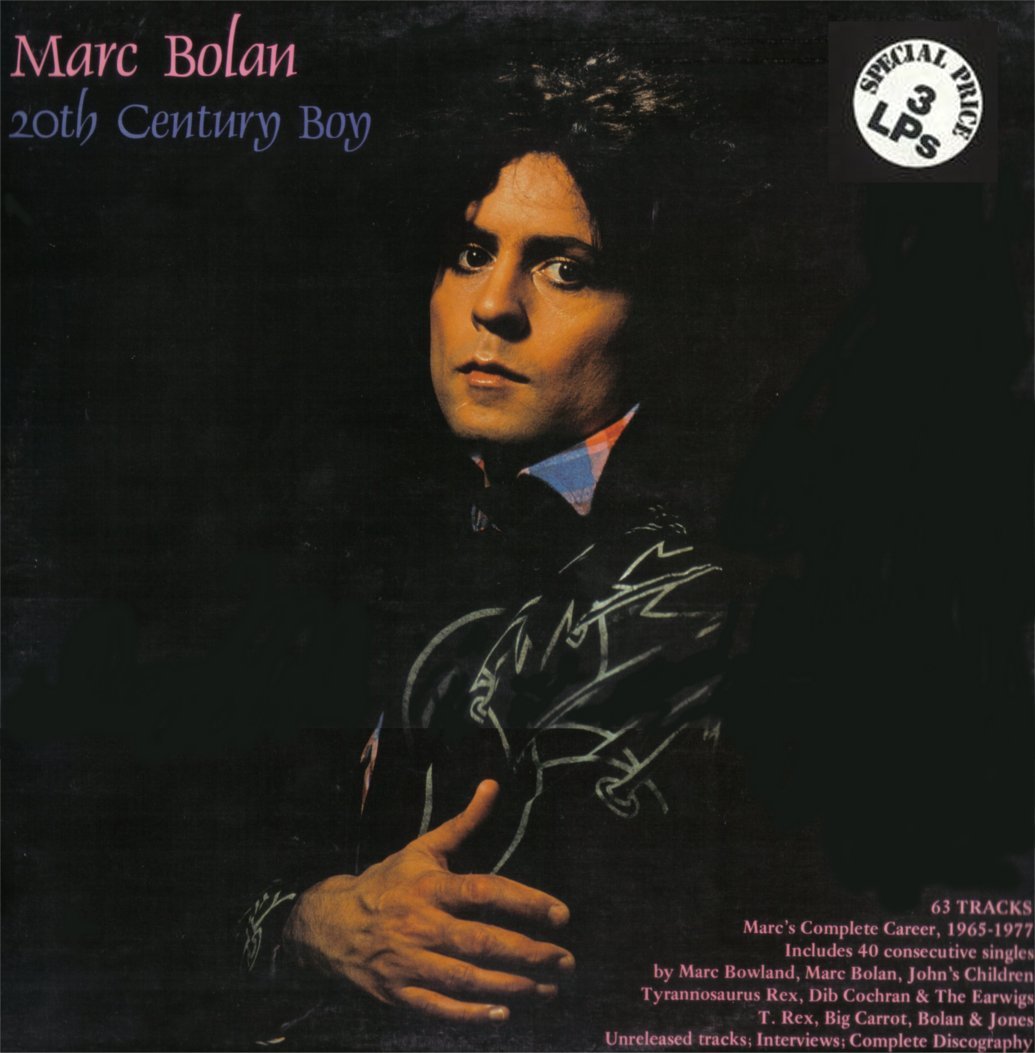
Marc Bolan - 20th Century Boy (3LP Anthology 1981)

(U.K 1965 - 1977)
.
Born Mark Feld in Hackney, East London, 1947, Bolan was youthful mod and budding male model before attempt to break into music scene at same time as other struggling young songwriters. David Bowie and Cat Stevens.
Changed name to Marc Bolan when Decca released "The Wizard" single in 1966 before becoming member of John's Children, who have claims to being first-ever glam rock band. This outfit had two minor British hits on Track label, "Desdemona" and "Go Go Girl", the latter actually a backing track for Bolan's later Mustang Ford with vocals added after he had left group. Around this time, also cut recordings for Track album, "Beginning Of Doves", although this was not released until 1974.
Bolan subsequently attempted to form five-piece electric group which, legend has it, failed when hire purchase company repossessed their equipment. Out of wreckage, surviving members Bolan and percussionist Steve Peregrine Took started gigging as acoustic duo 1968 under name 'Tyrannosaurus Rex'.
First and second albums were purely acoustic and featured Bolan compositions heavy with his own private mythologies. By the third album, 'Prophets Seers And Sages' etc, in 1969, Bolan had expanded instrumentation and was writing some of his best songs.
Steve Took quit soon after, mainly through disenchantment with inability to stamp his own personality on duo's work, and he was replaced by Micky Finn, who met Bolan in health-food restaurant.
Finn made debut on 1970 'Beard Of Stars' album, which was transitional collection in that Bolan introduced electric guitar on several tracks. Up to this point Rex were minority appeal outfit on fringes of what British press termed at time "progressive" boom, in competition for audiences with far more successful contemporaries like of Ten Years After, Jethro Tull and Fleetwood Mac.
Then, in late 1970, Bolan and Finn, now operating under abbreviated name of T. Rex, had surprise U.K. No. 2 single with "Ride A White Swan" - which was issued simultaneously with T. Rex album as their debut release or now defunct Fly label.
Bolan's audience changed dramatically within a period of months. With addition of bassist Steve Currie and later drummer Bill Legend, consolidated new position as fast-growing teeny-bopper and chart attraction with "Hot Love", which topped U.K. charts for six weeks in early 1971, and "Get It On" which enjoyed comparable success later same year. (Later is closest Bolan ever got to breaking U.S. singles charts, entitled as "Get It On, Bang A Gong".)
.
By this time, totally on strength of Bolan's charismatic personality and penchant for commercial songs. T. Rex were drawing from then increasingly younger audiences the kind of hysteria previously not seen since golden days IT. U.K. of Stones, Beatles and The Monkees.
In mid-1971 'Electric Warrior' completed transition from gentle folkiness of early Rex to full-blown rock n' roll attack. It was a brilliant collection, and Fly pulled the "Jeepster" track off the album to release as single. It made U.K. No. 2 but Bolan, upset at not being consulted, started his own T. Rex label.
Through 1972 Bolan was at peak of his popularity. The Slider was a great commercial success, and "Telegram Sam", "Metal Guru", re-issued oldie "Debora", "Children Of The Revolution" and "Solid Gold Easy Action" continued stream of U.K. hits.
In 1973, Ringo Starr turned film-maker and directed movie about the T. Rex phenomenon "Born To Boogie", which, despite the participation of Elton John, satisfied only the faithful.
Critically however, his output came in for increasing hammering, and Bolan himself was obviously decidedly frustrated by total inability to open U.S. market with same ease. Albums from 'Tanx' onwards failed to match U.K. sales of immediate predecessors, and by 1973 T. Rex fever started to abate as Bolan fans began to switch loyalties to U.S. bopper exports David Cassidy and Osmonds.
It all fell apart as quickly as it had began: Bolan got fat, baited his critics, churned out product, left his wife June Child to shack up with U.S. singer Gloria Jones (by whom he has a son), split from Micky Finn in March 1975 and pronounced T. Rex defunct, and finally retreated to the U.S.A. that same year, ostensibly as a tax exile.
He came back again spring '76 on a low-profile comeback tour with Gloria Jones, and by the close of the year formed a new T. Rex using Dino Dines (keyboards) and British rock veterans Tony Newman, Herbie Flowers and Miller Anderson. You almost had to admire his nerve when he started coming the 'elder brother' bit with U.K. new wave acts, and then got The Damned to support him on his early '77 tour.
The start of his own weekly TV show was a further indication of Bolan's resilience, and in all he was enjoying his best latter day period when he was killed in a road crash in 1977 — a passenger in a car driven by Gloria Jones. He died two weeks before his 30th birthday on September 16, 1977 years old [extract from The Illustrated New Musical Express Encyclopedia of Rock, 1977 p36]
.
Album Review
In the days before CDs, box sets, and vast archive-release projects, the Marc Bolan and T.Rex catalogue was basically spread over several dozen poorly annotated compilations, scarcely listenable bootlegs & overvalued rarities. Then "20th Century Boy" came along and for the first time the entire picture came blasting into perspective. Issued only in Australia, but widely imported elsewhere, the three vinyl albums document Bolan's entire career from 1965-1977, 63 tracks in all, rounding up impossibly scarce 45s by John's Children, Tyrannosaurus Rex, Dib Cochran & the Earwigs & Big Carrot alongside the expected T.Rex hits and album tracks. Brief interview segments close three of the six sides, and the triple gatefold packaging features excellent liner notes and illustrations. It is also worth noting that this remains the only career-spanning anthology for Bolan issued so far.
.
I grew up listening to Marc Bolan and T.Rex, and played 'Electric Warrior' non stop through my teenage years. I bought this triple LP anthology while attending University and saw it as a comprehensive collection of his best material. It was great value at the time, with each side clocking in at around 28minutes of music and hosting 63 tracks in total - all for the price of a double album.
However, there are a few track missing which I believe should have been included in this anthology How could classics such as "Summertime Blues" and "The Slider" not be included, while three of the 'best tracks' from Electric Warrior were also ignored - "Rip Off", "Cosmic Dancer" and "Lean Woman Blues".
.
Therefore, I have chosen to include these songs as bonus tracks in this post. Also included is a track released in 1981 called "You Scare Me To Death". This track was originally called "Horrible Breath" and was written as a proposed television jingle for Amplex Tablets.
To finish off the collection, I have also included a bonus MegaMix single of Bolan classics, released as a 12" single in 1985 (Songs covered are Metal Guru, 20th Century Boy and Children Of The Revolution).
.
The post is split up into 3 sections - all ripped from my A+ vinyl as mp3's (320kps) and not a pop or crackle to be heard. Full album artwork is included with CD3 but I am also providing the Album Artwork as a separate download link for the Bolan collectors who may already have the music. Included in the scans is an extensive discography of Bolan recordings along with a chronological summation of his recording career.
This truly is a brilliant collection of Bolan / T.Rex music and one can only wonder what music Marc would have released, if his life hadn't been cut so tragically short in 1977.
.
Track Listing
Record 1
1. The Wizard
2. Beyond The Rising Sun
3. The Third Degree
4. San Francisco Poet
5. Hippy Gumbo
6. Misfit
7. The Perfumed Garden Of Gulliver Smith
8. Jasper C. Debussy
9. Hot Rod Momma
10. Mustang Ford
11. Desdemona
12. Sara Crazy Child
13. Midsummer Night's Scene (Interview segment)
14. Child Star
15. Debora
16. Demon Queen
17. One Inch Rock
18. Catblack (The Wizard's Hat)
19. Pewter Suitor
20. King Of The Rumbling Spires
21. Do You Remember?
22. By The Light Of The Magical Moon
23. Once Upon The Seas Of Abyssinia
24. Blessed Wild Apple Girl
25. Find A Little Wood (Interview segment)
Record 2
26. Oh Baby
27. Beltane Walk
28. Ride A White Swan
29. Hot Love
30. Get It On (Bang A Gong)
31. Jeepster
32. Planet Queen
33. Telegram Sam
34. Metal Guru
35. Chariot Choogle
36. Baby Strange
37. Children Of The Revolution
38. Jitterbug Love
39. Sunken Rags
40. Solid Gold Easy Action
41. Born To Boogie
42. 20th Century Boy
43. Highway Knees
44. The Groover
45. Christmas Message (*)
Record 3
45. Squint Eye Mangle (instrumental)
46. Truck On (Tyke)
47. Teenage Dream
48. Venus Loon
49. Light Of Love
50. Think Zinc
51. Zip Gun Boogie
52. New York City
53. Dreamy Lady
54. London Boys
55. Solid Baby
56. I Love To Boogie
57. Laser Love
58. City Port (with Gloria Jones)
59. The Soul Of My Suit
60. Dandy In The Underworld
61. Celebrate Summer
62. Crimson Moon
63. Teen Rio Structure (Interview segment)

.
Note: (*) The "Christmas Message" listed on Side 4 was actually missing on the vinyl pressing, however, I have managed to source the 30sec segment, made available only to Fan Club members in 1973.
.
Marc Bolan - 20th Century Boy CD1 (1965-1970) MP3 (128Mb)  New Link 27/02/2024
.
Marc Bolan - 20th Century Boy CD2 (1970-1973) MP3 (163Mb) New Link 27/02/2024
.
Marc Bolan - 20th Century Boy CD3 (1973-1977) MP3 (163Mb)  New Link 27/02/2024
.
Artwork Only Link (16Mb)  New Link 25/04/2020
.

Friday, March 30, 2012

WOCK On Vinyl - Aussie Radio Jingles (Coca Cola)

.
Before things get too serious at Rock On Vinyl, I thought it might be fun to post a song at the end of each month, that could be considered to be either Weird, Obscure, Crazy or just plain Korny.
.
This WOCK posting comes under the 'Obscure' category and is Part 2 to an earlier posting, which included Coca Cola jingles by The Easybeats and the Bee Gees.

Music is a big seller of products and services and is an important part of advertising. In particular, well known bands and artists have been used to reproduce commercial jingles to sell their products (in this case that magic elixir we call Coca Cola).
.
This posting provides a sample of some more classic jingles from Aussie bands: Johnny Farnham, The Twilights, The Groove and The Executive.

.Coca-Cola was developed in 1886 by John Pemberton, a Pharmacist at the Eagle Drug & Chemical Company. Initially being sold as a patent medicine for a nickel, the first sale of Coca-Cola was on May 8, 1886 at a Pharmacy in Atlanta, Georgia. On May 29, 1886, Pemberton placed the first Coca-Cola ad in the Atlanta Journal. Coca-Cola was bought out by businessman Asa Griggs Candler who began to market it as a soft drink. The Coca-Cola Company produces extract not soda! They then sell the concentrate to licensed Coca-Cola bottlers who hold exclusive territory rights with The Coca-Cola Company. They in turn produce the final product in bottles and cans.

It was in 1963 that Coca-Cola started using the slogan "Things Go Better with Coke". Advertising agency McCann-Erickson worked with popular acts to create musical jingles utilising the slogan. The jingles became so popular that Coca-Cola eventually distributed 60,000 promotional "Let's Swing the Jingle for Coca-Cola" singles through their bottlers.

In these short radio spots, the original artists would rework their own popular songs to reflect the idea that "Things Go Better with Coke." What's amazing is that these short little reworkings are actually strangely compelling to listen to. In fact, even listening to several of them in a row is enjoyable, sometimes in a head-shaking kind of way. What's bizarre to me is that something that today would seem like such a crass sell-out was deemed not only acceptable, but was actually incredibly popular. What helps, I'm sure, is the earnestness that went into the production of these tracks. Clearly less cynical times, mind you.
.
An Aussie single was released in 1968 for Coke called "A Groovin' With Coca-Cola" b/w "Summerhill Road" (PRS-2028). The A side featured 4 one minute Coca-Cola jingles by The Executives, The Twilights, The Groove and Johnny Farnham. The Groove won the Hoadley’s National Battle Of The Sounds of that year. As a special bonus the B side featured the latest single by The Executives (at the time of its release) "Summerhill Road".
.
Thanks to Woodnet for supplying the FLAC rip of "A Groovin' With Coca Cola".  My favourite Coke Ad on this single in Farnham's, but be assured that all these jingles are worth the listen, cause - 'Things Go Better at WOCK on Vinyl' !
.
Aussie Coca Cola Jingles Link (64Mb)   New FLAC Link 30/03/2020
.

Tuesday, March 20, 2012

V. Spy V. Spy - Meet Us Inside (1984) Mini LP

(Australian 1981-1994)
.
Spy vs Spy is an Australian rock band from Sydney formed in 1981. They have been known as V.Spy V.Spy, Spy V Spy and quite simply 'The Spies'.
V. Spy V. Spy formed during high school in Newcastle, New South Wales, when bassist Craig Bloxom met guitarist Michael Weiley. Later they moved to Sydney where they met drummer Cliff Grigg. They started off as Spy vs Spy, but had to change their name just prior to releasing their first EP, 'Four Fresh Lemons' to prevent a lawsuit from Mad Magazine. The E.P was recorded for friends on an independent label, Green. The E.P's original pressing was a limited release of 1000 copies. They sold out in 5 days.
Originally the band oscillated between a kind of rocksteady-paced reggae and full tilt Oz rock. This was popular at the time that they formed - there was this whole ska/reggae thing that permeated the Australian music scene at the time, probably due to the influence of Madness and The Specials.
The Spies' music had this potent rhythmic reggae twist initially, no doubt thanks to the lovely skins work of Grigg. It wouldn't be long before some of their signature sounds started to emerge - particularly Grigg's drumming. Eventually their rock side would prevail over the reggae side.
Bloxom eventually became the lead vocalist, singing tales of inner suburban squalor. I read somewhere a tale of Grigg (I think) being busted for squatting illegally, which was probably fairly routine for inner suburban Australian musicians at the time.
They briefly broke up in early 1983 but thankfully were back together by July of that year - temporarily with a fourth member, Marcus Phelan.
Managed by Gary Morris of Midnight Oil fame, the Spies created an unique sound based around Craig Bloxom's driving bass, Michael Weiley on guitar & Cliff Grigg on percussion. Three piece bands often fight to achieve prominence, in the Spies case this was achieved by ear bleeding sound levels coupled with anthemic lyrics and Bloxom and Wieley's alternating vocals.
.
Anyway, to the Mini LP featured in this post. They still hadn't recorded a full length LP at the time, although 'Meet Us Inside' included not one but two bona fide rock epics in "One Of A Kind" and "Mugshot", which clocked in at 6:28 and 7:20 respectively. Not bad for a five track EP. I don't recall them ever doing a rock epic again.
"One Of A Kind" was released in truncated form as a single, but as always the E.P edit is far superior. The song itself starts with some nice rimshots by Grigg followed by the bass of Bloxom. Eventually the signature riff of Weiley's is sighted - an amazingly simple one at that.
Bloxom had this rather earnest vocal delivery which worked for a lot of their tunes and had progressed from the more weedy delivery on their earlier work. It would beef up further in years to come.
On this tune, as with some other Spies' tunes, Bloxom's vocals are punctuated by these little spoken rants delivered by Weiley, which could scared the poo out of anyone. Presumably, this is a tune about mental illness. Eventually, Weiley's signature digital delay pedal shows up. Weiley loved that pedal, and with good reason - nothing symbolised the Spies' sound more than that pedal. The Digital Delay was to the Spies what Robert Smith's Chorus pedal was to The Cure.

.The Spies went on to record a trilogy of extremely strong albums in 'Harry's Reasons?', 'A.O. Mod. T.V. Vers'. and 'Xenophobia [Why?]' before returning to their reggae roots a little with 'Trash The Planet' in 1989.
The Spies travelled to the UK to record 'Trash The Planet' but this album wasn't nearly as strong as the previous three, and the Spies found themselves without a label. Grigg left about this time to be replaced by Mark Cuffe.
Somehow along the way, they'd picked up the tag, "Poor Man's Midnight Oil", no doubt due to both the political content of their lyrics and the fact that they shared a manager with Midnight Oil.
.
They changed their name back to Spy vs Spy before recording Fossil, and around this time they discovered religion and became committed Christians. I didn't hear much from them after this, although I remember reading something where Cuffe moved out the front of the band to share lead vocals with Bloxom and Weiley and they got another drummer.
A 'best of' collection, 'The Spy File', was released in June 1992. Subsequent release Fossil was relatively ordinary and the band called it a day in 1994.
Bloxom appears to be a chef in Mexico, now, judging by his profile on Vuze.
In 2007, some of the former band members were touring as Spy - Spy and performing all of the classic hits. For a full discography of their albums, have a look at the following PDF
.
This post consists of a 320kps rip of this Mini LP taken from a cassette release (my vinyl copy has seen better days) and includes full album artwork and label scans. The reproduction is impressive and matches anything that could be produced from vinyl.
(band photos were sourced from The Spies Website with thanks)
.
Track Listing
01 - One Of A Kind (Full Version)
02 - Where Are We Going
03 - Voices Of The People
04 - Mugshots
05 - CES Limbo

.
Band members:
Craig Bloxom - Bass & Vocals
Mike Weily - Guitars
Cliff Grigg - Drums
Guest Artist: Sue Kempster - Cello
.
Spy V Spy Link (56Mb)
.

Saturday, March 17, 2012

Free - Live! (1971)

(U.K 1968–1971, 1972–1973)
.
Free was an English rock band, formed in London in 1968 and had a somewhat turbulent history. Their best-known line-up was founder Rodgers (b.Middlesbrough, Dec 12, 1949), Kirke (b. Chelsea, London, July 28, 1948) and Kossoff (b. Hampstead, London, Sept 14, 1950 - d. Mar 19, 1976).
Kirke and Kossoff were playing together in a blues group, Black Cat Bones, when they saw Rodgers singing with the outfit Brown Sugar in a North London pub, The Fickle Pickle.
The three assembled their new band with the addition of Andy Fraser, 16-year old bass player from John Mayall's Bluesbreakers.
While still in their embryonic stage, they came to the attention of Alexis Korner, one of' 'founding fathers" of British blues, who suggested the name "Free", introduced them to Island Records boss Chris Blackwell (who wanted to call them The Heavy Metal Kids), provided early musical 'coaching', and even arranged group's debut gig in spring 1968.
Though the subject of some initial criticism - they were dubbed as ersatz Cream in certain quarters of British rock press - the band established a strong club following within a year of formation, playing a mix of original material and blues standards.

.Early albums (first in 1969) were only moderately received by press and public alike, until in 1970 their original composition, "All Right Now", went to #1 in British singles lists, and into American Top 5 in autumn of that year. Free followed up with their next big hit "My Brother Jake".
In early 1971, however, for a variety of reasons never fully explained, one of them being possibly their immaturity, the band split — for the first time.
Each member pursued various, though largely unsuccessful projects. Rodgers and Fraser formed own bands, Peace and Toby respectively; Kirke and Kossoff recorded album (Kossoff Kirke Tetsu Rabbit - Island, 1971) with Texan keyboards player John "Rabbit" Bundrick and Japanese bassist Tetsu Yamauchi.
Then in early 1972, the band regrouped with their original lineup to cut a disappointing 'Free At Last', plus the hit single "A Little Bit Of Love", and for a reunion tour.
Fraser departed towards end of that year, however, and Tetsu and "Rabbit" - from a fore mentioned album - came in to make Free a five-piece for only a short period of time before Paul Kossoff, suffering from drug addiction, also quit. Nevertheless, Kossoff appears on parts of the final Free album 'Heart-breaker' (1973).
Wendell Richardson, then with Osibisa was brought in as a temporary replacement for Free's early 1973 American tour, after which Tetsu quit to join The Faces.
Free disintegrated for second and last time in late 1973, allowing Rodgers and Kirke to form instantly successful Bad Company. Original bassist Fraser subsequently led own eponymous Andy Fraser Band with relatively little commercial success [extract from The Illustrated New Musical Express Encyclopedia of Rock, by Nick Logan & Bob Woffinden, 1977 - p89)
Due to the publicity caused by their breakup, a live album was rush-released by Island Records to commemorate the band.
Recorded in 1970 and comprising of tracks drawn from their 1st four studio albums (Tons of Sobs, Free, Fire and Water, Highway), this is a brilliant and powerful live album from one of the great blues rock bands ever...'
A fitting live document to a magnificent band who were sadly short-lived. At the time, Free was on the verge of becoming extremely big, they just couldn’t see it. These live tracks capture this feeling very well indeed. I would give my paycheck to see these guys play live if only I could. Alas, Free Live! is the next best thing [review from Amazon]
.
This post consists of a rip (320kps) taken from my vinyl copy which I bought as a teenager and represented my first introduction to this legendary band. Full album artwork for both CD and vinyl is included along with label scans. I consider this album to be one of the few classics that have stood the test of time and it is still an integral part of my general playlist. Hope you enjoy it!
.
Track Listing
01 - All Right Now
02 - I'm A Mover
03 - Be My Friend
04 - Fire And Water

05 - Ride On Pony
06 - Mr Big
07 - The Hunter
08 - Get Where I Belong (Studio Track)

..
Free were:
Paul Rodgers (vocals)
Paul Kossoff (guitar)
Andy Fraser (bass)
Simon Kirke (drums)
.
Free Live Link (95Mb)  New Link 23/10/2015
.

Tuesday, March 6, 2012

Crossfire - Selftitled (1975)

(Australian 1974 - 1982, Present)
.
The cover may have you expecting some prog-psych-rock nightmare, but this is actually a rare piece of Australian 70s jazz. This album is largely instrumental but does include a vocal or two. It was only after many years that vocals would again feature when Crossfire toured with Michael Frank out front.
Crossfire were my introduction to electric jazz - introduced to the funk via the radio and some ReneƩ Geyer shows, then this local band Crossfire appeared in 1975, with some funk guitar riffs, rhodes and various woodwinds and brass, often with several instruments played through wah-wah pedals.
Listening to it again now, more than thirty years later, I think I can hear what they might have been listening to - maybe some early pre-guitar wank 'Return to Forever', some wah-wah Eddie Henderson, and even the occasional MPS jazz artist?
Crossfire made seven albums, and often backed international jazz visitors like Randy Brecker, Ben Sidran and of course Michael Franks on a 1980 live album.


The following is an article published in the Dec 5 1975 edition of RAM magazine (editorial by Felicity Surtees)
.
Crossfire: The approach is serious
Ironical, that's what it turned out to be. Y'see there's this group in Sydney called Crossfire who've established something of a reputation for themselves around the biz. Stories of people standing on each other's shoulders and applauding till they came up in bruises were not uncommon.
So here's what happens, your scribe turns up at the waterings-hole of French's to see the marvel and sure nuff, a band is playing involving and spontaneous music that stirs the crowd into mighty enthusiasm. They are finally let from the stage after they plead, "We just don't know anything else to play."
Good group that Crossfire, heh?
What's that?
Well, turns out it wasn't Crossfire after all. Crossfire had had to cancel out of the gig and what had been blowing was a jamming outfit consisting of the rhythm section of Sydney group Rocket with a few footloose sax players, etc. thrown in.
Oh, I see.
So anyway, catching the real Crossfire the next Saturday arvo was something of an anticlimax. It turns out that Crossfire is a bunch of very competent musos with influences ranging far and wide — but somehow the afternoon seemed to be lacking in the uh ... high spirits dept. The audience was part of
Crossfire's dedicated following and there was polite applause after any particularly tasty solo etc. The approach was Serious.
Earlier, as I d stumbled past the sprawled bodies of French's stairs, I d noticed a large poster asking Crossfire—Jazz or Rock? So I put the question to bass player, Greg Lyons. He returned it with a polite frown, saying, "That is not our doing. What we play is contemporary music. We re influenced by everyone really ..." Which basically means that Crossfire are not about to confine, define or restrict themselves with labels. "It allows everyone to be creative," explains Greg. Which is what Crossfire is about. A band where its members can feel free to experiment without compromising. It was originally formed as a creative outlet outside their "day jobs". Day jobs that ranged from percussionist lan Bloxsom's stint with the Sydney Symphony Orchestra to the various session/studio work of the other members. But now their first album Crossfire has been released, and it's gone past the stage of being just a creative outlet and has become a major part of their lives. As the band's guitarist, Jim Kelly puts it, "It's more of an onwards and upwards kind of thing."
Oh, I see.......
.

 
Post consists of a 320kps rip from vinyl and includes full album artwork (thanks to Micko and the Midoztouch community for the vinyl rip and scans). I have also included a scan of the magazine article featured above, along with a bonus track featuring Jim Kelly playing live at a small music venue called 'Queens Head Cafe' in Tasmania, sometime in 2011. Unfortunately, the track is untitled and was sourced via YouTube.
Complete with Derek Smalls 'etching' cover art, this is pure punchy driving fusion goodness, straight from the top drawer. Shades of Mahavishnu Orchestra, Soft Machine and electric Miles and all bundled up in knat's-chaff-tight arrangements.
This 1975 album is their first and best album in my opinion and I regret the day I sold my copy at a record fair back in the 80's. Hope you enjoy it!
.
Track Listing
01. Remember The Trees (Jim Kelly)

02. Nobody Nose (Mick Kenny)

03. Freddie Funkbump (Jim Kelly)
04. Perverted Pavanne (Mick Kenny)
05. Inside Out (Mick Kenny, Don Reid)
06. Nada (Ian Bloxsom)

07. Stygian Night (Mick Kenny)
08. You Gotta Make It (Greg Lyon)

09. Bonus live track (Jim Kelly, Queen's Head Cafe, 2011)

Band Members:
Greg Lyon - bass, voice
Mick Kenny - keyboards, trumpet
Don Reid - Reeds
John Proud - drums
Ian Bloxsom - percussion
Jim Kelly - guitars
.
Crossfire Link (119Mb)