

(U.S 1973-1987, 1991, 1995-Present)
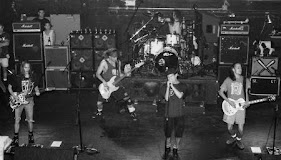
Prior to Steve Perry's arrival, Journey had been a fairly inconspicuous and mainly instrumental fusion outfit, looking to muscle in on the jazz-rock scene perpetrated by the likes of Weather Report and the Mahavisnu Orchestra.
Journey’s interest in experimental jazz-fusion was confirmed on their self-titled debut album issued in 1975. A classy work, the album resonates with a surety beyond their recent formation, all players coming across as both fluid and experienced. Neal Schon in particular rips up his fretboard like combination of Jeff Beck and Robert Fripp. Check out the seven-minute long Kahoutek where he trades call-and-response licks with Gregg Rolie.
Surprisingly for such complex music, the album sold moderately well, reaching No.138 on the Billboard chart. After George Tickner bailed out of the band, their next two albums – 1976’s 'Look Into The Future' and 1977’s 'Next' – repeated the pattern, with Gregg Rolie making a concerted effort to deliver reasonably effective vocals atop what was clearly a jazz-fusion fanfaronade.
Great players, Journey’s early style and meticulous arrangements would, inevitably, limit their appeal unless radical changes were implemented. Their sound had attracted stellar critical reviews but, as a commercial entity, they were stuck in a rut. Not surprisingly, at the behest of their label, Columbia, changes needed to be made, a radical re-modelling of the band was demanded to expand their appeal.
Effectively this meant adding a proper vocalist/frontman and modifying the musical direction. It was a bitter pill to swallow but the band took it on the chin and cast their net to see what was possible.
.jpg) |
| Journey with Robert Fleischman (Far Right) 1977 |
They settled on Californian Robert Fleischman, who teamed up with the band in June 1977, at the request of label president Bruce Lundvall, who asked Robert to fly to San Francisco and see the band. Fleischman rapidly assimilated with his new bandmates, co-writing a handful of songs, three of which – Wheel In The Sky, Anytime and Winds Of March – would later surface on Infinity.
However, after touring with Fleischman for nearly one year, things fell apart between the band and their nearly acquired vocalist and the decision was made to recruit Perry (who was working as the band's technician) to the position, after he auditioned for the role during a sound check.
It was the beginning of a new chapter for Journey. Equipped with an appealing personality, good looks and a voice to kill for, Perry soon became the focal point of attention. It was now time to unleash his talent in the studio by recording Journey’s fourth and pivotal album, Infinity.
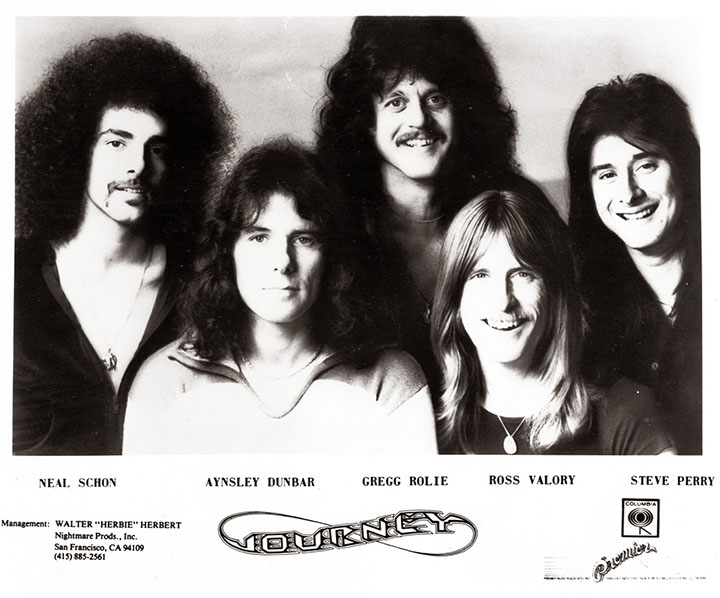 |
| Journey Infinity Publicity Photo 1978 |
The plan was simple: write songs, hire a producer, select a studio and make an album that would set out their stall for the next 10 years or more. Steve immersed himself in songwriting with all the band members, but mainly with new creative partner Neal Schon, eventually securing co-writing credits on eight of the 10 songs.
Steve and Neal struck up a strong rapport and quickly established a beachhead, strengthening the band’s sound and setting in place a new direction. The emphasis was now on fully formed songs with melodies, hooks and the sort of contemporary buff that made the competition quake in their boots.
Steve and Neal struck up a strong rapport and quickly established a beachhead, strengthening the band’s sound and setting in place a new direction. The emphasis was now on fully formed songs with melodies, hooks and the sort of contemporary buff that made the competition quake in their boots.
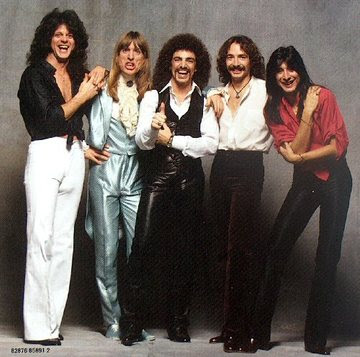
The choice of producer was inspired. Band, management and label all agreed on Roy Thomas Baker, the flamboyant British studio craftsman who had worked with some of the most influential rock bands around, including Free and – most importantly – Queen.
After seeing the band live in Santa Monica, RTB (as he is affectionately known) and his trusted engineer Geoff Workman rendezvoused with the band at His Master’s Wheels Studio (formerly Alembic Studios), located on Brady Street in downtown San Francisco.
“They put me in a little apartment on Bay Street,” remembers Steve. “I went to SIR [Studio Instrument Rentals, a well-known rehearsal room] every day and wrote songs with band.
“Then, all of a sudden RTB comes in. We had enormous respect for him, because he’d produced Queen and Free. He was so much fun. The studio [His Master’s Wheels] had an old Neve console and a large tracking room, and the next thing you know he was really giving us a different sound.
After seeing the band live in Santa Monica, RTB (as he is affectionately known) and his trusted engineer Geoff Workman rendezvoused with the band at His Master’s Wheels Studio (formerly Alembic Studios), located on Brady Street in downtown San Francisco.
“They put me in a little apartment on Bay Street,” remembers Steve. “I went to SIR [Studio Instrument Rentals, a well-known rehearsal room] every day and wrote songs with band.
“Then, all of a sudden RTB comes in. We had enormous respect for him, because he’d produced Queen and Free. He was so much fun. The studio [His Master’s Wheels] had an old Neve console and a large tracking room, and the next thing you know he was really giving us a different sound.

“Neal’s doing what we called ‘violin guitars’. Roy had me stack all the vocals on a 40-track machine, and I really enjoyed that process. Also, Geoff Workman was so instrumental that we ended up grabbing him to do one of the records [Departure] without RTB.
“We rehearsed the material quite a bit before we recorded it so everything was ready to go before Roy got there. What Roy gave us was the opportunity to try different textures and ideas, but the foundational aspect of the songs and the arrangements were done. He really gave us a direction, and from there the band found itself.”
“I have fond memories of working with Roy and Geoff,” says Gregg. “Roy was very much into experimentation, and quite wild in the studio. The multi-tracking of guitars and vocals was a brand new thing for us – all the layering. It was intense work. He created a sound which a lot of the guys didn’t like because it was so edgy, but I happened to dig it.
“Those tracks had a specific sound to them, which is what a good producer does. He was, and still is, a real character. Him and Workman both – they were fun to be around. Workman did a lot of the heavy lifting, inasmuch as getting things done.

“Geoff had worked with Roy for a long time and knew what he wanted. If Roy disappeared for a couple of hours, Geoff just carried on because he knew what they were doing as a team. We used the same team on the next album, Evolution. It got us on the map.”
Not surprisingly, the biggest impact was the quality and strength of Steve Perry’s vocals.
“I certainly discovered the depth of multi-tracking, as I never had a chance to work on a 40-track machine before,” says Perry. “I’d never had the ability to do eight root notes and then bounce them to one track, then wipe those and do the eight thirds, wipe those then do eight fifths and eight octaves and so on – and suddenly you have a big stack like on Anytime. When they are layered and smeared tight they just really block up. Roy knew how to do that.”
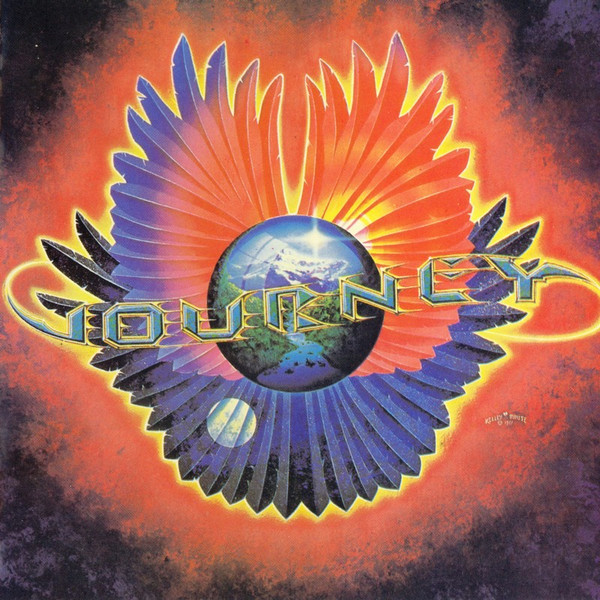
With the album completed, a design makeover followed. The band brought in renowned San Francisco artists Alton Kelley and Stanley Mouse (real name Stanley George Miller). The duo had first hooked up with San Francisco’s counter-cultural doyens the Grateful Dead (designing their album covers) and legendary West Coast promoter Bill Graham (designing his gig posters). During the early 70s they had formed the Mouse Studio, and helped rebrand Journey by designing and standardising their cover art, including Infinity’s colourful flaming wings. The pair also came up with a Journey logo.

Says Perry: “Bruce Lundvall was the president of Columbia at the time, and he quipped that, in order for us to make another record with me singing, we would have to sell one million units. Hence the reason we stayed on the road for 298 shows that year. We started touring in February and didn’t come home for almost a year.
"Wheel In The Sky" was the first single. Neal and I went to a pizza place, and I went over to the jukebox and saw a Wheel In The Sky 45 in that machine – an ecstatic feeling. I didn’t tell Neal, I just put two quarters in, pushed the button and sat down and the song started. Neal looked at me and started laughing. It was a monumental moment. Back then if you were starting to show up in jukeboxes it was a sign that you might be finally starting to happen."

'Infinity' marked Perry’s initiation into the world of professional recording, a milestone in contemporary aural acrobatics. Within the confinement of 10 songs he effortlessly switched from breezy improvisation (La Do Da) to epic bombast (Wheel In The Sky), providing a template from which future creative diamonds would emerge, forever cementing the appeal of Journey and securing his place in rock’s vocal Hall Of Fame. [ extract from Louder Sound)
Album Review (by Easy Livin' - Progarchives)
Following the spectacular lack of success for their musically credible first three albums, Journey succumbed to pressure from their record company and reinvented themselves. Recognising that they were weak in the vocal department, they initially brought in Robert Fleischman as lead vocalist. He however lasted less than a year, there being only one commercially available recording by the band with his vocal ("For you" can be found on the "Time 3" box set). He did however write other songs with the band, three of which can be found on "Infinity".

Noted Queen producer Roy Thomas Baker was brought in to produce the album, Baker bringing with him many of the techniques he had used to great success with Queen.
The opening "Lights", written by Steve Perry and Neal Schon, gives an immediate indication of the way Journey will head forever more. This classic AOR ballad may be ultra smooth, but it has a killer melody and all the ingredients of a live anthem. Perry and Schon dominate the writing on the album as a whole, but the other band members do contribute too.
The songs alternate between the ballads, the anthems and the upbeat rock songs, but all the while they are shorter and much more focused. Gone are the long instrumental breaks, and improvisations are now a definite no go area. The tracks here run from 2½ to 5 minutes, with most being around the preferred single length of 3-4 minutes.
Tracks such as the vocal ballad "Patiently" may sound nothing like anything we have heard thus far from Journey, but sales of the album speak for themselves, and such songs at least secured a future for Journey. Personally, I consider it a wonderful song anyway.

The upbeat "Wheel in the sky" is similar to Gary Moore's "Murder in the skies", melodically at least but not in sentiment. "Wheel In The Sky" was chosen to be released as the album's first single.
The five minute "Winds of March", written during Robert Fleischman's brief time with the band, is the closest we get to anything prog here. The song includes some fine organ and guitar, which sit well alongside Perry's superb vocal.
In all, an album which for my money is unfairly derided, not for the music it contains, but for what it represents in terms of Journey's history. The simple fact is though that the band's record label were ready to drop them. They had to reinvent or die. It is to their credit that they took the bold steps they did. While "Infinity" may represent the end of Journey as a band with progressive credentials, it is still a fine album.
This post consists of FLACS ripped from my vinyl copy, acquired from one of the major Import Shops in Melbourne back in 1979, located in Flinders Street if my memory serves me right. The album cover and records labels have their Record Label details blackened out with texter, a common practice by Aussie import shops at the time. Why, I am unsure.

Tracks Listing
01. Lights (3:10)
02. Feeling That Way (3:27)
03. Anytime (3:28)
04. Lă Do Dā (2:58)
05. Patiently (3:20)
06. Wheel In The Sky (4:12)
07. Somethin' To Hide (3:26)
08. Winds Of March (5:04)
09. Can Do (2:39)

10. Opened The Door (4:34)
11. Wheel In The Sky (Bonus Demo with Robert Fleischman on vocals)
Line-up:
- Steve Perry / lead vocals
- Neal Schon / electric & acoustic guitars, backing vocals
- Gregg Rolie / keyboards, lead (2,3) & backing vocals
- Ross Valory / bass, backing vocals
- Aynsley Dunbar / drums, percussion
Journey Infinity Link (233Mb)


 Mal Logan: Keyboards