Showing posts with label Coloured Balls. Show all posts

Monday, August 11, 2025

REPOST: Various Aussie Artists - A Hair Of The Dog (1974)

(Various Australian Artists)
.
A 12 track sampler from EMI's top Australian pop albums, this is a very rare Australian Various Artists compilation album. Some of the artists featured on this album went onto bigger and better things (eg. Johnny Farnham, Ariel and Ross Ryan) while others simply disappeared off the grid (eg. Pirana, The Ormsby Brothers).  The following are brief bio's on the featured group, while the back cover of the album provides details about the albums from which these tracks were lifted.
The tracks themselves are not the singles that were officially released from the albums, which makes this sampler even more desirable from a collectors point of view.
Overall, there is a wide range of musical styles represented on this sampler, from cabaret, to popular to progressive rock. Not the greatest album cover which probably didn't help EMI in their venture to promote the artists showcased, but the title is quite cliche' and clever (hopefully when you hear one track from the album, you'll want more and consequently buy the LP)
.

Ariel
(Both "Worm Turning Blues" and "And If It Wasn't For You" taken from LP 'A Strange Fantastic Dream)
Ariel formed in mid-1973, after the breakup of Spectrum. When Spectrum drummer Ray Arnott announced he was leaving to join Ross Wilson's new band Mighty Kong, Putt and Rudd decided to end the band rather than try to recruit a new member, feeling that it wouldn't be possible to recreate the special spirit of the group. Within a few months of Spectrums's farewell performance a new band (its name taken from the character in Shakespeare's "The Tempest") was up and running. Ironically, the two new members, Tim and Nigel, had originally come to Melbourne to work with Ross Wilson and Ross Hannaford on their new project (which became Mighty Kong) and it was after they departed that Ray Arnott was invited to join, thus precipitating the split of Spectrum!
Strong record company interest in Ariel quickly led to a contract with EMI's progressive Harvest imprint. Their superb debut single Jamaican Farewell looked set to repeat the early success of Spectrum but it managed to reach only No.34, its success hampered by lack of airplay, especially in Sydney. They toured as support to Gary Glitter November 1973 and released their excellent first LP 'Strange Fantastic Dream' in December, with writing credits split fairly evenly between Gaze and Rudd. According to Noel McGrath, the album was also the first use of Moog synthesizer on an Australian rock record. It fared very well commercially and critically, reaching No 12 in the LP charts in February 1974.
.
Ross Ryan
("Goodbye Mitchy" was taken from LP 'A Poem You Can Keep', "There Is No Pain" was taken from LP 'My Name Means Horse')
Ross Ryan is one of Australia's most respected and successful singer-songwriters. Like his contemporaries Greg Quill and Mike McClellan, he emerged from the folk scene, and enjoyed brief chart prominence in the mid-70's with his 1974 hit single "I Am Pegasus", for which he is probably best remembered these days.
In March, 1973 he released his second album, 'A Poem You Can Keep', which got his career off to a flying start. Produced by Dawkins, engineered by former Abbey Rd chief Martin Benge, and arranged by Peter Martin, it spawned a hit single "I Don’t Want To Know About It", won 'Record Of The Year' at the Australian Record Federation Awards for 1973 and earned Ross a second gong as 'Best New Talent'.
In November '73, Ross supported Helen Reddy on her national tour, coinciding with the release of his new single, "I Am Pegasus" (b/w "Country Christine Waltz"). It was a runaway success, becoming one of the most successful Australian singles of the year, and the biggest hit of Ross's career, earning him the first of four first gold records. It went to #1 in Sydney, reached #9 nationally, and stayed on the top forty for an extraordinary twenty-three weeks. 
Ross made a memorable appearance at the 1974 Sunbury Festival in January, followed up by the release of his third album in January 1974 and the subsequent release of the single "Orchestra Ladies". Propelled by the huge success of the "Horse" single, the Horse LP was also a major hit -- it sold 15,000 copies within two weeks, in March it was declared "gold", and it peaked at #3 nationally in April 1974. It eventually earned Ross three gold record awards and stayed in the charts for 17 weeks. In March Ross made another short US trip, performing concert and clubs dates, after which he briefly returned home, when Prime Minister Gough Whitlam presented him with gold record awards for both the album My Name Means Horse and "I am Pegasus" [extract from Milesago]
.
Pirana
("Then Came The Light" taken from LP Pirana II)
For anyone who is hopelessly hooked on progressive and classic rock of the 70s, Pirana is simply a must. "Pirana" was a short-lived act from the 70s, which was one of the major driving forces and attractions in Australian music scene in these years.
Pirana was formed in 1970 by Stan White (keyboards), Jim Duke-Yonge (drums), Tony Hamilton (vocals, guitar) and Graeme Thompson (bass) as a new musical venture for the latter three following their tenure in pop band Gus & The Nomads. Their first recording were as a backing band for a solo album by Greg Quill, but in 1971 they were signed by legendary record label Harvest and soon got busy making their debut album.
Pirana I hit the shops in 1971, and while their debut album didn't exactly set the world on fire the band quickly established themselves as a popular live act. For anyone who is hopelessly hooked on progressive and classic rock of the 70s, it's simply a must. Too often the description of their music is concentrated on the influence of Santana - yes, that's difficult to deny, but "Pirana" performed their own unique version of quite heavy prog rock balancing on the verge of acid/hard, not unlike their British peers, with powerful drumming, roaring guitars and lengthy Hammond solos. In my humble opinion the influence of Santana is grossly exaggerated. "Stand Back" from the first album is a true masterpiece featuring exceptional drumming solos, while the opening track from the second album - "Pirana" - is mesmerizing tune inspired by Maurice Ravel's "Bolero".
Pirana
Stan White left the band shortly after the release of their first album and was replaced by Keith Greig. And with White out of the band guitarist Hamilton had a more prominent place as a songwriter for Pirana's second effort Pirana II, issued late in 1972. A direct result of that was that the band started moving slightly away from their Latin-inspired sound. They never managed to hit the big time with their second LP unfortunately, not even a superb performance at 1972's Sunbury festival gave the band the true commercial breakthrough they required. Indeed, the latter actually cemented their reputation as a Santana-influenced act, and while their credibility as a live unit soared their merits, their studio efforts remained unrecognised.
Grieg left the band in 1972, and a flurry of line-up changes followed for the next couple of years, until Pirana fizzled out to disbandment in late 1974.
.
The Ormsby Brothers
(Both "Da Doo Ron Ron" and "The Sun Ain't Gonna Shine Anymore" taken from their Selftitled LP)
The Ormsby Brothers were: Neville Ormsby, Michael Ormsby and Adrian Ormsby. Their sound was almost like the USA Osmond Brothers who were enjoying world-wide success at the time, and I'm sure these two groups have been confused at some stage by the unwarey.
The boys were born in New Zealand and began vocalising together as a group in 1967. In September, 1971 they moved to Australia. Their first single was 'I Saw Mommy Kissing Santa Claus' which was released just prior to Christmas, 1972. The following year they recorded Lesley Gore's 'You Don't Own Me' which became their first and only hit, making the top ten in all states. It reached #2 and stayed in the charts for 20 weeks. Music producer Peter Dawkins said he looked back on that single, engineered by former Beatles studio assistant and later Sherbet producer Richard Lush, as the best of his early Australian productions.
Following on from the single's success they released an album entitled The Ormsby Brothers which won for them the 1973 Easy Listening Vocal Award presented by the Australian Federation of Commercial Broadcasters.
The latter part of the year was crammed with television and live appearances all over Australia with the highlight being part of the first concert presented at the Sydney Opera House.
In December they released their next single, 'Sweet Virginia' which sold only moderately and since 1975 they've been singing in the Sydney club circuit. Although they were not contracted to a record company at the end of 1977, they had plans of putting together an album in the near future.
Strangely enough, Chris Spencer's Who's Who Of Australian rock makes no refernce to this group.
.
Johnny Farnham
("My Love" from the LP 'Johnny Farnham sings the big hits of '73 Live' and "Don't You Know It's Magic" from the LP "Hits Magic & Rock 'N' Roll")
John Farnham, aka Farnsy, Johnny, Whispering Jack and The Voice is an iconic Australian entertainer whose career has spanned over four decades.
Farnham was born on the 1st July 1949 in England and moved to Melbourne at the age of 10 and has lived here ever since. This wannabe plumber took a break from his apprenticeship in order to pursue a music career which has seen him become one of Australia's best-loved performers with a career spanning over 40 years.
In 1967, Sadie (The Cleaning Lady) was his first hit which topped the Australian charts for six-weeks running.  Selling 180,000 copies in Australia, "Sadie" was the highest selling single by an Australian artist of the decade. Farnham's debut studio album, Sadie was issued in April 1968.
He later released a cover of BJ Thomas's "Raindrops Keep Falling On My Head" in 1969, which also reached the #1 position on the Australian charts.
Most of his early 70's material could be classified as being both Pop and Cabaret music, but he soon reinvented himself in the early 80's with the help of Glenn Wheatley to be labelled as one of the best voices in Australian rock.
.
The Coloured Balls
("Whole Lotta Shakin" taken from the LP 'Ball Power')
Original line-up: Mick Hadley (vocals); Robbie Van Delft (lead guitar); Rob Dames (bass guitar); Peter Miles (drums); Sam Shannon (vocals).
The band was formed in Brisbane following the breakup of the Purple Hearts. Mick and Rob were from the Hearts; Robbie was from the Bowery Boys; and Peter and Sam had had a variety of experience.
In 1971, Lobby Lloyd took over on guitar and the group, all sporting 'skinhead' hair styles, gained a reputation as a loud band after the style of the Aztecs.
By August 1972, the line-up had changed totally and included Trevor Young (drums); Lobby Lloyd (guitar); John Miglands (bass guitar); and Bobsie Millar (guitar). The band's first notable single was "Liberate Rock", which was written by Lobby. Most of the backing was provided by the Aztecs prior to the hew Coloured Balls being formed. Although it didn't quite make the charts, the single did make history being the first in Australia to be advertised on radio.
The Coloured Balls

The follow-up was "Mr. Mean Mouth"/"Love Me Girl" in May '73. Then in September they enjoyed their first chart success with a revival of Elvis Presley's "Mess Of Blues". Later, in November, came a single called "Flash", and in December they released their best selling 'Ball Power' album.
Another single by the boys, "Love You Babe", charted midway through 1974, but unfortunately the group disbanded not long after. However, in May 1976, an album entitled The First Supper Last, which was recorded in 1972 with the line-up at that stage, was released on the Rainbird label.
Lobby initially went solo, recording for Bootleg Records. In 1976 he released an LP with the Southern Electric Band called Obsecration which was also on the Rainbird label. Then, in 1977 he left for England. Trevor Young turned up in popular band, Fingerprint, in 1977.
.
Jeannie Lewis
("Fasten Your Wings With Love" taken from the LP 'Free Fall Through Featrherless Flight')
Jeannie Lewis is widely acknowedged as one of Australia's most accomplished, versatile and passionate vocal artists, and a performer whose work crosses many musical boundaries. Jeannie started her singing career on the Sydney folk and jazz circuit in the mid-1960's then moved into the rock scene in the early 70s, establishing a strong reputation through her dynamic performances and powerful interpretations of songs both on stage and on the outstanding recordings she made in those years. During the 80's and 90's she continued to develop and broaden her career, with roles in musical theatre and the unique one-woman cabaret shows that reflected her growing love of Latin music, and her commitment to the often-underrated role of women's voices in music. Jeannie can adapt her voice to a large and eclectic range of material -- folk, rock, blues, opera, torch songs, Broadway tunes, tango and jazz -- and she is recognised both here and overseas as a peerless interpreter, with a rare ability to make almost any material her own.
Jeannie Lewis

In 1973 EMI issued Jeannie's classic debut album, Free Fall Through Featherless Flight, arranged and directed by Carlos. Its cover was designed by renowned Australian artist Martin Sharp whose first record designs were the classic psychedelic covers for Cream's Disraeli Gears and Wheels of Fire LP's
Backing Jeannie on the album was an all-star lineup including Michael Carlos on Moog, organ and harpsichord, Mike Wade and Mike Reid (guitars), Ken Firth (bass; ex-Tully), Jamie McKinley (ex-Cool Bananas, piano), Greg Henson (drums), Alan Lee (percussion), Marcia Hines (backing vocals), Shayna Stewart (backing vocals, ex-Extradition, Tully), The Fidelio String Quartet and a wind section. The album won the Australian Radio Record Award for the Best Australian LP of 1974, despite receiving virtually no radio support whatsoever outside the ABC, although it was featured on Chris Winter's pioneering show Room To Move, and gained further airplay in the early days of radio station 2JJ (Double Jay) in Sydney.
.
The La De Das
("The Place" taken from the LP 'Rock and Roll Sandwich')
Original line-up: Bryan Harris (drums); Trevor Wilson (bass); Bruce Howard (organ/sax); Phillip Key (lead vocals); Kevin Borich (lead guitar).
The band formed in New Zealand in 1965 and after reaching the top there (with their single, "Hey Baby" which made number one), they left for Sydney two years later.
On their arrival in Australia they received little attention from their recording company who at first refused to let them record. As a result they fell into a rut working steadily, but uneventfully, in Melbourne and Sydney. Then early in 1968 they decided to buy new instruments and develop a new act. The change brought with it a renewed interest in the band and in March, 1969 they released their highly acclaimed 'Happy Prince' album. Two months later they left Australia to try their luck in England. Other, more renowned groups, had tried before them without success and the La De Das found the going just as tough. They returned in April, 1970 minus Trevor and his place was taken by Reno Tehei (ex-Genesis and Compulsion). In the meantime their album had sold steadily during their absence, and later in the year Bryan left and he was replaced by Keith Barber.
More line-up changes occurred in January, 1971 when Bruce left to form a duo with Trevor, and Reno also moved out. The band added Peter Roberts and reformed as follows: Phil Keys (vocals and guitar); Peter Roberts (bass); Keith barber (drums); and Kevin Borich (vocals and guitar).
They consolidated with the new format and released a new single, "Sweet Girl"/"I Can't Find A Reason". Then in November, '71 came the breakthrough they had been waiting for when they made the charts with one of their biggest hits "Gonna See My Baby Tonight". Another hit was achieved six months later with "Morning Good Morning". But, just as they seemed destined to become the superstars they had tried so long to be, the band experienced another setback. In September, '72 Peter and Phil left to form the Band of Light. But not to be discouraged, the band took on Ronnie Peel (ex-One Ton Gypsy and Thunderclap Norman) to play bass and worked as a trio.
The new three piece format created a new vigour, with Kevin having to work harder on guitar, and in November, 72 they released an exciting single called "I'll Never Stop Loving You". From there they settled into a hectic pattern of work and in July, 1973 they issued their notorious Rock'n'Roll Sandwich album.
The following year was their last together, but included a single, "The Place" (May, 74), a tour with Gary Glitter (July, 74) and also a re-entry into the charts with Chuck Berry's old rocker "Too Pooped to Pop".
Kevin went on to form Kevin Borich Express while Ronnie recorded under the alias of Rockwell T. James as well as playing with John Paul Young's All Stars.
.
This post consists of FLACs ripped from my vinyl copy of the EMI sampler, which I found at a flee market for the pricely sum of $2. Also included is full album artwork and label scans, plus all photos featured here. Please note that a majority of the band bio's were sourced from: Australian Encyclopedia of Rock (Noel McGrath, 1978. Outback Press) and the Milesago Website.


New Improved RIP
.
Track Listing
01 - Worm Turning Blues (Ariel)
02 - Goodbye Mitchy (Ross Ryan)
03 - Then Came The Light (Pirana)
04 - My Love (Johnny Farnham)

05 - Da Doo Ron Ron (The Ormsby Brothers)
06 - Whole Lotta Shakin' (Coloured Balls)
07 - Don't You Know It's Magic (Johnny Farnham)
08 - The Sun Ain't Gonna Shine Anymore (The Ormsby Brothers)
09 - Fasten Your Wings With Love (Jeannie Lewis)
10 - The Place (The La De Da's)
11 - There Is No Pain (Ross Ryan)
12 - And If It Wasn't For You (Ariel)

.
EMI Sampler Link (274Mb) New Link 11/08/2025
.

Saturday, December 14, 2013

Various Artists - The GTK Tapes Vol 3 & 4

(Various Australian Artists 1969-75)
.
The series title was an abbreviation of the phrase "Get To Know". GTK is one of several significant popular music programs produced by the ABC, and like the later establishment of Double Jay, GTK was created to address the perception that the Australian youth audience was being poorly served by commercial radio and TV and that much important international music and especially Australian popular music was being ignored by commercial TV and radio at that time.

GTK premiered on 4 August 1969 and ran until 1974, after which it was superseded by the even more successful weekly show Countdown. The first series of GTK was directed by noted TV and event director Ric Birch, who was at the time the youngest director in Australian television. Because colour television was not introduced in Australia until early 1975, most of GTK was shot on black-and-white film or videotape, although segments of programs ca. 1974 are known to have been shot in colour.

GTK ran for ten minutes and was broadcast daily from Monday to Thursday, at 6.30 pm just before the ABC's popular rural soap opera Bellbird. GTK's magazine-style format—which gave strong emphasis to local Australian rock and pop music—included interviews, reports, music film-clips (music videos) and occasional footage of local and visiting international acts in concert.   

GTK (1969-74) aimed to introduce 'new teens and twenties … to the world of trendsetting fashions, records, movies and events’. The first program included a profile of Sydney rock band The Cleves and most episodes featured a live performance filmed for GTK at the ABC’s Gore Hill studio in Sydney.

A feature of every episode—and one that makes GTK a unique document of that period of Australian music—was the daily live-in-the-studio performance segment, especially recorded by GTK. These segments featured hundreds of notable and lesser-known Australian acts of the period. The band chosen as featured group for the week would often record their own 'cover' version of the GTK theme (composed by Hans Poulsen), which was played at the start of each of the programs.

Certainly the nightly viewers -always devoted and dismayed in equal parts - were served up the readily familiar likes of Zoot, Axiom, Doug Parkinson In Focus, Autumn, Jeff St John, Sherbet, Country Radio, the La De Das, Blackfeather, Billy Thorpe, Chain, Hush, Max Merritt & The Meteors, Russell Morris, Daddy Cool, Spectrum, and Flake, but they were also exposed to new, challenging contemporary acts such as Company Caine, Captain Matchbox, Pirana, Tamam Shud, Bakery, Sun, Third Union Band, Syrius, Glenn Cardier, Kahvas Jute. Band of Talabene No Sweat, Gungan Dim; Mother Earth, Human Instinct, Langford Lever, Duck, Jeannie Lewis, Friends, Wendy Saddington, Wild Cherries, Band of Light, Gary Young's Hot Dog, Moonstone, Mighty Kong, Home, Buffalo, King Harvest, Headband and Carson.

These live performance segments were filmed in Studio 21 at the ABC's Gore Hill complex, which had originally been used for drama during the early days of live-to-air production. Groups were called in early on Monday mornings, and four songs/pieces were recorded, with one segment broadcast each day. Another aspect that makes this GTK footage important is that many of the bands were asked to play material from their live repertoire—including cover versions—rather than their current or recent hit song/s, since it was felt that the groups would perform these better and because it would show off other facets of their music. It is believed that because these live performances were filmed (and later transferred to videotape for broadcast) most of this footage was preserved, despite the fact that many of the broadcast master tapes were later erased.

It was thought for many years that most of the videotapes of the program had been erased during an ABC economy drive in the late 1970s, but recent discoveries at the ABC, notably during and after the closure of the old Gore Hill studio complex in Sydney, have revealed that much of the series (including location pieces and in-the-studio performances) was shot on film and then transferred to video. Recent estimates from the ABC indicate that as much as 90 percent of the series has survived, although regrettably most of the first year of the show was only videotape, which has since been erased.

Recent discoveries have included Mick Jagger discussing his role in Ned Kelly (1970), an exclusive GTK interviews with Pete Townshend and Marc Bolan and unique colour footage of Lou Reed's 1974 Sydney concert (including one of the earliest known films of Reed performing "Walk on the Wild Side") and his legendary Sydney press conference, which features noted Australian television journalist Ian Leslie.

GTK's final show was broadcast in late 1974 and was superseded by the highly successful ABC pop music show Countdown (1974-87).  [extracts from Wikipedia and Australian Screen website]
.
This post consists of MP3's (320kps) most likely ripped from YouTube snippets of GTK episodes (and sourced with thanks from Deutros) along with full CD artwork.  Vols 1 & 2 are also available on my blog. The GTK tapes are a wonderful chronology of the diverse and highly talented Aussie musos that dominated our music charts in the early 70's.
.
Vol 3. Track Listing
01 - Who Said What (Carson)
02 - Blow In D (Chain)
03 - The Devil's Disciple (Coloured Balls)
04 - Mango's Theme (Blackfeather)
05 - Winter Song (Country Radio)
06 - If Only (Ted Mulry)
07 - Only You And I Know (Doug Parkinson)
08 - Woman With Reason (Company Caine)
09 - Poem Of Joy (Healing Force)
10 - Lucille (John Farnham)
11 - 64,000 Dollar Question (Daddy Cool)

12 - Launching Place Part II (Spectrum)
13 - Way Out West (The Dingoes)
14 - Gee (Daddy Cool)
15 - Private Eye (Skyhooks)


GTK Tapes Vol 3 Link (83Mb)
.
Vol 4. Track Listing
01 - Don't You Know That I Do (Sherbet)
02 - Ginger Bread Man (Brian Cadd)
03 - Munge (Chain)
04 - Boogie (Friends)
05 - Down At The Station (Daddy Cool)
06 - Nile Song (Human Instinct)
07 - Johnny B. Goode (Johnny Farnham)
08 - Message (Renee Geyer & Sun)
09 - Wishing Well (Sherbet)
10 - Sunset Song (Mighty Mouse)
11 - I've Grown Tired Already (Syrius)
12 - Speak To The Sky (Rick Springfield)
13 - Come Back Again (Daddy Cool)
14 - Make Your Stash (Spectrum)

.
GTK Tapes Vol 4 Link (121Mb)
.

Tuesday, June 14, 2011

Various Artists - Great Aussie Rock (1975)

(Australian 1973-1975)
.
Other than Festival Records, no local company has had such a dramatic impact on Australian popular music as Michael Gudinski's Mushroom label. Although it struggled as a minor player for its first two years, it had a major effect on the direction of Australian music because of the many important acts it signed, and because of its intimate business connections with what became the leading east coast agency, Premier Artists.
Mushroom evolved from Premier's immediate ancestor, Consolidated Rock, which was formed by Michael Gudinski and Ray Evans in 1971.
The fledgling label's inaugural release in February 1973 was Madder Lake's Goodbye Lollipop. The inaugural album release, issued in April 1975, was typically ambitious -- a triple album compilation of live tracks from the previous January's Sunbury Festival. The first year of Musroom's output reflected the diverse rage bands Gudinski and Evans had signed -- Madder Lake, Friends, Bobby James Syndicate, Chain, Matt Taylor, Ray Brown's One Ton Gypsy, Ayers Rock, The Dingoes, Sid Rumpo, Buster Brown.

The label might well have folded had it not been for the signing of an up-and-coming Melbourne art-rock band called Skyhooks, who were championed by former Daddy Cool supremo Ross Wilson. Wilson signed them to his publishing company, convinced Gudinski to sign them to Mushroom and produced their debut album and single. Released in August 1974, it shot to the top of the charts around the country [extract from Midoztouch]
.
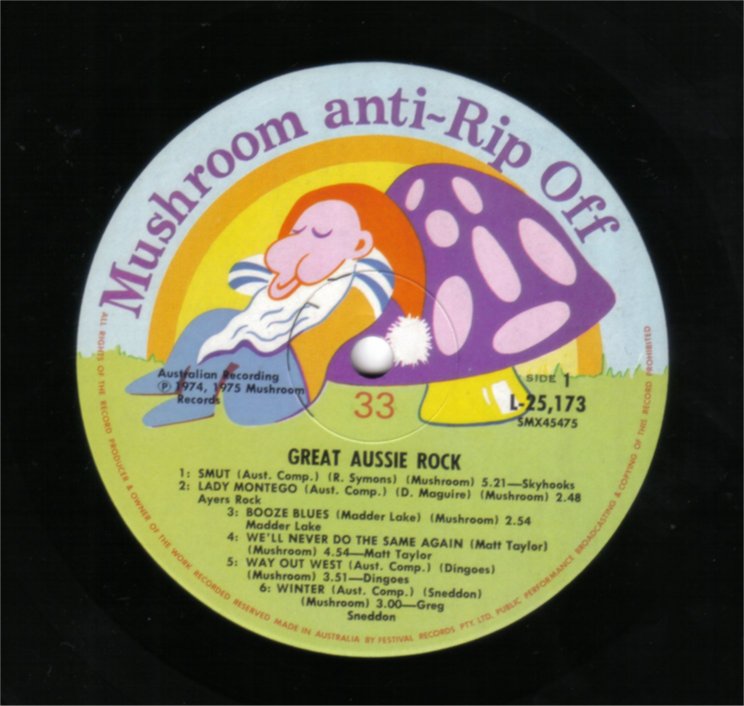
In addition to the releases on their standard label, Mushroom records also released a limited number of 'compilation' albums on their 'budget priced' anti-Rip Off label. One of these releases was called 'Great Aussie Rock' which is featured in this post. All artists on this great compilation were signed to Gudinski's record company and in many respects were his showcase bands. Bands such as Skyhooks, Madder Lake, Chain and The Aztecs were all huge at the time and help to make this a very collectible item indeed.
.
Here is a brief run down of the bands on this compilation and the albums from which the tracks were taken:.
Skyhooks - Living In The 70's
Living in the 70's was the debut album released by Melbourne band Skyhooks in October 1974 on the Mushroom Records label. Initially charting in Melbourne only in 1974, by early 1975 the rest of the nation began to catch on. It spent 16 weeks at the top of the Australian album charts from late February 1975, and became the highest-selling album by an Australian act in Australia up until that time, with sales of 240,000. In October 2010, it was listed at No. 9 in the book '100 Best Australian Albums'. The album was produced by former Daddy Cool lead singer Ross Wilson.
Two singles were lifted from the album: "Living in the 70's"/"You're a Broken Gin Bottle, Baby" and "Horror Movie"/"Carlton (Lygon Street Limbo)", the latter spending 2 weeks at the top of the Australian singles chart in 1975. Six tracks from the album were banned on commercial radio in Australia, including the featured track 'Smut' on this compilation However, in defiance of this, the ABC's new youth station in Sydney, 2JJ, played the track "You Just Like Me 'Cos I'm Good in Bed" as their first ever song when they began broadcasting in January 1975.
.
Ayers Rock - Big Red Rock
Ayers Rock's debut album 'Big Red Rock' was taped live before an invited audience at Armstrong's Studios in Melbourne, over two nights in September 1974. The live-in-the-studio approach worked extremely well for Ayers Rock, and the album clearly demonstrated why their awesome live 'chops' had made them such a popular concert attraction. But it also was something of a necessity for the cash-strapped label -- they took the same approach with and another early signing, Mackenzie Theory. The Ayers Rock LP reportedly cost Mushroom a mere $5000 to record.
Big Red Rock was an early critical and commercial success for Mushroom, showcasing the band's considerable prowess and the material was a good balance between the more commercial song-based material of McGuire and Brown and the more adventurous instrumentals. The LP features three songs by McGuire, including their memorable second single, the Latin-flavoured "Lady Montego", a song that dated back to McGuire's stint in Friends; an earlier, slower version appears (in a live recording) on the Garrison: The Final Blow LP.
Big Red Rock also features two excellent pieces by Loughnan including an awesome power-jam "Crazy Boys", two songs by Chris Brown, and a dazzling cover of Joe Zawinul's "Boogie Woogie Waltz", originally recorded by Weather Report (who were at that time virtually unknown in Australia).

..Madder Lake - Butterfly Farm
Recorded in October 1973 at TCS studios Richmond Melbourne . Produced by John French and Madder Lake.This album takes on a different musical direction with the inclusion of " Andy Cowen" on keyboards.
The second LP, 'Butterfly Farm', was released in April 1974; it sold very well (giving the band their second gold album) and went to #18 in the album charts. Mushroom lifted two Singles from it: the first was Butterfly Farm / Back Seat Song (April '74). Radio in Melbourne picked up one of the album tracks, "Booze Blues", and gave it a lot of airplay. Many fans thought it was the new single, so Mushroom rush-released it in May, but it was only a local hit in Melbourne and didn't chart nationally. The next single, It's All In Your Head / Slack Alice (November) was written specifically as with radio airplay in mind, but it didn't make the charts. A CD release of 'Butterfly Farm' is currently from Aztec Music
.
Matt Taylor - Straight As a Die
His debut solo album, 'Straight as a Die', was released at the end of 1973. The single "I Remember When I Was Young"/"Krishna Loves You, Too," which had been recorded in an open paddock at Kingston Park Farm, hit the Top Ten in Melbourne. Note that his single "I Remember When I Was Young" didn't actually appear on the vinyl release in 1973 (even though a longer version of "Krishna Loves You, Too" did), but was included on the CD release in 1997.
The album reached number 15 on the national charts and Taylor toured the country, performing at Sunbury 1974; the live track "We'll Never Do the Same Again" appeared on the various artists album 'Highlights of Sunbury '74 Part 2'.
. .
Dingoes - Selftitled
The Dingoes are one of the greatest bands Australia has ever produced.
The Dingoes were only relatively successful when they released their self-titled debut album in June 1974, one of the first signings to Michael Gudinski’s Mushroom Records label. The lead single ‘Way Out West’ made an impression as did the second single ‘Boy On The Run’ released to coincide with the release of the album, but they weren’t runaway hits – and yet, you will know both those songs, as all through the years that have passed since they’ve never been far away from radio playlists. That in itself is a not sign of greatness but certainly of longevity.
.

Greg Sneddon - Mind Stroll
Decent biographical information on Greg Sneddon is hard to come by; suffice to say that he's still performing today, thirty years after the release of what I presume was his debut album, 'Mind Stroll'. A keyboard player of some repute, Sneddon used a handful of other musicians on the album (not least a singer), playing multi-keys himself, although I'm afraid to say the end result's a little anodyne; the composition has its moments, but overall has far too much of a 'soft-rock' vibe about it. Full-on symph this is not. The two longer compositions, the title track and Madman are probably the best, but there's something lacking in this album; it doesn't even touch Aussie prog masters such as Sebastian Hardie or Aleph.
Ignore online references such as 'lots of Mellotron' with regard to this record; only two tracks I can hear, with polyphonic flutes on Winter and orchestrally-inclined strings on Take It Slow And Easy, which doth not a 'Tron album make.
.
Coloured Balls - First Supper Last
Australia's Coloured Balls are the sort of thing legends are made of. In their homeland, that's exactly how they're revered, though their impact in the states and other parts of the world has gone virtually unheard. Headed by guitar hero Lobby Loyde, Coloured Balls pioneered a raucous, abrasive and loose sound that at one point became the mantra of skinheads in their native country.
'First Supper Last' is a stonkingly rocking album that was actually recorded in 1972, making it their first album, but was not released until 1976 after the band split in 1974.
'First Supper Last' is the sound of a band finding its sound. Though it is essentially a blues workout on most of the material here, the sound is punishing and energetic. It's evident from the start how this band earned its reputation. The album is padded with numerous cover tunes, but the original material is what really demands your attention. Loyde's guitar work is abrasive, chaotic and teetering on the verge of destruction...everything a charged rock and roll album should be.
.
Buster Brown - Something To Say
Buster Brown was a short-lived, but highly influential Melbourne band from the early Seventies, who are remembered as the breeding ground for some of Australia ’s most famous musicians (AC/DC drummer Phil Rudd & Rose Tattoo vocalist Angry Anderson being the most notable).
Lack of industry infrastructure and media outlets plus sheer bad timing were factors - newly signed and fellow mushroom label-mates Skyhooks eclipsed Buster Brown just as they were gathering momentum. Angry Anderson on vocals and Phil Rudd on drums were the backbone of a rock outfit who were a force to be reckoned with on the live circuit.
Title track/theme song Buster Brown showcases the roots of Australian heavy blues-rock and Angry's penchant for writing lyrics that address growing up tough on the wrong side of an Australian suburb; Young Spunk and Apprentice do the same, echoing a time when panel vans had murals and kids from private schools would never dream of having tattoos. A CD release of 'Something To Say' is currently available from Aztec Music
.
Chain - The (Very) Best Of
Chain were an Australian blues band formed in Melbourne as The Chain in late 1968 with a lineup including guitarist, vocalist Phil Manning; they are sometimes known as Matt Taylor's Chain after lead singer-songwriter and harmonica player, Matt Taylor. Their January 1971 single "Black and Blue", which became their only top twenty hit, was recorded by Chain line-up of Manning, Taylor, drummer Barry Harvey and bass guitarist Barry Sullivan. The related album, Toward the Blues followed in September and peaked in the top ten albums chart.
Chain had various line-ups until July 1974, they separated for several years then reformed in 1982 for a one-off concert and more permanently from 1983–1986. Further line-up changes occurred with some forms called Matt Taylor's Chain, from 1998 Chain members are Harvey, Manning, Taylor and Dirk Du Bois on bass guitar. Both Manning and Taylor have also had separate solo careers.
In 1973, Mighty Mouse would evolve into yet another Chain -- by now the 15th permutation of the band!. Signing to Mushroom, this line-up issued two singles, the medium-tempo "I Thought You Weren't My Friend" (August) and the gruff shuffle-blues "I'm Gonna Miss You Babe" (November). Neither was particularly successful, but the reconstituted group did impress on the touring circuit, appearing in March at yet another large outdoor gathering, the Down Under Rock Festival in Melbourne (again, all the usual suspects were on a bill that featured – surprise – headliners The Aztecs). During May, Chain toured the country as support to the Muddy Waters Band and soon after teamed with that band's James "Peewee" Madison (guitar, vocals) and George "Mojo" Beauford (vocals, harmonica) for recordings that would form part of Chain's next LP, Two Of A Kind.
Sadly, the single "I'm Gonna Miss You Babe" was never released on a studio album, although it did appear on later compilations 'The History Of Chain (1974)' and 'The (Very) Best Of Chain (1978)'
.
Sid Rumpo - First Offence
Sid Rumpo was a fairly polished pub-rock band which formed in Perth in 1971 and unfortunately disappeared into the mists of time in 1974. 'First Offence' - Sid Rumpo's one and only LP as it turned out - features the twin guitar riffing of Elliot and Rob Searls on some very catchy boogie and blues-rock songs.
All the songs pump along with the assistance of some tasty electric piano chops from Ken Wallace over the tight grooves laid down by Noel Herridge on drums and Owen Hughes on bass.
But for me, it's Rob Searls' bluesy vocals that stamp 'First Offence' with it's appealing, distinctive 70's, Aussie Rock sound.
"The Riddle"/"Jump Down, Step Aside" was their only single with the A-Side only appearing on their album.
.
Phil Manning - I Wish There Was A Way
One of Australia's best known guitarists, Phil has a single handedly turned more Australians onto the Blues than any other performer.
Chain guitarist and sometimes vocalist "I Wish There Was A Way" was Phil Manning's first solo album. In this case, Phil has pulled out his acoustic guitar and presented a set of predominantly well-structured soulful ballads - in most parts far removed from the sometimes meandering blues of Chain. Phil is one of the great Aussie guitarists and his playing on this sets a pretty high standard. The superb title track opens the album and fairly well sets the scene for what is to come. Renee Geyer also features on vocals. [extract from Midoztouch]
.

Aztecs - Sunbury 73
Thorpie and the Aztecs' Mk V legendary performance at the inaugural Sunbury Pop Festival in January 1972 spawned the Top 5 hit album Aztecs Live! At Sunbury. The album peaked at #3 on the national chart during September, sold over 80000 copies and remains a milestone in the annals of Australian heavy rock. The crunching 'Mamma' also appeared on the Various Artists live album Sunbury, issued by EMI. Just after Sunbury, alongside La De Das and Friends, The Aztecs were responsible for drawing one of the largest crowds ever assembled in Australia at Melbourne's Myer Music Bowl (estimated at over 200000 people).
Thorpie was back in Australia in time to headline at Sunbury 1973. The live track, 'Going Back Home', appeared on Mushroom's triple album set 'The Great Australian Rock Festival Sunbury 1973' (April 1973). The version included here is an edited rendition of the 13min original, with the track fading out after 6 mins.
.
The rip included here was taken from CD at 320kps and includes full album artwork for both LP and CD (thanks to Woodynet for the CD artwork). I have also included scans of the LP labels which depict Mushroom's infamous anti-rip off label.
This is certainly one of my favourite compilation records and a prize possession amongst by Aussie record collection.
.
Track Listing
01 - Smut (Skyhooks)

02 - Lady Montego (Ayers Rock)

03 - Booze Blues (Madder Lake)
04 - Well Never Do The Same Again (Matt Taylor)

05 - Way Out West (Dingoes)
06 - Winter (Greg Sneddon)

07 - Johnny B Goode (Coloured Balls)

08 - Something To Say (Buster Brown)

09 - I'm Gonna Miss You Babe (Chain)

10 - The Riddle (Sid Rumpo)

11 - Love Is The Mender (Phil Manning)
12 - Going Back Home - Live (Aztecs)

.
Great Aussie Rock Link (108Mb) New Link 11/01/2023
.