Showing posts with label Glenn Shorrock. Show all posts

Saturday, March 21, 2026

Little River Band - Little River Band (1975)

 (Australian 1975 - Present)

Little River Band (LRB) are a rock band originally formed in Melbourne, Australia, in March 1975. The band achieved commercial success in both Australia and the United States. They have sold more than 30 million records; six studio albums reached the top 10 on the Australian Kent Music Report albums chart including Diamantina Cocktail (April 1977) and First Under the Wire (July 1979), which both peaked at No. 2. Nine singles appeared in the top 20 on the related singles chart, with "Help Is on Its Way" (1977) as their only number-one hit. Ten singles reached the top 20 on the Billboard Hot 100 with "Reminiscing" their highest, peaking at No. 3. Only First Under the Wire appeared in the top 10 albums on the Billboard 200.

Early members were Beeb Birtles, Ric Formosa, Graeham Goble, Roger McLachlan, Derek Pellicci and Glenn Shorrock. Most of the group's 1970s and 1980s material was written by Goble and/or Shorrock, Birtles and David Briggs (who replaced Formosa).


Little River Band have received many music awards in Australia. In May 2001 the Australasian Performing Right Association (APRA), as part of its 75th anniversary celebrations, named "Cool Change", written by Shorrock, as one of the Top 30 Australian songs of all time. The 1976 line-up of Birtles, Briggs, Goble, Pellicci, Shorrock and George McArdle (who replaced McLachlan), were inducted into the Australian Recording Industry Association (ARIA) Hall of Fame at the 18th Annual ARIA Music Awards of 2004.

Original cover of their debut LP
Little River Band have undergone numerous personnel changes, with over 30 members since their formation. None of the musicians now performing as Little River Band are original members, nor did they contribute to the success the band had in the 1970s. In the 1980s, members included John Farnham, David Hirschfelder, Stephen Housden, Wayne Nelson and Steve Prestwich. Currently the line-up is Nelson with Rich Herring, Greg Hind, Chris Marion and Ryan Ricks. Two former members have died, Barry Sullivan in October 2003 (aged 57) and Steve Prestwich in January 2011 (aged 56).

An Australian sextet, Little River Band's debut album sounds as American as anything by the Eagles or the Doobie Brothers, and is driven by "It's a Long Way There" -- whose eight and a half minutes of crunchy electric guitars, luminous acoustic guitar, and smooth harmonizing is spread across a musically dramatic arc that is worth every second of its running time. This is an astonishingly strong debut album. There aren't any surprises, just seven more eminently enjoyable if slightly looser structured mainstream rock songs in the same vein, inventive where they had to be (like on the solos or the variations on the extended choruses), all more modestly proportioned than the hit and thoroughly enjoyable. 

Guitarist Graham Goble dominated the songwriting with the single and "I Know It," but drummer Glenn Sharrock contributed significantly with the delightfully exuberant "Emma" and the hauntingly beautiful movie-within-a-song "The Man in Black," and guitarist Beeb Birtles showed himself no slouch in the ballad department with "I'll Always Call Your Name," which overstays its welcome by about 30 seconds but is otherwise nice and catchy.

50+ years ago on March 20, 1975, Little River Band played their first ever gig together at Martini’s in Carlton, Victoria, Australia. The rest they say is history, and what an incredible and illustrious history it is. But exactly how did LRB come about, you might ask ?  Well, Jeff Apter (an Australian Author) has recently discussed this in his book entitled 'Up From Down Under - How Australian Music Changed the World'.  The following is an extract from this book:

Glenn Wheatley
The Greyhound pub in Earls Court, London, was dark, dingy and sparsely populated, a real dive. When Glenn Wheatley’s eyes adjusted to the dim light, he sensed there were more people on the small stage than inside the pub itself, or so it appeared as he peered through the smoke that seemed to hang in the air like a fog.

Wheatley (pictured left), until recently the bassist for Melbourne band the Masters Apprentices, recognised some of the musos up on stage: singer-songwriters Beeb Birtles and Graham Goble. Drummer Derek Pellicci, too. The band was called Mississippi, straight out of Adelaide, of all places. And from what Wheatley could observe, they were seemingly on the same path as so many Aussie bands in the UK at the time — the road to nowhere. It was 1974 and times were tough. 

Wheatley knew that empty feeling only too well. The Masters Apprentices had arrived in London in 1970, full of hope and fire, yet within a few years had crashed and burned, yet another Oz rock casualty. He’d recently shifted away from performing, learning the music industry ropes in LA and London, working for the Gem Toby Organisation. Wheatley was in a unique position; he understood how things operated on-stage and off; he identified with a musician's struggle but was also coming to grips with the intrigue and small print that was a key component of the music business. Over time, these qualities would prove incredibly helpful for Wheatley and the band he’d come to manage. And there was something about Mississippi that Wheatley liked: the songs were strong, the sound was good — and those harmonies. Wow. There was one song in particular, ‘A Long Way There’, that really had potential. But they could use a lead singer. No disputing that.

The single release of "It's A Long Way There" was an edited version (4:16)
while the album version is (8:43) which I prefer much more
Singer Glenn Shorrock was also in London in 1974, sniffing out a solo career in the wake of the demise of his band Axiom, who’d travelled to the UK from Adelaide only to dissolve when their drummer decided to quit. (Just two weeks earlier they'd finished recording an album with UK hitmaker Shel Talmy.)
Shorrock, for a time, had sung back-up vocals for Cliff Richard, Olivia Newton-John’s buddy. And Shorrock was a big fan of the songs Goble had written for Mississippi, especially the haunting ‘Kings of the World’, an Australian hit, and ‘Early Morning’. He liked their soulful pop grooves and deep harmonies.

Shorrock & Birtles
Shorrock was a vastly different person to Goble — he was a piss-taker, mouthy, whereas Goble was pedantic and detailorientated, with a keen interest in numerology and matters spiritual — but Shorrock sensed a kindred musical spirit and a fellow traveller. Shorrock once boasted, ‘I come from a long line of show-offs.’
As a kid, he’d mimed Elvis Presley’s ‘All Shook Up’ with a guitar made of cardboard and the rock’n’ roll bug bit him hard, much to the horror of his opera-loving father. When he handled a real guitar, it was a revelation. ‘It was like seeing the wheel for the first time, Shorrock said. He loved American rock’n’ roll, Elvis, Little Richard: the masters. There was an aggressive quality to Shorrock when he stood on stage and sang. As his future bandmate, guitarist David Briggs, came to learn: ‘To see him working, I saw a guy who knew how to project all the way to the back of the room. He was an incredibly charismatic performer.’

The shaggy-haired, bespectacled Goble, meanwhile, was a dead ringer for Bill Oddie from British comedy team the Goodies. Goble was quiet and thoughtful, introspective. He and Shorrock were worlds apart.

‘Glen and I saw things from very different perspectives, Goble admitted, perhaps understating the case. As for handsome Dutch-born Birtles, whose real name was the challenging Gerard Bertelkamp, he’d been a member of Oz pop-rockers Zoot. Rick Springfield was his bandmate and close buddy. Although a supercharged rendition of the Beatles’ ‘Eleanor Rigby’ had been a huge hit in Australia for the Zoot, they, too, fell apart in the early 1970s. It was a familiar pattern: Oz band breaks out at home and then breaks up after a failed offshore sojourn.
Better to burn out than fade away, or so it seemed. ‘I call those years,’ Beeb Birtles now says with a wry chuckle, ‘my apprenticeship years.’
Things had played out well for Springfield, however; his winsome folk ditty ‘Speak to the Sky’ was a US Top 10 in 1972, launching a meteoric (if occasionally bumpy) career Stateside.


Birtles, meanwhile, played to a succession of empty rooms in London. Birtles’ career, just like the Greyhound pub, had seen better days. Wheatley was only passing through London in 1974; he was about to slowly make his way back to Australia, travelling for a few months. But before he left he hastily set up a meeting with Goble and Birtles, who agreed that their band needed a lead singer, at the very least. Wheatley also reached out to Shorrock. It was pretty clear that Mississippi was about to run dry, Wheatley acknowledged, ‘But why don’t you guys try working together?’

Wheatley also identified that the USA was a better target for the new band. He’d seen way too many groups fall apart in the UK, including his own. ‘America, he told the trio. ‘That’s where you should be looking. Forget England.’ It was sage advice. By the time that Wheatley and the four musicians (including drummer Pellicci) reconnected back in Australia, their master plan was in place: America or bust. ‘It was all such chance,’ Birtles said of their union, ‘because Glenn Shorrock had had enough of getting nowhere in England and Glenn Wheatley was passing through London.’ 


It didn’t take long for Birtles, Goble, Pellicci and Shorrock to find common musical ground. They also bonded over poverty and ambition, especially ambition. Everyone, Wheatley included, had served their apprenticeship: it was time to put together a band with the requisite skills as players and writers to sell some records. A great commercial band with great commercial songs. And when their voices joined in harmony, well, it was pretty special. They also had a good stock of new songs ready to unveil. 

They didn’t have a new name — they were still using the Mississippi tag — but they had a sound that seemed tailor-made for the US market. ‘We were unified through the music we were writing and performing, said Birtles. ‘We were also friends in those early days because we started with nothing between us.’ Shorrock had a slightly different take on their roots. ‘I knew these were the best songs that I'd come in contact with and I was able to sing them very well with these guys. [But] these two guys and me, we weren't brothers. ‘This wasn’t a marriage born of love; it was a marriage of convenience. And a good marriage. I felt pretty confident, and my feet were on the ground still, and I was ready to give it another crack.’ 

It was duly decided: they'd break America in a bigger way than any other Australian band. And Wheatley would be their manager. But what to call the group? Mississippi was rooted in the past.

The current sign on the Geelong/Melbourne Highway, but
not the original one that
the band would have seen back in '75

The same dumb luck that connected the four musicians with Wheatley continued when they were back in Oz. The as-yetunnamed group were driving through rural Victoria, not too far from Geelong, when a road sign caught everyone's eye. It read: ‘Little River’.
‘That, someone said, ‘would make a great name for a song.’ ‘No, said another voice. ‘That's the perfect name for a band.’
It was simple, stark and absolutely perfect. They pulled over to the side of the road and made a pact: ‘We're now the Little River Band.’ 

[LRB discuss this historical moment in the following interview]


While still on the dole — seemingly another rite of passage for a struggling Aussie band with big dreams — they played their first gig under this new name at Melbourne's Martinis Hotel on 20th March 1975. By the end of April they'd already played 20 shows. They'd barely stop to take a breath for the next 10 years, playing  more than 1300 concerts and recording 10 albums, a hefty load that would break the toughest of bands. Yet LRB, as they came to be known, seemed to revel in the work, and truly demonstrated how Australian Music could change the world. [extract from "Up From Down Under - How Australian Music Changed the World" by Jeff Apter, 2013 p85-91]

This post consists of FLACs ripped from CD and includes full album artwork for both CD and Vinyl.
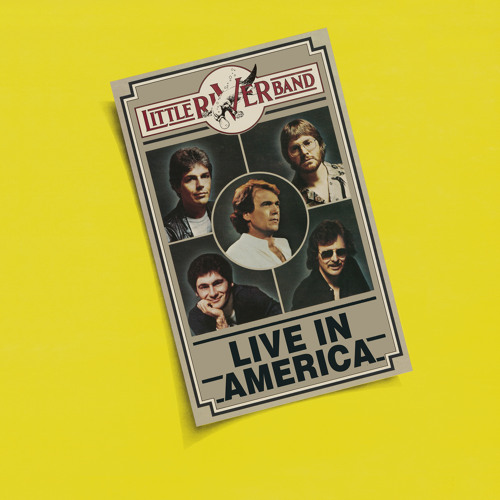
Although I own both vinyl releases, I much prefer the reissue cover (see top) rather than the cartoonish original cover which only appeared on vinyl, as it depicts a more serious band and probably better suited the American market anyhow.

Track List:    
01. It's A Long Way There 
02. Curiosity (Killed The Cat) 
03. Meanwhile... 
04. My Lady And Me 
05. I'll Always Call Your Name 
06. Emma
07. The Man In Black
08. Statue Of Liberty 
09. I Know It

Band Members:
Glenn Shorrock - Vocals 
Graeham Goble - Vocals/Guitar
Beeb Birtles - Vocals/Guitar
Derek Pellicci - Drums
Roger McLachlan - Bass
Ric Formosa - Guitar


Sunday, November 30, 2025

W.O.C.K On Vinyl: Andre L'Escargot And The Society Syncopators (feat. Glenn Shorrock) - Purple Umbrella [45] (1971) + Glenn Shorrock - Let's Get The Band Together [45] (1971) & Rock 'n' Roll Lullaby [45] (1972)

Before things get too serious here at Rock On Vinyl, I thought it might be fun to post a song / album at the end of each month, that could be categorized as being either Weird, Obscure, Crazy or just plain Korny.

Glenn Shorrock is an English-born Australian singer-songwriter. He was a founding member of pop groups 'The Twilights', 'Axiom' and 'Little River Band' as well as being a solo performer during various stages of his musical career.

Glenn started singing for the Australian band 'The Twilights' in 1964, eventually clocking up eight consecutive national hit singles including "Needle in a Haystack" and "What's Wrong With The Way I Live". After the Twilights, he helped form another Australian band with mate Brian Cadd called 'Axiom', which evetually released three top 10 hits:  "Arkansas Grass", "Little Ray of Sunshine" and "My Baby's Gone". 

Axiom toured both Australia and England over a 2 year period, but when Axiom decided to go back to Australia for the second time in 1971, Glenn decided to exit the band and said 'goodbye', choosing to remain in England. Like a lot of other people at the time, he was trying to find himself - his marriage had broken up and he was heavily into meditation, macrobiotic food and all that. He was looking for something to do and Carry Spry, who was in London with The Groove (Eureka Stockade), came to his aid. At that time he was hanging out with other Australians, like the Master's Apprentices, and that's when his relationship with Glenn Wheatley began. 

Carry managed to get Glenn a deal with the management record company MAM, which was owned by Gordon Mills, the manager of Tom Jones, Englebert Humperdinck and Gilbert O'Sullivan. He negotiated a good contract with MAM which paid a weekly wage rather than a big advance. Signed to MAM's publishing arm (which was to eventually prove rather profitable for them), Glenn recorded a considerable number of demos but released only three singles for MAM. Into the picture had stepped Twilights producer McKay, who was also based in London; and the Decca group Quartet, which comprised former Adelaide comrades Terry Britten (his old mate from The Twilight days), Kevin Peek, Alan Tarney and Trevor Spencer (all ex members of The James Taylor Move)

The first single cut by this collective under Glenn's name, "Let's Get The Band Together", stiffed (perhaps because he didn't have a live band together) but the second, Mann and Weil's lovely "Rock'n'Roll Lullaby", at least picked up reasonable airplay. Glenn described the flipside, "When God Plays His Guitar" as 'a pretty good indication of where his head was at around that time.'

Another Shorrock MAM single, the mock-French "Purple Umbrella", was recorded under the alias of Andre L'Escargot & His Society Syncopaters, with his Decca group Quartet backing band. The A-Side was written by Frisco & Head, while the B-Side "Petunia" was written by Shorrock. This single is not well known (probably due to the alias name used by Glenn's group) and has become very much a rarity for record collectors, along with his earlier solo releases.

So for this WOCK post, I am ending the drought on these rarities, and I'm providing all three for your enjoyment.  So, it's not rocket science which box this months WOCK post ticks - Obscure, but also just alittle Weird, based on the group alias he chose for his second single. All singles have been ripped to MP3 (320 kps) and artwork has been included where available.

Single 1971
Glenn Shorrock
01 - Let's Get The Band Together
02 - Contemporary Caveman

Single 1971 
Andre L'Escargot And The Society Syncopators (feat. Glenn Shorrock)
01 - Purple Umbrella
02 - Petunia

Single 1972
Glenn Shorrock
01 - Rock 'n' Roll Lullaby
02 - When God Plays His Guitar
 

Thursday, May 30, 2024

REPOST: W.O.C.K On Vinyl - 21 Years of Rock N Roll: A Tribute to 'Rock Around The Clock' (1977)

.
Before things get too serious here at Rock On Vinyl, I thought it might be fun to post a song / album at the end of each month, that could be categorized as being either Weird, Obscure, Crazy or just plain Korny.
.
"Rock Around the Clock" is a rock and roll song in the 12-bar blues format written by Max C. Freedman and James E. Myers (the latter under the pseudonym "Jimmy De Knight") in 1952. The best-known and most successful rendition was recorded by Bill Haley and His Comets in 1954. It was a number one single on both the US and UK charts and also re-entered the UK Singles Chart in the 1960s and 1970s.

It was not the first rock and roll record, nor was it the first successful record of the genre (Bill Haley had American chart success with "Crazy Man, Crazy" in 1953, and in 1954, "Shake, Rattle and Roll" reached No. 1 on the Billboard R&B chart). Haley's recording nevertheless became an anthem for rebellious Fifties youth and is widely considered to be the song that, more than any other, brought rock and roll into mainstream culture around the world. The song is ranked No. 158 on the Rolling Stone magazine's list of The 500 Greatest Songs of All Time. [extract from wikipedia]
.
21 years of Rock and Roll, "Rock around the Clock" was released in 1977 to celebrate the 21st anniversary of the release of Bill Haley's "Rock Around the Clock," 2SM and its sister radio stations, 3XY in Melbourne and 4IP in Brisbane, put out a re-make of the song with a host of stars doing the vocals including: Glenn Shorrock, Shirley Strachan, John Paul Young, Daryl Braithwaite, Renee Geyer and Frankie J Holden.
.
The rear sleeve states:
'The record that launched the Rock 'n' Roll era became a hit in Australia in July, 1956. It proved to be one of the most fantastic hits of all time with collective sales estimated at over 22 million. 'Rock around the Clock' has been waxed in thirty-five different languages with over 140 versions globally'.


2SM/3XY/4IP with the ANZ Bank commissioned the cream of Australian rock talent to record this limited edition tribute to 21 years of Rock 'n' Roll. Hope you enjoy it."
.
.
The artists appear by courtesy of:
Glenn Shorrock - E.M.I. Records
Graeme 'Shirley' Strachan & Frankie J. Holden - Mushroom Records
John Paul Young - Albert Productions
Daryl Braithwaite - Razzle Records
Renee Geyer - R.C.A. Records
.
This is a rather Obscure 7" Single as it was only released in Australia, in relatively small numbers and therefore it earns a place in this month's WOCK On Vinyl. Perhaps it should be renamed to:
"WOCK around the Clock" ! Ripped from vinyl in FLAC format and includes full artwork.
.
New Improved Rip

Track Listing
01 - Rock Around The Clock (Tribute)
02 - Spoken Word: History Of The Song Rock Around The Clock
.
Rock Around The Clock Link (33Mb)
.

Saturday, May 7, 2022

Little River Band - Live Backstage Pass (1979) and Live In America (1980)

(Australian 1975 - Present)

Little River Band (LRB) is an Australian rock band, formed in Melbourne in early 1975.
The band chose its name after passing a road sign leading to the Victorian township of Little River, near Geelong, on the way to a performance. Little River Band enjoyed sustained commercial success not only in Australia, but also in the United States. They have sold more than 25 million records and achieved 13 U.S. Top 40 hits, besides many music awards gained in Australia.

The band's original members were: lead vocals Glenn Shorrock, acoustic guitar and vocals Graham Goble, rhythm guitar and vocals Beeb Birtles, lead guitar Ric Formosa, bass guitar Roger McLachlan, and drums Derek Pellicci. Goble was the only original member born in Australia. The music and lyrics for most of the group's compositions were primarily written by Goble and Shorrock, with contributions from Birtles, Briggs and Pellicci.

Just before LRB began touring abroad in the 70's, lead guitarist Ric Formosa, apparently not enthusiastic about touring outside of Australia, left the group in August 1976 to pursue other musical interests and was replaced by David Briggs. At the same time, the group decided to replace bassist Roger McLachlan, who left to join Stars and was replaced by George McArdle. However, Formosa remained in touch with his former bandmates and conducted and wrote string parts for several songs after he officially left the band.

More concert performances in the U.S. followed and in 1977 "Help Is on Its Way" (an Australian #1 single) and "Happy Anniversary" were both mid-top 20 Hot 100 singles. From 1978 until 1981, Little River Band achieved one gold album (Diamantina Cocktail, released in 1977) and two platinum albums (Sleeper Catcher in 1978 and First Under the Wire in 1979) plus six US Top 10 singles with "Reminiscing" (#3, their biggest hit), "Lady" (#10), "Lonesome Loser" (#6), "Cool Change" (#10), "The Night Owls" (#6) and "Take It Easy on Me" (#10). During their career they have sold more than 25 million records and scored 13 American Top 40 hits.

From 1976 through 1985, the group maintained a constant touring schedule which kept it in the U.S. for long periods of time and may have contributed to much of the constant shuffling of personnel. For example: The band's schedule was so busy that when drummer Derek Pellicci was severely injured in a gas grill fire in May 1978, the band brought in a substitute drummer (Geoff Cox) rather than cancel shows. Drummer Cox remained with the group through the summer of 1978 and even played alongside Pellicci after he came back until he was healed enough to continue on his own. A keyboardist, Mal Logan, was added in time for another U.S. tour in late 1978.
After finishing a U.S. tour in January 1979, bassist McArdle left after one final appearance with the band at the Nambassa Music & Alternatives Festival in New Zealand on 29 January 1979. He went on to take up Bible study, eventually pursuing a path as a minister. Barry Sullivan took over on bass until American Wayne Nelson, currently the group's lead singer, joined in April 1980. [extract from radioswisspop.ch]


Live Backstage Pass - Album Review
(Juke Magazine 30th Nov, 1979)

If you're looking for sheer professionalism, superb stereo fidelity, as close to perfect harmonies and world-class performance on a live album, then this one is quite simply the best sound on a live album yet to be recorded in Australia. That doesn't mean the most exciting by any means. There is no rawness, exuberant energy or gutlevel feel (definitely low level sweating going on here), just slick, smooth showmanship.

No problem reproducing the studio sound (with a little help from Adelaide's Symphony Orchestra) on stage for LRB. In fact, apart from the applause that greets the opening bars of "It's A Long Way There" through the clapping responses to "Reminiscing" and "Help Is On Its Way", you wouldn't know the album was recorded live at all.


This says a lot for the combined talents of LRB, but it makes one wonder why they bother releasing a live LP all. There are no rearrangements, expansions of ideas in 'live' exceptional moments - though there are subtle changes in the orchestration and accents in the rhythm section (tight and tasteful). The orchestra - conducted by David Measham, who has worked with Rick Wakeman among others - is always understated, they're more for gloss apart from the grandiose intros to some of the big numbers. True to their current 'philosophy', most of the time LRB come across as a band rather than a production.

Shorrock's and Birtles' vocal work comes across superbly and McArdle's (absent from the cover) bass solo on "Light Of Day" is worth having. Briggs' guitar, of course, is technically proficient and masterful throughout, but it all tends to become monotonous, in style as well as tone, which makes the album sound a bit thin and toppy, compared to the studio cuts.

Four of the eight tracks are taken from the 'Sleeper Catcher' LP, which the Home Run tour, from which these live tracks were taken, was set up to promote, with three songs from the first LP and "Help Is On Its Way" from 'Diamantina Cocktail', all perfectly reproduced here.

On the positive side, the album showcases a truly world-class Australian band outclassing a lot of the OS competition. It will sell by the truckload and might recoup some of the loss they incurred in putting on such an ambitious and lavish tour here last year. (Review by Michael Smith)


LRB Home Soon From America
(Juke Magazine, 12th July, 1980)

The Little River Band will return to Australia on July 25 following its successful tour of America in support of the double, live album Backstage Pass which has so far sold 350,000 copies.
The band arrived in the USA on June 7 and undertook a heavy schedule of concerts in Detroit, St Louis, Witchita, Oklahoma and Tulsa, supporting Pure Praire League.


The band also played support to Foreigner and Checker Dome in St Louis and to Player at the Universal Amphitheatre in Los Angeles for three nights. Their last concert was on Sunday at the 13000 seater Memorial Colosseum in Portland.

Little River Band arrives in Japan this week for five shows between July 15 and 22.
Prior to arriving in the States, the band spent two weeks touring Europe and in Munich they played before 40,000 people as support to Fleetwood Mac.
The trip was followed by a show at the Rainbow Theatre in London, the same venue they performed at on an earlier visit and failed to impress either the press or public. The scene was somewhat different this time around. The latest issue of the English rock magazine Lam carries this review "LRB are taking London by storm.

A record walk-up crowd witnessed pure, unadulterated Little River Band. Gone were any of the show gimmicks one normally expects from pop concerts. Instead it was the smooth professionalism of the group and the overall quality of the sound that carried the night".
LRB's latest single in America, "It's Not A Wonder" went into the high 40's in the trade charts before dropping out. No single is expected to be released there for some time.
In Australia, the single "Red Shoes" from the live album has been slow to move.
Once home, the band will rehearse material for their next studio album and a national tour will be arranged (by Graham Simpson).

The two rips below were taken from my vinyl in FLAC format and the post also includes artwork for both vinyl and CD releases. I have also taken the liberty of including the CD artwork for the US release of Backstage Pass which includes both of these live albums as a double CD compilation (see left).

I have always thought that LRB have been one of the best bands to come out of Australia, but only up until the late 90's when Pellicci (the last member of the original band) left the band. All iterations of the band since have been imposters in my opinion and the opinion of many other Australians. So, enjoy this post from the 'real LRB' and don't accept anything less. Link below contains both LP's plus all artwork


LIVE Backstage Pass (1979)
Recorded at a concert given by the Australian Broadcasting Commission in The Adelaide Festival Theatre, 1978. (Concert dates were 7th, 8th, 9th November, 1978)

Track List
01 It's A Long Way There
02 So Many Paths
03 Statue Of Liberty
04 Fall From Paradise
05 Light Of Day
06 Reminiscing
07 Man In Black
08 Help Is On Its Way

LRB were:
Glenn Shorrock - Lead vocals
Beeb Birtles - Vocals and Guitar
David Briggs - Lead Guitar
Graham Goble - Vocals and Guitar
George McArdle - Bass
Derek Pellicci - Drums


Live In America (1980)
Recorded In The USA And Canada during their American Tour in 1979. Tracks taken from their October and November concerts

Track List
01 Hard Life 4:22
02 The Rumour 4:04
03 Mistress Of Mine 5:36
04 Too Lonely Too Long 3:04
05 Red Shoes 4:29
06 I Don't Worry No More 4:10
07 Let's Dance 3:31
08 Man On The Run 3:57
09 It's Not A Wonder 4:24
10 Sweet Old Fashioned Man 4:29


LRB Were:
Glenn Shorrock - Lead Vocals
Beeb Birtles - Vocals and Guitar
Graham Goble - Vocals and Guitar
David Briggs - Lead Guitar
Barry Sulliuvan - Bass
Derek Pellicvi - Drums
Mal Logan - Keyboards


Little River Band Live Link (514Mb)

Tuesday, February 25, 2020

Little River Band - Time Exposure [Radio Special] 1981

(Australian 1975 - Present)
.
The genesis of Little River Band's (LRB) formation can be traced back to London in late 1974, when former Twilights / Axiom lead singer Glenn Shorrock - about to return to Australia after five fairly fruitless years in England - received a call from former Zoot member Beeb Birtles, who was living in a house with the remnants of the Aussie soft-rock group Mississippi.

As Glenn remembers it, "he said they wanted to talk to me about starting a new group and I said, "no thanks, I've had enough, I need to get out of this business for a while". But they were very persuasive and had some great songs, so I jutted my jaw, gritted my teeth and agreed to get involved".

The Mississippi members floundering in London - Graeham Goble, Beeb Birtles and Derek Pelicci - had begun to formulate ambitious plans for world domination with Masters Apprentices bassist Glenn Wheatley, who was proving to be more interested in the business side of music.

L-R Beeb Birtles, Graeham Goble, Glenn Shorrock - 1980
Named after a signpost on the freeway from Melbourne to Geelong, Little River Band snared classically trained guitarist arranger Ric Formosa and bassist Roger McLachlan from the Australian Godspell cast. Their aim, as highly competent adult rock musicians, was to create textured, harmony dominant mass appeal sound and within an eight month period they had 3 top twenty singles,2 top ten albums and a collective eye set on the lucrative American market.
The band's vocal strength was matched by a great songwriting depth, with at least four significant song sources within the band at any one time. The two main writers - Graeham Goble and Glenn Shorrock - were masters of song craft.

L-R David Briggs, Derek Pellicci, Sir George Martin (Producer), Graeham Goble, Beeb Birtles, Glenn Shorrock
Photo taken at AIR Studios Montserrat in the Caribbean
Time Exposure
'Time Exposure' was the sixth studio album by LRB, which was recorded with producer George Martin at Associated Independent Recording (AIR) in Montserrat and released in August 1981. It peaked at No. 9 on the Australian Kent Music Report Albums Chart, while it stayed in the 3XY's charts for an impressive 18 weeks. In the United States, it reached No. 21 on the Billboard 200.

It was the group's last album with Glenn Shorrock on lead vocals until 1988. In the interim John Farnham took over as main lead vocalist, staying with the band for the next three studio albums 'The Net' (May 1983), 'Playing to Win' (January 1985) and 'No Reins' (May 1986). 'Time Exposure' was also the last album with lead guitarist, David Briggs, who left prior to its release. He was replaced on tour by Stephen Housden, who later joined the group. The album had other band members on lead vocals: Beeb Birtles on two tracks, "Ballerina" and "Guiding Light", and Wayne Nelson on the hit single, "The Night Owls" (1981). Two other singles, "Take It Easy on Me" and "Man on Your Mind", were also top 20 hits in the US for the band.

The album opens with the Wayne Nelson sung Night Owls (peaked #6 in 1981) and follows with two more hit singles-- Man On Your Mind (peaked #14 in 1982), and Take It Easy On Me (peaked #10 in 1981). And while none of the other songs on the album were released as singles, many of them including "Full Circle" and "Just Say That You Love Me" could have easily been released as singles. In addition to Shorrock's lead vocals the vocal tandem of David Briggs, Beeb Birtles, and Graeham Goble provide harmonies so tight they sing as one. While the Eagles were likely better musicians, I'd argue that Little River Band's vocal harmonies were superior to those of the Eagles. There was a tightness, a cohesiveness that was pure vocal magic.

3XY Music Survey - Jan 20th 1981
What likely prevented this album from matching the success of the 2 previous LRB albums (1978's 'Sleeper Catcher' and 1979's 'First Under the Wire' both went platinum) was the disparity between the stronger and weaker songs on this album. While the strong material is as good as their best tracks on their previous albums, their weaker material on 'Time Exposure' feels uninspired and some might argue "phoned in."


In 1996, a CD re-issue featured the John Farnham sung "The Other Guy" (peaked #11 in 1982) as a bonus track. An enjoyable yet curious inclusion considering that song was recorded after Time Exposure was released.
.
This post consists of FLACS ripped from a special vinyl release (pressed for radio station use only).  Each track has an introduction by Glenn Shorrock discussing the origin of the track and lyric derivations. It came in the standard album cover with a "Radio Special" label stuck on the front.
Thanks to Sunshine for this excellent rip - cheers mate. This album is certainly a rarity and worth its weight in gold, especially to all LRB fans. Enjoy listening to the 'Real LRB' - unlike the impostors who currently tour under the LRB name.
.
Track List
1-01 Album Promo Spot _ Introduction
1-02 The Night Owls - Intro
1-03 The Night Owls
1-04 Man On Your Mind - Intro
1-05 Man On Your Mind
1-06 Take It Easy On Me - Intro
1-07 Take It Easy On Me
1-08 Ballerina - Intro
1-09 Ballerina
1-10 Love Will Survive - Intro
1-11 Love Will Survive
1-12 Album Promo
1-13 Full Circle - Introduction
1-14 Full Circle
1-15 Just Say That You Love Me
1-16 Suicide Boulevard - Introduction

1-17 Suicide Boulevard
1-18 Orbit Zero
1-19 Don't Let The Needle Win - Introduction
1-20 Don't Let The Needle Win
1-21 Guiding Light - Intro; Guiding Light
.
Credits
Vocals – Glenn Shorrock
Bass, Vocals – Wayne Nelson
Drums, Percussion – Derek Pellicci
Guitar [Lead, Acoustic] – David Briggs (3)
Guitar, Vocals – Beeb Birtles, Graeham Goble
Piano [Acoustic, Electric], Organ [Hammond] – Peter Jones (6)
Synthesizer [Prophet], Clavinet, Organ [Hammond] – Bill Cuomo
Producer – George Martin
.
LRB Time Exposure FLAC Link (431Mb) New Link 24/12/2023
.

Sunday, October 4, 2015

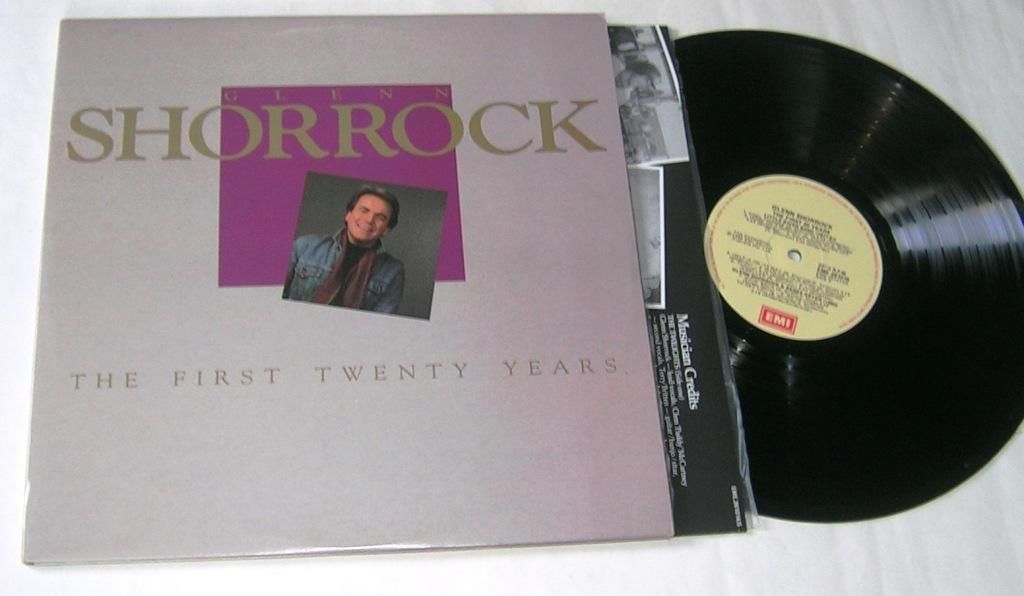
Glenn Shorrock - The First 20 Years (1985)

(Australian 1962 - Present)
.
Glenn Shorrock has been in colours most of his life. Drafted as an adolescent, he re-enlisted so many times that he became a career soldier, a lifer before he realised it. He served with valor in Australian English European and American campaigns. His name has passed into legend, synonymous with unstinting dedication and stirring achievement. As he enters his third decade of performing and recording, this battle scarred veteran observes that "Circles close up ten years or more after they begin". Early influences become recent influences. Old incidents become new songs.   Glenn has traversed a series of circuitous routes during the past twenty years and, although he has worked and recorded all over the planet, there is a familiar thread of honesty and excellence to all he has done.

This anthology is a powerful testament, not just to Glenn's fine talent, but to his own belief in that talent His tenacity, which sent him knocking on international doors many times before they were opened to him was shared by only a few other Australian rock principals of the sixties — Terry Britten, Barry Gibb Steve Kipner and George Young among them.

Born in Rochester Kent in 1944, Glenn arrived in Australia with his family a decade later as an assisted-passage immigrant. Blessed with the legacy of good humour from his Yorkshire father and Londoner mother he saw the sea journey to the far southern land as "a hell of an adventure". As he recalls clearly, "We saw a future in Australia but not in England, where post-war rationing was still in force. Australia was like a colour movie not a bit like grey old England."
"We were booked through to Melbourne but after Perth they said they were short on their Adelaide quota and wanted volunteers. So dad said, What the hell, let's go to Adelaide. The first sight of the city was horrific it was like Changi Prison. The seaport was a long tin shed set in a mangrove swamp. Mother cried for nine months straight; I went to sleep with her crying and woke up to her crying. But dad dug his heels in and got a job at the Weapons Research Establishment in Salisbury and found us a house there."

Glenn's mother took her son and daughter back to England for nine months, then decided to return and give it another chance. In time, the family prospered and moved to the Adelaide suburb of Elizabeth populated heavily by British immigrants. Glenn, by this stage, was obsessed by rock'n'roll. Back in England he had listened to Frankie Laine and Johnnie Ray records on his Aunty's radiogram but his trembling conversion came at the Elder Park Migrant Hostel (on the site of the present Festival Theatre). "I was laying on my bunk It was a hot day and I had nothing to do, so I was just listening to the sound of somebody else's radio Heartbreak Hotel came on and I almost fell off my bunk. Nothing had ever sounded like that before."

The Checkmates
Glenn's first job was as a junior draftsman at the Mines Department. A workmate was a member of a local hot-shot vocal quartet and when a member quit, Glenn was invited to audition. He was accepted and was in the process of having his stage clothes made when the member decided to come back. Undaunted Glenn decided that he was good enough to be accepted by the Four Tones, he was good enough to lead his own vocal group "I had some friends and we'd sing in the car, drive-in or wherever. There was Mike Sykes, Cklem 'Paddy' McCartney and bass singer Billy Volraat. We worked engagement parties as The Checkmates and then, when Billy left became The Twilights. We worked a-cappella a lot. We couldn't do rock'n'roll because we didn't have a backing band, but if we were at a party where there was a band we'd always get up and sing.

"Then the Beatles broke and everything went crazy. Some friends had a band called the Vector-Men, which included Alan Tarney, and we worked with them for a while. Then we started singing with The Hurricanes which was Kevin Peek, Peter Bridecake, John Bywaters, Frank Barnard and lead vocalist John Perry, who went to the Vibrants and is now Kerry Packer's chauffeur. Perry got edged out, we dropped Mike Sykes, and all became The Twilights. Kevin Peek left to join Alan Tarney in Johnny Broome & The Handels and we got his number one admirer, Terry Britten, in to replace him. Before very much longer we were resident at the Oxford Club, there were lines around the block, and Carry Spry flew over from Melbourne to ask if he could manage us. There were a lot of bands in Adelaide then and the rivalry and jealousy was pretty fierce. All of them seemed to have at least a couple of British members, to make them authentic. This was a way for us to get back at those who saw us as 'dirty poms'; it was a chance to feel better about ourselves."

Twilights - 1964 Lineup
The Twilights existed from 1964 to 1969, recorded 13 singles and 2 albums, scored 8 consecutive hits (some double-sided), won the 1966 Hoadley's National Battle of the Sounds, recorded and performed in England, and set new standards for live performance in Australia. The Twilights live were an awesome spectacle, capable of creating note-perfect renditions of any song by the Beatles, Stones, Move, Who et al. They were Australia's international music barometer. Absolutely and irrevocably in, they anticipated and introduced audiences to each new phase of rock music and culture. In time, they outgrew their own market and joined the lemmings' rush to London in September 1966. They fared no better than Normie Rowe, Johnny Young, MPD Ltd., Groove or The La De Das but did get to record with Rubber Soul engineer Norman 'Hurricane' Smith and perform at Liverpool's Cavern.

Twilights- 1969 (Glenn far right)
The Twilights came back from London replete with new influences, droopy moustaches, sitars, trendy beards and Carnaby Street clobber. They took to playing 15 minute versions of Hendrix' Purple Haze (during which Glenn would climb into a gorilla suit and chase faint-hearted ladies through the audience) and cutting increasingly complex singles which enjoyed progressively less radio support. When Laurie Pryor refused to have another crack at England in December 1968 and decided to take his leave instead, The Twilights suddenly ceased to exist.
"The breakup of the Twilights was not something that we planned. It all happened in three days" Glenn reveals. "I didn't know what to do with myself, so Carry Spry gave me a job as a band booker in the AMBO agency. That's how I met the Brisbane Avengers, who wanted me to manage them. I gave it a shot for about three months; got Terry to write them some songs and pushed all the work I could their way. But it never felt right. I'd rehearse with them, take them to gigs, get them on the stage and then have to stop there. I never did have the chance to prove if I was a good manager or not, because after about three months, I ran into Brian Cadd at a party."

Axiom
Cadd, leader of the defunct Groop, had written songs for the Master's Apprentices, The Zoot and Paul Jones, and was keen to develop an outlet for his collaborations with Don Mudie. The three enlisted Cam-Pact guitarist Chris Stockley and Valentines drummer Doug Lavery and were, not surprisingly, labelled as a 'Supergroup' in the same manner as The Groove (Spry's post-Twilights hit act). With an old roadie mate (the late) Wayne DeGruchy, Axiom hid out at Don's mother's place in Nathalia for a couple of weeks and furiously emulated The Band and Traffic by rehearsing at the local football club in rural isolation.
Axiom's success was almost a forgone conclusion. Manager DeGruchy had no difficulty finding them work; they were immediately offered a recording contract and found instant radio acceptance for a Christmas 1969 single, the unashamedly American Arkansas Grass. Fool's Gold, the first album, was the soundtrack to a 20 minute film starring Happening '70 personality Tony Healey and dealing with the release of an elderly man from prison. It was also the first truly important and accomplished Australian rock album, offering an honest antipodean sound (Glenn played some didgeridoo) without descending to kangaroo and cork hat kitsch. A second single, A Little Ray of Sunshine, was, in Glenn's own words, "pure schmaltz". But the poorly recorded track possessed a certain magic which propelled it into both the national top five and innumerable sentimental hearts.

Recording the beautiful Fool's Gold album was "unadulterated joy" for Glenn, as the superb title track and Ford's Bridge attest. But the euphoria was short-lived. In April 1970, Axiom arrived in a creatively exhausted England, still spending the money flowing in from the British Invasion but offering little more to the world than burned-out hippies and heavy metal hammerheads. There were advances to be had and Axiom landed one large enough to keep them alive for a year, along with a three year Warner Bros recording contract. Handed to ill producer, Shel Talmy, of Kinks, Who and Easybeats fame (who by that stage was suffering from failing eyesight and hearing) cut a second album under engineer Glyn Johns. The title, If Only . . . , said it all. The harsh, uncomfortable album yielded up one minor hit in My Baby's Gone and is not remembered fondly by any of the participants or purchasers.

"My confidence was pretty low" says Glenn. "When the band decided to go back to Australia for the second time, I said 'goodbye, I'm staying here'. Like a lot of other people at the time, I was trying to find myself - my marriage had broken up and I was heavily into meditation, macrobiotic food and all that. I was looking for something to do and Carry Spry, who was over there with The Groove (Eureka Stockade), came to my aid again. At that time I was hanging out with other Australians, like the Master's Apprentices, and that's when my relationship with Glenn Wheatley began. Carry managed to get me a deal with the management  record company MAM, which was owned by Gordon Mills, the manager of Tom Jones, Englebert Humperdinck and Gilbert O'Sullivan. I negotiated a good contract which paid me a weekly wage rather than a big advance. Signed to MAM's publishing arm (which was to eventually prove rather profitable for them), Glenn recorded a considerable number of demos but only three singles. Into the picture had stepped Twilights producer McKay, who was also based in London; and the Decca group Quartet, which comprised former Adelaide comrades Terry Britten, Kevin Peek (now leader of Sky), Alan Tarney and Trevor Spencer.

The first single cut by this collective under Glenn's name, "Let's Get The Band Together", stiffed (perhaps because he didn't have a live band together) but the second, Mann and Weil's lovely "Rock'n'Roll Lullaby", at least picked up reasonable airplay. Glenn describes the flip, When God Plays His Guitar, as "a pretty good indication of where my head was at around that time." Another Shorrock MAM single, the mock-French "Purple Umbrella", was recorded under the alias of Andre L'Escargot & His Society Syncopaters.

The most important event in Glenn's career at this point was his move, at the very end of the Axiom days, into serious songwriting. It stands as extraordinary that a number of his very first compositions are today considered as among his best. Writing gave a new dimension to the accomplished singer, enabling him to achieve the sort of soulful, heartfelt expression which would reach its zenith with "Cool Change" and "Home On A Monday".
"Statue Of Liberty was inspired by the closing scenes of the film Planet Of The Apes. I wrote it at a time when America was looking decidedly shaky and in danger of real anarchy. Kent State seemed like just a beginning. I had this vision of the Statue of Liberty crumbling." The song, recorded only as a demo for MAM, found release (for the first time) in 1973, via another David McKay project.


"David told me he had a new project that he wanted me to front — classical rock band that would be much more avant-garde than ELO. He played me some tapes and it was really left-of-field stuff. But it was a challenge and A&M was right behind it, so I went in boots and all. "Esperanto was billed as 'the world s first international rock orchestra'. An unwieldy 12 piece outfit, it boasted members from Italy, Belgium, Australia, New Zealand, England and Hawaii. The antipodean contingent was Glenn, Janice Slater, Brian Holloway (from Somebody's Image) and Maori singer Joy Yates. Glenn sang and co-wrote two songs with Belgian leader Raymond Vincent and contributed his own Statue Of Liberty. Unfortunately, despite all the hype, the public just didn't buy Esperanto, and by the second album, Glenn was credited only with 'lyrics, backing vocals and ideas'; by the third he was gone completely. "They made me manager for a while because they wanted to go completely avant-garde and then instrumental. But it was a complete mess, half the band lived in London and half in Brussels and I couldn't even get them together for a meeting.

Esperanto  (Glenn 2nd left)
So that last year in England I was really depressed. My hair was falling out and I decided to quit. I was still getting my weekly wage from MAM and Terry Britten got me some vocal sessions and a couple of months live work with Cliff Richard. I made good money working at the London Palladium with Cliff, eight shows a week. After the first night they came to me and said 'you were great Glenn, in fact you were too good, cool it'. I was making an amazing (for me) £100 a week for that, so I decided to stash it away and buy a ticket back to Australia.

Glenn & Graham Goble
"I booked a seat for October, 1974. 1 had no idea what I was going to do here. I though I'd get involved in agency or management work. I didn't know what my musical credibility would be after five years away. About a month before I left England, I got a call from Beeb Birtles, who was living in a house in London with the remnants of Mississippi, who I'd never head of. He said they wanted to talk to me about starting a new group and I said, 'no thanks, I've had enough, I need to get out of this business for a while'. But they were very persuasive and they had some great songs, so I jutted my jaw, gritted my teeth and said I'd get involved, if they'd give me a couple of months to go home and be with my family. We all agreed to meet in Melbourne early in 1975."
Mississippi had grown out of Graham Coble's Adelaide soft-rock group Allison Gros (who had scored the 1971 hit Daddy Cool as Drummond). Floundering in England, members Goble, Birtles and Derek Pellici had begun to formulate ambitious plans for world musical domination with Master's Apprentices bassist Glenn Wheatley, who was proving to be more interested in the business side of music. They saw Shorrock as a proven and respected singer. What they were not to know was that he had a head full of completed songs, such as Seine City, Emma and Statue Of Liberty, all of which would be cut by Little River Band in their first year of recording.

Named after a signpost on the road from Melbourne to Geelong, Little River Band snared classically-trained guitarist arranger Rick Formosa and bassist Roger McLachlan from the Australian Godspell cast. Their aim, as highly competent adult rock musicians, was to create a textured, harmony-dominant, mass-appeal sound. Within an eight month period, LRB had 3 top twenty singles, 2 top ten albums, and a collective eye firmly set upon the lucrative American market. This assault, Glenn's third, had all the pieces in the right places. In November 1976, an edited version of "It's A Long Way There" made its way into the American top thirty and Dutch top ten. The following year, Glenn's powerful "Help Is On Its Way" broke worldwide, made the U.S. top twenty and cracked AM playlists. The third album, Diamantina Cocktail, sold over half a million units stateside, earning LRB their first gold disc, the first to be awarded to an Australian-based entity.

American hits flowed regularly and by 1982, Billboard had given LRB the honour, along with Olivia Newton John, of being the only act to score an American top ten hit every year consecutively for the previous five years. This was in addition to a string of gold and platinum albums. American acceptance of the sophisticated LRB sound was immediate; surprising Glenn, who admits, "International success may have been the stated aim of Wheatley, Goble and Birtles but Glenn Shorrock went along for the ride. I'd been disappointed too many times ... I'm always suspicious of happiness. But the first American performance was definitely an eye opener. We supported the Average White Band in the college town of Harrisburg, Virginia and the crowd went nuts. They gave us two encores. That was amazing, but none of us then realised the enormity of the market."

In February 1982, Glenn took his leave from Little River Band and was replaced by fellow English-born Adelaide singer John Farnharn. His departure was something less than a surprise for those who had observed the band during his seven year tenure. For Glenn it was, in many ways, a blessed release. "I had a strong feeling that it was not going to be peaches and cream from my first rehearsal in 1975. After two weeks we knew just three songs — we knew them bloody well but we still only knew three. I thought we should have known 23, so we could be out there working, honing our technique live. Graham and Beeb worked obsessively on points of detail, they wanted to dismember everything and put it back together, piece by piece. That frustrated me, I wanted to move, move, move. It led to a bit of a blue in rehearsal and they said, 'Glenn, back off, this is our baby and this is how we're gonna do the thing'. I backed off and I seemed to keep backing off all the way through. Graham always worked harder at getting his songs recorded than I did and I don't think I exerted as much influence on the band as I should have. I left it to fate, because that's the way I am. But then it got to the stage where I had to fight to get Cool Change on an album."

Glenn had enjoyed moderate success in 1979 with a solo rendition of Bobby Darin's "Dream Lover"; and the 1981 LRB single, "Long Jumping Jeweller" (never released outside of Australia) was very much a Shorrock initiated and promoted project. So the move from LRB frontman to individual entity was a relatively effortless one. Glenn enthusiastically embarked upon a number ol projects, starting with a superb solo album Villain Of The Peace; recorded in Los Angeles under LRB producer and close friend John Boylan, and featuring contributions from three members of the Eagles, Bill Payne (Little Feat), Jeff Baxter (Steely Dan/The Doobies), Garth Hudson (The Band), Jimmy Fadden (Dirt Band), Andrew Gold and Tom Scott. The American release featured three newly recorded songs, one of which (Don't Girls Get Lonely?) is included herein. From those sessions, "The Duchess Is Returning" emerged as a single B side and "Big Smoke" was, until now, unreleased.

To support the album's release in Australia, Glenn undertook a short tour with his own hot road band. He also joined Renee Geyer on stage at Sydney's Tivoli in December 1982 for a soaring rendition of the Coffin/ King masterpiece "Goin' Back", which achieved some chart success when released as a single. Having previously supplied a title song to the television documentary Australian Music To The World, Glenn was approached to provide themes for the films We're Coming To Get You and World Safari II, both of which are featured on this album; along with a lovely treatment of Paperback Writer (cut at the Dream Lover session) and the very first (unreleased) Little River Band recording, the Everly Brothers' "When Will I Be Loved" (featuring guitarist-for-a-day Graham Davidge).

Glenn 1980's
Three years of work under his own auspices may not have brought Glenn as much commercial success as he enjoyed with LRB, but his personal satisfaction is considerably greater. "When I made my own album" he confides, "there was just two of us making decisions, instead of six or eight. Instead of compromise, I now have the freedom to feel my way around. I've always thought of myself as a very versatile singer and now I have the chance to prove it."

Listening to Glenn's major contributions to Little River Band, it is appropriate to view him as the soul of the outfit, the true artist within its ranks. His voice then, as now, can be a plaintive cry or a surging energy charge - always imbued with integrity and an earthy passion. Asked to summarise his own career, he thoughtfully offers, "I think I've done things fairly quietly, never made a big noise. I may have lost a few career chances as a result but I can say that I don t have any major hang-ups and I don't lose sleep over my frustrations. I still have a fairly happy disposition."  [Linear notes by Glenn A. Baker]
.
This post consists of FLACs ripped from my mint condition double vinyl set, released by J&B Records. Full album artwork for LP and CD are included along with label scans. As an added bonus, I have chosen to include a super rare single that Glenn released back in 1975 on Playboy records "Daydream Sunday" / " I Have Seen the Universe" which was only released in the states from what I can gather (thanks to Garethofox at Midoztouch for this rarity).
This is a brilliant anthology of Glenn's musical achievements between 1965 and 1985 and is a must for any serious collector of Aussie Rock.
.

Track Listing
LP1
01 Needle In A Haystack (Twilights)
02 Bad  Boy (Twilights)
03 If She Finds Out (Twilights)
04 9-50 (Twilights)
05 Young Girl (Twilights)
06 What's Wrong With The Way I Live (Twilights)
07 Cathy Come Home (Twilights)
08 My Generation (Twilights)
09 Ford's Bridge (Axiom)
10 Fool's Gold (Axiom)
11 Arkansas Grass (Axiom)
12 A Little Ray Of Sunshine (Axiom)
13 My Baby's Gone (Axiom)
14 Rock 'n' Roll Lullaby (Solo)
15 Let's Get The Band Together (Solo)

16 Statue Of Liberty (Solo)
17 Seine City (Little River Band)
18 When Will I Be Loved (Little River Band)
LP2
01 Cool Change (Little River Band)
02 Home On A Monday (Little River Band)
03 Shut Down, Turn Off (Little River Band)
04 Help Is On Its Way (Little River Band)
05 Man On Your Mind (Little River Band)
06 Long Jumping Jeweller (Little River Band)
07 Goin' Back (with Renee Geyer)
08 We're Coming To Get You (with The Bushwackers)
09 Paperback Writer (Solo)
10 Dream Lover (Solo)
11 Restless (Solo)
12 Don't Let Girls Get Lonely (Solo)
13 Big Smoke (Solo)
14 Will You Stand With Me (Solo)

15 The Duchess Is Returning (Solo)
16 Rock 'n' Roll Soldier (Solo)

Bonus Single
01 - Daydream Sunday
02 - I Have Seen the Universe


Glenn Shorrock FLACs LP1  (328Mb)  New Link 27/07/2026
.
Glenn Shorrock FLACs LP2 (388Mb)  New Link 9/04/2016

Bonus Single MP3 (11Mb)  New Link 29/09/2025