Thursday, November 13, 2014

Air Supply - Selftitled (1976) plus Bonus Tracks

(Australian 1975 - Present)
.
With their heavily orchestrated, sweet ballads, the Australian soft rock group Air Supply became a staple of early-'80s radio, scoring a string of seven straight US Top Five singles. Air Supply, for most intents and purposes, was the duo of vocalists Russell Hitchcock and Graham Russell; other members came through the group over the years, yet they only functioned as backing musicians and added little to the group's sound.

The group evolved after Graham joined the cast of Jesus Christ Superstar in April 1975 and began singing with fellow cast members Russell Hitchcock and Chrissie Hammond. The trio became a serious project during Superstar's New Zealand tour when they made some appearances at campuses and on radio and TV.
Chrissie left to pursue a solo career and went on to play the part of Mary Magdalene in Jesus Christ Superstar before becoming part of the duo, Cheetah. She was replaced by Jeremy Paul, who joined the show in Brisbane after performing in Joseph And The Amazing Technicolor Dreamcoat. Jeremy had also played bass with a Sydney band called Soffrok and therefore added additional instrumentation to the trio.

In September 1976, they scored a recording contract with CBS and subsequently released a single comprising two Graham Russell compositions, 'Love and Other Bruises' backed with 'If You Knew Me'.
"Love And Other Bruises" and "If You Knew Me", the first demos of Graham’s compositions were recorded on a tiny tape deck in a theatre orchestra pit. Everyone turned them down, but one - CBS Records who admired their unique style. They made a single in one afternoon and it shot to number one on the National charts. The duo found help from Frank Esler-Smith, Superstar’s musical director, and Air Supply’s future keyboardist. Graham and Russell settled on the named Air Supply, because it held several meanings: Air is the term used in classical music, meaning melody. At the time, it seemed as though everyone else in Australia was doing heavy metal. Ballads were a breath of fresh air. Astrologically speaking, Graham and Russell are both Geminis, which is an ‘air’ sign. In the mid-seventies, "the star sign bit was really hip, you know", laughs Graham.

Superstar ended its season in Sydney on October 16, thus freeing the boys to make personal appearances to promote the single which was already receiving airplay. By the end of October they had begun touring and had augmented their line-up with a drummer (NIGEL MACARA, ex-Ariel), guitarist (BRENTON WHITE) and a keyboard player (ADRIAN SCOTT).

For several years, the group gained no attention outside of Australia, earning one significant hit single, "Love and Other Bruises" (1976). In December 1976, they released their first album 'Air Supply' which is featured in this post, and it attained them a gold record three months later. Meanwhile their follow-up single, 'Empty Pages', was released in February 1977, and although it sold well, particularly in Brisbane, it just missed becoming a top forty hit.

Their first international exposure came in the late '70s, when Rod Stewart had them as his opening act on a North American tour. The group's tour of Australia with Rod Stewart increased their status enormously and gained them assurances from Rod and his management as to the international potential of their act. At this point also, they began receiving some recognition overseas with the release of their first album and single in Canada, the UK and New Zealand.

The group's big break came hot on the heels of the release of their new single, 'Do What You Do', when, in June 1977, it was announced that they would be appearing at the annual CBS Convention in London with Chicago and Boz Scaggs. This was a fantastic achievement being the first Australian act to work at such an exclusive function.

Late June saw another step forward with the release of the new LP, 'The Whole Thing's Started' (which featured Graham's compositions and continued in their soft rock theme), and a tour of the US and Canada with their old friend, Rod Stewart. Air Supply's first stumbling block happened in August when it was announced that Jeremy was leaving and returning to Australia with no news of a replacement. This retarded their progress and was not helped by the lack of airplay and therefore chart success of their next Australian single, "That's How The Whole Thing Started', released in October 1977. However, the group continued as a duo supported by their band and completed their tour with Rod, which turned out to be more than successful, before returning to Australia late in December.

Air Supply signed a record contract with Arista in 1980, releasing their first album for the new record company by the end of the year. 'Lost in Love', was a major success in the U.S., selling over two million copies and spawning the hit singles "Lost in Love", "All Out of Love" and "Every Woman in the World". The following year they released their second Arista album, 'The One That You Love'. The title track became their only number one hit and it also featured two other Top Ten hits, "Here I Am (Just When I Thought I Was Over You)" and "Sweet Dreams". With their third album, 1982's 'Now and Forever', their popularity dipped slightly -- it only had one Top Ten hit, "Even the Nights Are Better" and the other two singles, "Young Love" and "Two Less Lonely People in the World", scraped the bottom of the Top 40. Air Supply released a Greatest Hits collection in 1983, featuring a new single, "Making Love Out of Nothing at All". The single spent two weeks at number two while the album peaked at number seven and eventually sold over four million copies.

Two years later, they released another self titled album 'Air Supply' (1985), their fourth album. It featured the number 19 single "Just As I Am", but it was clear that their audience was shrinking -- the album was their first not to go platinum. 'Hearts in Motion' (1986) was even less successful, peaking at number 84 and spending only nine weeks on the charts. The duo still released their 'Christmas Album' (1987) and after its disappointing performance, Air Supply decided to break up. Russell started a solo career without any participation of Graham and released his first solo album, Russell Hitchcock (1987). The cover song "Someone Who Believes in You" (previously recorded by Carole King) was a hit in several countries.


Hitchcock and Russell reunited in 1991, releasing 'Earth Is...', but the album failed to make the charts, although its tracks "Without You" and "Stronger Than The Night" were being played in several countries. Two years later, they released 'The Vanishing Race' (1993), whose single was a smash hit worldwide, except in the States. The duo released 'News From Nowhere' (1995) and topped the world charts with "Unchained Melody", another cover songs recorded previously by the American duo The Righteous Brothers. That same year, Air Supply recorded a live album during their successful tour in Asia, 'Now And Forever... Greatest Hits Live and More' which featured a brand new studio song "The Way I Feel" and a re-recording of their old hit "Now And Forever". The album was released worldwide followed by the releasing of a VCD, VHS tape and a laser disc which would offer their fans anywhere the chance of seeing the band performing live during their famous Asian tour. An interactive CD-ROM called 'As Closes As This' (1996) was also available featuring videos, music and much more about that tour. Still in the end of the decade, the due released 'The Book of Love' (1997), which featured woman's backing vocal and a new rhythm and instruments on some songs. The same year, they also released a new compilation album called 'Air Supply The Ultimate Collection'. Two new studio songs were included, "Longer" (a new cover) and "The Scene", which would be released later on Yours Truly.

Graham Russell (left) and Russell Hitchcock (right) Today

The new millennium marked the band's first studio album in four years, and a summer tour in support of 'Yours Truly' (2001). Their single "You Are The Reason" (duet with Manhaz) had a minor hit. That would be their last studio album for Arista (BMG). The next ones would all be released by their new recording company, A Nice Pear: 'Celestine Travelers', 'The Heart of the Rose' (both in 2002), 'The Future' (2007, all Graham's solo recordings), 'Across The Concrete Sky' (2003) and their last studio album 'The Singer' and the 'Song' (2005). Still in 2005, the band released 'It Was 30 Years Ago Today' (recorded live during their tour in Canada) and 'Love Songs', featuring their last studio recording "Miracles".

The band keeps on the road, touring live across several countries, performing their greatest hits ever. They also have included some Graham's solo songs from his last album 'The Future' and some brand new Air Supply songs which will hopefully be included on their next studio album, Zed as The River and Me, Faith in Love, Let Me Be The One and A Little Bit of Everything. [Sources: All Music Guide - Stephen Thomas Erlewine; and Noel McGrath's Australian Encyclopedia of Rock. Outback Press. 1978  p9-10]
.
This post consists of FLACs ripped from my vinyl bought the same year I was doing my HSC and "Love and Other Bruises" was riding high in the 3XY charts, reaching #5 by the start of 1977.
Also included is full album artwork and inserts featuring lyrics and band credits. As a special bonus, I'm also including the (non-album) B-Side Single "If You Knew Me" (flip side to Love and Other Bruises) plus a live rendition of "Love and Other Bruises" which was recorded in 1977 and sourced from a compilation LP "The Lost Tracks". Another Air Supply album which I recommend is "Life Support" (released in 1979) and is available from a mate's blog Vinyoleum.
(On thing that I learned while researching this post, is that Mark McEntee eventually went on to play guitar for the Divinyls - a complete change in musical style I must say ! )
.
Track Listing
01 - Feel The Breeze
02 - I Don't Believe You
03 - Empty Pages
04 - What A Life
05 - Secret Agent
06 - The Weight Is My Soul
07 - Love And Other Bruises *
08 - It's Not Easy
09 - We Are All Alone
10 - Strangers In Love
11 - Ain't It A Shame
12 - If You Knew Me (Bonus B-Side Single)
13 - Love And Other Bruises (Bonus Live, 1977)

.
Air Supply were:
Graham Russell (Lead Vocal, Acoustic & Electric Guitar)
Russell Hitchcock (Lead Vocal, Congas)
Adrian Scott (Keyboards)
Jeremy Paul (Bass)
Mark McEntee (Electric, Rhythm and Lead Guitars)
Jeff Browne (drums)
Ian Bloxson (Percussion)
* Guest artists - Graeme Pearce (Drums) Peter Dawson (Piano)

.


Air Supply FLAC Link (330Mb)  New Link 08/04/2026

Thursday, November 6, 2014

The Silver Beatles - The Original Decca Tapes (1991) Bootleg

(U.K 1960-70)
.
In 1959, McCartney, Lennon, Harrison and Sutcliffe (previously named The Quarrymen and Moondogs) started to seriously trying to think of what to call themselves, just as they'd done for the Carroll Levis audition, as it looked as if they were about to get another important audition.
This is when the idea of calling themselves the Beatles came up for the first time. No one is definitely sure how it happened. Paul and George just remember John arriving with it one day.
They'd always been fans of Buddy Holly and the Crickets. They liked his music, and the name of his group. It had a nice double meaning, one of them a purely English meaning which Americans couldn't have appreciated. They wished they'd thought of calling themselves the Crickets first.
Thinking of the name Crickets, John thought of other insects with a name which could be played around with. He'd filled books as a child with similar word play. "The idea of beetles came into my head. I decided to spell it BEATles to make it look like beat music, just as a joke.'

That was the real and simple origin of their name, though for years afterwards they made up different daft reasons each time anyone asked them. Usually they said a man with a magic carpet appeared at a window and told them.
Though they'd at last thought of a name they liked, they weren't simply called the Beatles for a long time.
They met a friend who ran another beat group, Casey Jones of Cass and the Casanovas, who asked them what then- new name was. They said Beatles. Cas said it was rotten. You had to have a long name for a group, he said, like his. Why didn't they call themselves Long John and the Silver Beatles? Beatles on its own, he said, was far too short and simple.
They didn't think much of his idea either. But when this important audition came up and they were asked what they were calling themselves they said 'Silver Beatles' which was a name they stuck to for the rest of that year, 1959.
The important auditioner was none other than the famous Larry Faroes, then the king of British rock and roll who had in his stable Tommy Steele, Billy Fury, Marty Wilde, Duffy Power and Johnny Gentle.

They'd heard about Larry Fames coming to Liverpool while hanging around the Jackaranda, a club where many beat groups used to play. This was owned by a Liverpool-Welshman called Allan Williams. He also ran the Blue Angel, the club in which the Larry Fames audition was going to be held.
They arrived at the Larry Fames audition without a definite name - it was only when one of Larry Parnes's assistants asked them for a name that they came out with Silver Beatles. They also arrived without a drummer. A drummer they'd been using had promised to turn up, but he didn't. Once again, they were drummerless.
A drummer who was at the Blue Angel for the audition with another group did them a favour and stood in with them. He was Johnny Hutch, looked upon as one of the top three drummers of the time in Liverpool. There is a photograph of the Silver Beatles taken at that audition. Johnny Hutch is sitting at the back looking very bored and superior. As usual, you can't see much of Stu Sutcliffe. He has his back to Larry Fames, trying hard to hide his fingerwork on the bass.
The audition was to find a backing group for Billy Fury. Larry Fames didn't think any group was good enough, but he offered the Silver Beatles a two week tour of Scotland, as the backing group to one of Larry Parnes's newest but unknown discoveries, Johnny Gentle. It was in no sense their tour. The Silver Beatles were to be very minor. But it was their first ever proper engagement as professionals, and a real tour at that, however short and however second rate. 

The Silver Beatles in 1960, auditioning before Larry Parnes. Left is Stu Sutcliffe,
who had just joined the group. At the time he could hardly play bass which he is
trying to keep his back to the audience. John, Paul and George are in the foreground,
trying very hard. The drummer, looking very bored, is Johnny Hutch who stood-in at
the last moment as they arrived without a drummer

Day By Day Account Jan, 1962
The Star Club opens in Hamburg, Germany, with The Beatles as first-nighters; they stay for only a few weeks, returning in April.   BAB-96 (opened in May)   BCE-15 (Jan 1961)

JAN 1      The Beatles travel to London for their audition at Decca
Records, driven there in a van by Neil Aspinall. The Beatles perform 15 songs for their first audition before a major record company, Decca Records; Mike Smith, Decca A&R man, auditions them at Decca's Hampstead studios, London, along with another group, Brian Poole and the Tremoloes. (The other group is subsequently signed by Dick Rowe, Mike Smith's superior - The Beatles are not.)

JAN 2/3  Music critic of the Liverpool Echo, Tony Barrow (known as "Disker"), mentions the possibility of The Beatles recording for Decca, the first printed notice about The Beatles.

JAN 4     The front page of Mersey Beat proclaims The Beatles -John Lennon, George Harrison, Paul "McArtrey" and Pete Best - Liverpool's top beat group in MB's popularity poll.

JAN 5     My Bonnie/The Saints (45) is released in the U.K. on the Polydor label.


JAN 6     The Beatles perform at The Cavern with The Collegiansin an evening show

In 1962 Brian Epstein first writes to "Disker," music critic of the Liverpool Echo - Tony Barrow, later The Beatles' senior press official - after Barrow's paragraph about the possibility of The Beatles recording for Decca appeared.

JAN 10   Beatles perform at The Cavern, part of an evening show with The Strangers and Gerry and The Pacemakers.

JAN 12   The Beatles perform during an evening show at The Cavern, along with Mike Cotton's Jazzmen.

JAN 17 The Beatles perform as part of an evening show at The Cavern, along with The Remo Four and lan and The Zodiacs.

LATE JANUARY-MARCH
Sometime during this period, before their turndown by Decca, The Beatles play their first engagement as artists contracted by Brian Epstein at the Thistle Cafe in West Kirby, ten miles from Liverpool.
FEBRUARY
Stu Sutcliffe again collapses in Hamburg, returns to his room and remains there writing, drawing and enduring headaches and temper tantrums.

FEB 3     The Beatles perform in an evening session at The Cavern, along with Gerry and The Pacemakers and The Saints Jazzband.

FEB 24   The Beatles perform as part of an all-night session at The Cavern, along with four other groups.

FEB 28   The Beatles perform at an evening session at The Cavern, along with The Searchers, and Gerry and The Pacemakers.

LATE FEBRUARY-EARLY MARCH
The Beatles perform at the BBC's Playhouse Theatre, Manchester.
MARCH
Decca Records turns down Brian Epstein and The Beatles after reviewing the audition tapes made on January 1, executive Dick Rowe tells Brian Epstein that groups of guitars are on the "way out."
[extract from The Beatles: A Day In The Life (The Day-By-Day Diary 1960-70) by Tom Schultheiss. Omnibus Press 1980. p28-29]
 .
This post consists of FLACs ripped from my Yellow Dog CD Bootleg and includes full album artwork, along with a multitude of photos when the Beatles called themselves The Silver Beatles.
Alternative covers and pictures of original LP releases are also included. Not bad for 1962 I must admit.
But how wrong were Decca for turning them down - I'm sure they've been kicking themselves ever since !
. 
Track Listing
01 - Like Dreamers Do
02 - Money (That's What I Want)
03 - 'Till There Was You
04 - The Sheik Of Araby
05 - To Know Her Is To Love Her
06 - Take Good Care Of My Baby
07 - Memphis
08 - Sure To Fall (In Love With You)
09 - Hello Little Girl
10 - Three Cool Cats
11 - Crying, Waiting, Hoping
12 - Love Of The Loved
13 - September In The Rain

14 - Besame Mucho
15 - Searchin'
16 - I Saw Her Standing There
17 - The One After 909 (Take 1)
18 - The One After 909 (Take 2)
19 - Catswalk (Take 1)
20 - Catswalk (Take 2)


Tracks 1-15: Recorded Monday, January 1, 1962. Decca Studios, London
Tracks 16-20: Rehearsals. Early 1962. Cavern Club, Mathew Street, Liverpool


The Silver Beatles were:
Paul McCartney (guitar)

John Lennon (guitar)
Stuart Sutcliffe (bass)
George Harrison (guitar)
Johnny Hutch?, Pete Best (drums)


Silver Beatles FLAC Link (247Mb) 
New Link 20/02/2026
..

Friday, October 31, 2014

W.O.C.K On Vinyl - Carl Douglas: Kung Fu Fighter (1974)

.
Before things get too serious here at Rock On Vinyl, I thought it might be fun to post a song / album at the end of each month, that could be categorized as being either Weird, Obscure, Crazy or just plain Korny.
. 
Carl Douglas' 1974 song "Kung Fu Fighting" was such an unlikely smash hit that the T.V show Soundcheck features it in the intro theme for our occasional series That Was A Hit?!? But the song itself has gone unexplored. Until now.
Back in the early 70's there was a T.V series called Kung Fu that caught the attention of Australian audiences hungry for anything related to Martial Arts after the success of the Bruce Lee movies.
Kung Fu was an American action-adventure western drama television series starring David Carradine. The series aired on ABC from October 1972, to April 1975 for a total of 63 episodes. Kung Fu was preceded by a full-length feature television pilot, an ABC Movie of the Week, which was broadcast on February 22, 1972. 

The series became one of the most popular television programs of the early 1970s, receiving widespread critical acclaim and commercial success upon its release.  
I can atest to this, as I would watch the show religiously each week and found the story lines to be sufficiently entertaining in between the Kung Fu fights and flashbacks to when Caine was just a 'grasshopper'.
The series followed the adventures of Kwai Chang Caine (portrayed by David Carradine as an adult, Keith Carradine as a teenager, and Radames Pera as a young boy), a Shaolin monk who travels through the American Old West armed only with his spiritual training and his skill in martial arts, as he seeks Danny Caine, his half-brother.
Keye Luke (as the blind Master Po) and Philip Ahn (as Master Kan) were also members of the regular cast. David Chow, who was also a guest star in the series, acted as the technical and kung fu advisor, a role later undertaken by Kam Yuen.
Flashbacks were often used to recall specific lessons from Caine's childhood training in the monastery from his teachers, the blind Master Po (Keye Luke) and Master Kan (Philip Ahn). Part of the appeal of the series was undoubtedly the emphasis laid, via the flashbacks, on the mental and spiritual power that Caine had gained from his rigorous training. In these flashbacks, Master Po calls his young student "Grasshopper" in reference to a scene in the pilot episode:

Master Po: Close your eyes. What do you hear?
Young Caine: I hear the water, I hear the birds.
Po: Do you hear your own heartbeat?
Caine: No.
Po: Do you hear the grasshopper which is at your feet?
Caine: Old man, how is it that you hear these things?
Po: Young man, how is it that you do not? 


Caine's Challenge - Lift the red hot caldron with his bare hands
And so, on the popularity of anything related to martial arts, the Jamaican-born artist Douglas and his Indian producer Biddu wrote the song "Kung Fu Fighting" after walking past a group of kids shadow-boxing to the music coming out of a pinball machine. Douglas remarked, "It looks like everyone is kung fu fighting," and he immediately heard the whole song in his head, and had to write it down.

The song was actually recorded as a throwaway B-side in ten minutes, but became a number one hit in more than a dozen countries, and made Douglas the first Jamaican to top the American charts. "Kung Fu Fighting" has sold more than 11 million copies. 
Despite attempts to capitalize on the song's success (ie. his 1975 follow up "Dance The Kung Fu") Douglas remains a one-hit wonder. The song's place in the cultural consciousness seems secure, however; witness the recent remake of the tune by Cee-lo Green and Jack Black for the Kung Fu Panda film franchise. 
.
So this Month's W.O.C.K on Vinyl post certainly has the Korny factor and of course the Kung Fu element as well, and it's just a little bit frightening too.....
The usual of course - MP3 (320kps) with full album artwork plus a bonus non-album B-Side single.
.
Track Listing
01 - Kung Fu Fighting
02 - Witchfinder General
03 - When You Got Love
04 - Changing Times
05 - I Want To Give You My Everything
06 - Dance The Kung Fu
07 - Never Had This Dream Before
08 - I Don't Care What People Say
09 - Blue Eyed Soul (Instrumental)
10 - Gamblin' Man ( Bonus B-Side Single)

.
Kung Fu Link (78Mb) New Link 29/09/2025
.

Saturday, October 25, 2014

Lisa Bade - Suspicion (1982)

(Australian 1980 - 1986, 2002 - Present)
.
Lisa Bade is a rock and blues artist with Australian origin that has been known for her raw singing style that sometimes been compared to an artist as Janis Joplin. Lisa Bade started as backing singer for the artist Mark Gillespie who later produced her first single and contributed songs for this and for Lisa Bade's album Suspicion (1982). The album was recorded in USA with star musicians as Mick Ronson, Steve Lukather, Jeff Porcaro and Mike Porcaro. The New York recorded single "(That ain't) No way to treat a lady" failed despite this to make impact on the American charts. Lisa Bade was support act to Little River Band the same year. She has later been singer in bands as Wilbur Wilde's Blowout, The Mark Gillspie Band, Pink Cadillac and her own formed cover band Love Stars.

Lisa is member of the three piece rock and blues band Lisa Bade & Devils River Band from Mansfield, Victoria, where she is the vocalist. Among other artists she has been touring with are Australian Crawl and John Farnham.
.
Lisa was recently interviewed by Mornington Life Magazine in the Spring of 2011, in her house in Rye where she has lived with her husband and two children for more than 20 years. The following is a transcription of this interview:

Rock Star Among Us
 According to bass-player Joe Creighton. singer-songwriter Mark Gillespie knocked on his door and asked him if he'd come play on his soon to be recorded debut album 'Only Human'. A story that has not been chronicled is how peninsula resident and respected singer Lisa Bade found her way onto the same hallmark record, considered by some scribes to be one of the top 10 Aussie rock albums of all time. "My mum went to Mullumbimby to stay with a friend whose son owned The Music Farm recording studio. Mark was up there and she got to know him, she thought he was a funny character. I'd just got back from overseas, and mum said to Mark: 'You should get my daughter to sing on your album'." said Lisa from her home in Rye, where she lives with stonemason husband Billy Hastings."Mark contacted me, we hung out a bit at his flat in Brunswick, and I had a bit of a sing with his 'makeshift' band that already included Joe Creighton, Ross Hannaford and mark Meyer."

Her Husky voice, awash with pail-loads of emotion must have impressed everyone in the room. Lisa soon found herself invited to sing with the band.
"When it was time to record the album I caught the train up to Mullurnbimby and Mark met me at the station, I just did backup on one track (Suicide Sister) and we had a ball. We came back to Melbourne, did some gigs and then kept in touch'
A year later Lisa was again invited to contribute to Gillespie's second LP, 'Sweet Nothing',
Next thing, Lisa was recording two Gillespie songs for her first single. "Traveller in the Night"/"Stormy Bed"
"Someone in MM records heard it and liked ft and flew me to the States to do an album/
"We recorded Suspicion and we had so many demi-gods in the music business on board, (Mick Ronson, Steve Lukather, Watty Kacmei, Jeff and Mike Porcaro) that when it didn't take off, there was no budget for a second record"
"So I didn't get a second shot. I came home and toured Australia supporting Little River Band and gigged with my own band".
Lisa also got to support Bryan Adams and The Police, at their last ever gig' in 1984 at Melbourne Showgrounds where she learned up with Nikki Nicholls to sing backup for Aussie Crawl
'Yeah, we were hanging out with the guys from The Police - it was pretty amazing," Lisa fondly recalls
Through the 90's Lisa continued to perform occasional shows with Hannaford and Gillespie and continued her now close association with Nikki Nicholls in 'The Love Stars' "We mostly did covers and re-wrote the lyrics to songs, in a funny way"
Lisa also heaved her husky heart out with Wilbur Wilde's Blowout; a fine, condensed example of her form is visible via a rendition of Natural Woman easily seen on YouTube.
The clip is recorded at Coast 2827 in Blairgowrie where she currently gigs, every couple of weeks, sometimes with The Love Stars and sometimes with Sorrento-based muso Tony Byrne
"My daughter Billie-Jade has just turned 22 and she plays in a heavy-metal band called 'Hatchet Dawn'. I'm going to their Halloween gig - we have a lot of fun with all the make-up and costumes"
"I've got doing an album in mind, of stuff just for me, and my son Nicholas will probably play drums. When we jam, sometimes it's really nice stuff."
"If I've got a message to peddle, it's 'keep music live' because our kids love live music as well."
Mark Gillespie's Only Human and Sweet Nothing are available at aztecmusic.net

[from Mornington Life Spring 2011, Issue 14, p56-57 - Interview by Grattan Anderson]
.
The 10 songs on Lisa's debut album were composed by a who's who of rock, namely Bryan Adams, Joan Amatrading, Mark Gillespie, Nils Lofgren, Jim Vallance and Tom Waits.
Her first single off the album was the song "(That Is Not) No Way To Treat A Lady" but success did not materialize. The second single  "Willow" / "Pile Up On The Highway"  also missed the U.S. charts.
In the same year Lisa Bade went on as support with the Little River Band on their 1982 U.S. tour.
Published in 1985 Lisa Bade then released the single "Walk Away" / "Never Looked So Good".
She also sang in the bands Wilbur Wilde's Blowout, The Mark Gillespie Band and Pink Cadillac.
She then founded the Blues Rock Trio Lisa Bade & Devils River Band in Mansfield Victoria. Lisa also went on tour with Aussie bands Australian Crawl and John Farnham. "Suspicion" has also been released on CD in 2002, by the Gold Mine Label but is currently out of print.

Although this album is definitely one for collectors due to the involvement of prominent guest musician's of great interest, Lisa also has a lot to offer on her solo disc musically.  While researching this album, many sources have made reference to Peter Frampton playing guitar on her album under the pseudonym 'Shane Fontayne' but this has been discredited by several credible sources, nor was it mentioned in her recent 2011 interview. So let's put this one to bed folks - Frampton did not Come Alive on this album !
.
This post consists of MP3's ripped from my personal vinyl which I purchased many years from Batman Records in Melbourne City. The cover is a little rough but the vinyl itself is pristine. I have enhanced the recording with additional bass, as I found the production to be a little tinny. Full album artwork is included along with screen captures of the Mornington Life Magazine article sourced from their website, with thanks.
Late addition: FLACs thanks to Sunshine from Midoztouch (cheers mate)
.
Track Listing
01. - No Way to Treat a Lady (B. Adams, J. Vallence)
02. - When Things Go Wrong (R. Lane)
03. - Jersey Girl (T. Waits)
04. - Pile Up on the Highway (N. Lofgren)
05. - Shakin' All Over (J. Kidd)
06. - Suspicion (S. Wilk)
07. - Murder at Mignight (S. Lynch, L. Whitman)
08. - You're the Weight (N. Lofgren)
09. - Losin' Feelin'(M.Gilespie)
10. - Willow (J. Armatrading)

.
Lisa Bade - lead vocals
Steve Lukather - guitars
Jeff Porcaro - drums

Mike Porcaro - bass
Mick Ronsom - guitars
Earl Slick - guitars
Waddy Wachtel - guitars
Shane Fontayne - guitars
John Regan - bass

.

Lisa Bade FLACs Link (275Mb)
New Link 24/12/2023
.

Thursday, October 16, 2014

Jimi Hendrix - The Best Of Hendrix (Bootleg)

(U.S 1967-70)
.
This bootleg release is a combination of four different sources and recording dates and has been released under many different names: 'Jimi Hendrix Live' (1990), 'Purple Haze' (On Stage 1993), 'Foxy Lady' (Algebra 1996), 'Fire' (Swingin' Pig 1989) and this release 'Best Of Hendrix' by Eclipse (date unknown)
The following are brief accounts from these four concerts (thanks to Tony Brown):
.
Studio 4/Radiohuset, Stockholm Swedish Radio
"Pop 67 Special"
September 5, 1967
(Tuesday)

- Sgt.Pepper's Lonely Hearts Club Band  
- Hey Joe
- The Wind Cries Mary    
- Foxy Lady  
- The Burning Of The Midnight Lamp
.
The Experience record a live radio recording at the Radiohuset, Studio 4 in Stockholm before a live audience.
The experience perform "Sgt. Pepper's", "Hey Joe", "I Don't Live Today" (not included here, but was released on Fire In Stockholm 67),"The Wind Cries Mary", "Foy Lady", "Fire", "Burning The Midnight Lamp" and "Purple Haze" in front of a live audience for Swedish Radio and are interviewed by Klaes Borlin. The show was broadcast on September 10 as 'Pop 67 Special'
The Experience open with 'Sergeant Pepper's Lonely Hearts Club Band'. "Yeah, thank you very much that was our own little thing. I'd like to do this song that really got us into something, a little song called 'Hey Joe.'"... "Thank you very much, now while your ears are still ringing, we'd like to go on and do another little tune called 'I Don't Live Today' dedicated to the American Indian."... "So right now we'd like to slow it down a little bit and do one of the tunes we recorded as a single. It's a little thing called 'The Wind Cries Mary'."... "Yeah okay than, we'd like to proceed on with a little tune from our LP... it's named 'Foxy Lady'." ... "Thank you very much, we'd like to go ahead on with this tune named 'Let Me Stand Next To Your Fire'."... "We'd like to do our latest release... it's a thing called 'The Burning of the Midnight Lamp'... it's the first time we ever did it in front of people."... "So right now we'd like to do our last number and say thanks a lot for coming and listening. It's a song named 'Purple Haze'." Jimi is now adding the wild feedback introduction to the song at almost all of his concerts around this time.
 .
L'Olympia,Paris 2nd show
January 29, 1968
(Monday)

- Red House   
- Fire
- Little Wing
.
The Experience fly from Heathrow to Paris for two shows at the Olympia supported by The Animals. Their set comprises: "Killing Floor", "Catfish Blues", "Foxy Lady", "Red House", "Driving South", "The Wind Cries Mary", "Fire", "Little Wing" and "Purple Haze".
After their introduction for the second show, Jimi opens with 'Killing Floor'. "Yeah, thank you very much... We'd like to go ahead... and do a song that goes like this, here." He continues with 'Catfish Blues'. At the end of the song, someone in the audience shouts out in French, "Alee pop pa". Jimi responds with, "Yeah, dig. We got this groovy tune man..." At that point, someone in the audience takes a photo of him; he comments: "They're taking my picture man, oh man. Anyway dig, we've got this groovy tune that's named 'Tune up time, tune up time", dig, we got this groovy tune'." Jimi tunes his guitar and asks Noel to play an A, which he sings in a high-pitched voice, before asking the audience: "Give me a P, give me a P, come on." The audience responds by singing the same note that Jimi is singing. He comments: "Yeah, yeah that's great, that's great. We've got this song that goes something like this here - you all have to quiet as bunnies. And it goes something like this here." Jimi continues with 'Foxy Lady'. Afterwards, he tells the audience, "Hey dig... we're gonna feature Noel Redding, you know, the bass player. He's gonna play guitar on this song named 'Red House'. Remember this one, the record named 'Red House'? Anyway we gonna do this song named 'Red House' and Noel Redding's gonna play guitar there. So [we'll] get tuned up..." After tuning their guitars, Jimi instructs Noel and Mitch: "Real slow, real slow."
When the song is over, Jimi announces: "Right, now what we'd like to try to do is a instrumental for you just for a second, you know, just see if we can get ourselves back together again." They continue with 'Drivin' South', the last known time they play the song. Noel comments: "We have just learn't that." Jimi continues: "You know that there's a certain song that we like to play between every other song that we play. It's called a tune up song, you know."

At this point someone in the audience screams, and Jimi responds, "Yeah, and all that kind of... Elvis Presley... stuff." The same person screams again and Jimi announces in his Elvis voice, "Yeah there baby, you just have to sit down in a big old rocker there, yeah." He starts playing a few bars of old-time 12 bar blues. "Thank you very much there, thank you very much, yeah we sold a million records on that one right there and all that bull. Yeah, we'd like to go and do a song called 'The Wind Cries Mary', all right?" Afterwards, he comments: "We'd like to keep on going with a song called 'Let Me Stand Next To Your Fire'. During the song, Mitch manages to break his snare drum skin and so he has to find a replacement. Jimi is deciding what to play next and Noel suggests 'You've Got Me Floating'. Jimi replies "You've Got Me Floating, wow I think I've forgot the words to that one." Mitch has located another snare drum and Jimi announces, "Yeah, we're having trouble with the drums. If you just hold on for a second, Mitchell over there, better known as Queen Bee, he's having slight trouble, so will you just hold on for a second there.


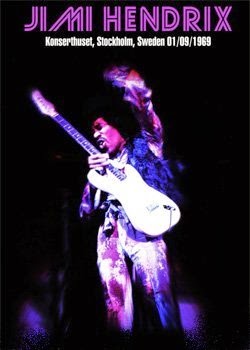
Konserthuset, Stockholm (2 shows)
January 9, 1969
(Thursday)

- Killing Floor
- Voodoo Child(slight return)   
- Purple Haze 
- The Star Spangled Banner
.
The Experience arrive in Stockholm at 14:25 and book into the Hotel Cariton. Jimi is interviewed by Ulla Lundstrom in his hotel room. They attend a press reception at 16:00 and are interviewed by Margareta Klinberg for Aftonbladet, published January 10, Peter Himmelstrand for Expressen,  published January 10, Dagens Nyheter, published January 10, and Benny Moller for Bildjoumalen, published January 10.
In the evening they play two shows at the Konserthuset at 19:00 and 21:30, supported by Jethro Tull.
During the first show The Experience perform 'Killing Floor', 'Spanish Castle Magic', 'Fire', 'Hey Joe', 'Voodoo Child', 'Red House' and 'Sunshine Of Your Love';
During the second, 'I Don't Live Today', 'Spanish Castle Magic', 'Hey Joe', 'Voodoo Child', 'Sunshine Of Your Love', 'Red House', 'Fire',  Purple Haze' and 'Star Spangled Banner'.
The second show is videotaped for Swedish TV Number 9 programme. Jimi is interviewed by Lennart Wretlind for Swedish radio, broadcast January 12 Pop 68 Special, Channel P3.
.
The Forum, Los Angeles
April 26, 1969
(Saturday)
 
- The Sunshine Of Your Love
.
The Experience play The Forum, Los Angeles, supported by Cat Mother and Chicago Transit Authority.
The Experience perform "Tax Free", "Foxy Lady", "Red House", "Spanish Castle Magic", "Star Spangled Banner", "Purple Haze", "I Don't Live Today", "Voodoo Child" and "Sunshine Of Your Love". Jimi plays the last two tracks together breaking into "Sunshine Of Your Love" during the middle of "Voodoo Chile". You can just hear him going back into "Voodoo Chile" as "Sunshine of Your Love" fades out on this release.
After the show, Jimi goes to the Whiskey A Go Go with Mama Cass Elliot and Billy Eckstine
[Extracts from Hendrix: The Visual Documentary by Tony Brown: The Original Edition, Omnibus Press, 1992. & Jimi Hendrix: Concert Files by Tony Brown. Omnibus Press, 1999]
.
This post consists of MP3 (320kps) ripped from the Australian release Eclipse CD and includes full album artwork. You'll also see below that I have this bootleg on Cassette Tape. The recordings are pretty damn good and highlight some peak moments in Hendrix's concert recordings. The title says it all....Enjoy !
.
Track Listing
01 - The Wind Cries Mary
02 - Burning The Midnight Lamp
03 - Foxy Lady
04 - Voodoo Chile (Slight Return)
05 - Killing Floor
06 - Sgt Pepper's Lonely Hearts Club Band
07 - Hey Joe
08 - Sunshine Of Your Love
09 - Little Wing
10 - Fire
11 - Red House
12 - Purple Haze
13 - Star Spangled Banner (Not Listed)

.
The Jimi Hendrix Experience:
Jimi Hendrix - Guitar / Vocals
Noel Redding - Bass
Mitch Mitchell - Drums
.
The Best Of Hendrix Link (119Mb) New Link 03/01/2024

Wednesday, October 8, 2014

Fraternity - Flaming Galah (1972)

(Australian 1970-75)
.
Original line-up: BON SCOTT (vocals); BRUCE HOWE (bass); MIC'KJURD (guitar); JOHN FREEMAN (drums); JOHN AYERS (harmonica); JOHN BISSET (keyboards).
Fraternity formed late in 1970 and based themselves in Adelaide. All the members had previously played with professional bands.
Before long they began recording for the Sweet Peach label and by June 1971, they had released three singles — 'Question', 'Why Did It Have To Be Me' and 'Seasons Of Change' (which was written originally for them by Blackfeather), along with their first LP 'Livestock'.

In September Sammy Lee (ex-Flying Circus) joined to become their seventh member (playing slide guitar and piano). They went on to win the 1971 Hoadley's Battle of the Sounds. Meanwhile, they switched record companies to the Raven label. In October, although they had terminated their contract two months prior, Sweet Peach released 'The Race'. The band disagreed with its release as the sound on it was mechanical and not representative of their talents.

Also in October, came their first single for Raven, 'You Got It'. Then in March '72 (after Raven had been taken over by RCA), another single, 'Welfare Boogie' was released, followed by their second album 'Flaming Galah'. But the band couldn't seem to produce hit records and eventually dissolved with Bon turning up later in AC/DC. [extract Noel McGrath's Australian Encyclopedia of Rock, Outback Press, 1978. p 120]

After their first LP 'Livestock' came out, Adelaide businessman Hamish Henry took over management of Fraternity and the group moved to Adelaide. Most of the band took up residence at Hemmings Farm in the Adelaide Hills, where they wrote and rehearsed communally (in the spirit of Traffic and The Band) while Bissett and his wife rented a flat above Henry's art gallery in North Adelaide. Vince Lovegrove reported on the group's new base in the June 1971 edition of Go-Set:

L-R Mick Jurd, John Freeman, 'Uncle' John Eyers, Bruce Howe, Bon Scott, Sam See, John Bisset

(Fraternity) live like no other band in Australia, in a house in the hills 17 miles from Adelaide. It's surrounded by seven acres of bushland. They're from everything but nature. What a buzz! Once a week they come into the city to have a meeting with their management and collect their pay. They only leave their pad to play gigs.

Bon Scott, vocalist, recorder and timbala player, is constantly in a dream world of his own but he's having a ball. He says: "The point is, the dollar sign is not the ultimate. We want to try and help each other develop and live. So that the thing inside of us, whether it be creative or not, is satisfied. Something makes us tick and it's up to people to satisfy that something. We are satisfying ourselves and others by creating an environment."

The group's next single "Livestock", "Why Did It Have To Be Me?" b/w "Cool Spot" was issued in January, but did not chart. Their second single became their only major hit -- it reached #1 in Adelaide and made the Top Ten in other cities, but for reasons beyond their control it faced strong competition from the original version by Blackfeather. As noted above, Fraternity had wanted to cover "Seasons of Change" for some time, and with the blessing of David Sinclair and John Robinson, they cut their own version, which was released in March 1971. It would probably have been a major national hit, because John Robinson had generously obtained an undertaking from Infinity not to release Blackfeather's version as a single. Predictably though, as soon as Fraternity's version became a hit in Adelaide, Festival reneged on its promise and rushed out the Blackfeather version as a single.

Two new members joined during 1971, expanding the band to a seven-piece. Harmonica player 'Uncle' John Ayers joined in May, and not long after that the group achieved another career peak, winning the 1971 Hoadley's Battle of the Sounds. Next on board was guitarist-pianist Sam See (ex Sherbet, Flying Circus) who was apparently approached to join Fraternity by Bruce Howe. Sam left Flying Circus at the completion of their Australian tour in September. Flying Circus had relocated to America earlier in the year and they were beginning to build up a following in Canada, where they recently toured, and they returned there after their Australian tour and it eventually became their permanent base.

Two more Singles were released after Sam joined -- "The Race" came out in October 1971 on Sweet Peach, and the same month their fourth single "If You Got It" came out on the Raven label (not to be confused with the present-day reissue company), evidently signaling the end of their relationship with Sweet Peach.


Now augmented by Ayers and See, Fraternity' cut their second album 'Flaming Galah', which came out on the RCA label in April 1972. It was a much rockier album that their debut and featured a distinctive twin-keyboard interplay between Bissett and See. Although songs like "Welfare Boogie", "If You Got It", "Hemming's Farm" and "Getting Off" showed the group moving into a bluesy hard rock style, there were only three new songs alongside re-recorded (albeit superior) versions of earlier songs.

By the time the album had been released, Fraternity were in the UK, having taken advantage of their Battle of the Sounds prize (a free trip to London). Unfortunately, like so many other Australian bands, the dream of 'making it' in the UK proved impossible to achieve. Basing themselves in Finchley, London the group slogged away in the UK and Europe from early 1972 to mid-1973, playing one-off gigs around England and one or two short tours of Germany.

As John Bissett recalled in an interview with the AC/DC website 'Back In Black', Fraternity's sojourn on the punishing UK music scene had the same effect on them as it did on so many other Australian bands:

John Bisset & Bon Scott
Our wealthy and benevolent manager, Hamish, transplanted the whole Fraternity community to London. My dog Clutch even joined us after six miserable months in quarantine. In all there were 17 people and a dog living in a house designed for maybe 6 people. It was very cramped and communal and there was a lot of bickering as you can imagine. Each band member had a girlfriend or wife and I also had a young child and a dog. There were also the two roadies, Bob and Rob, Bob's wife and our tour manager, Bruce King. Hamish had also shipped our Fraternity tour bus to London from Australia. The Finchley residents were bemused by the mini greyhound bus parked in the narrow London street.

I remember London rehearsals being very gloomy, unproductive affairs. We had very little money so the booze and drugs supply was severely limited. The whole mood of the band went downhill in London – hag-sub reality began to set in. The party was over. We were not up with the play as far as sound production went. Our PA was inadequate and we lacked the know-how and experience of the UK bands. We supported Status Quo at our first gig. The audience was appreciative and kind but we could not compete with the gear we had.

Other problems inherent in the band became prominent. We had too many members to get a clear sound definition of individual instruments and we lacked good original material. We also had not established a clear musical and cultural niche or direction for ourselves. We were a strange type of country-rock band by this stage. We all tried to write new and better songs but to no avail. I was unhappy on piano but felt like a passenger on a bus that no one in particular was driving, and clueless and powerless to change anything. Things were briefly better in Germany. We focused more on rock for the German audiences and went over quite well. Bon introduced a song or two in German, much to the delight of the audience.

I was the first to jump ship and Sam See followed soon after. The rest (Howe, Jurd, Ayers, Scott and Freeman) carried on for a time as Fang but soon returned to Australia.

John Bissett was hired and fired from Mungo Jerry then moved into computing for several years. Sam See was contacted by Doug Rowe and headed to Canada to rejoin Flying Circus. The rest of Fraternity returned to Australia and briefly changed their name to 'Fang', but not long after they got back Bon (whose daredevil exploits were already the stuff of legend) was severely injured in a motor-bike accident that almost claimed his life, and he was forced to leave the group and spent many months recuperating.  He collaborated with a group of Adelaide musos, dubbed The Mount Lofty Rangers.

In July 1974 Vince Lovegrove introduced Bon to AC/DC at an Adelaide gig, while the band was touring as support for Lou Reed. They were about to ditch vocalist Dave Evans and Bon was offered his place, but Bon wanted to be the drummer so he turned it down, although he did sign on as their roadie. During a residency in Perth in September Bon 'subbed' as singer when Evans refused to go on; soon after that he was sacked, and Bon was again offered the job. This time he accepted, and the rest is history.

Meanwhile, Howe, Ayers and Freeman had put together Fraternity II in 1974 with Mauri Berg (guitar), John "Swanee" Swan (vocals) and Peter Bersee (violin). Freeman left in mid-1975, so Swan switched to drums and his younger brother Jimmy Barnes briefly took over the new lead singer, but he left soon after, rejoined his earlier band, Cold Chisel and of course went on to become one of the biggest Australian rock stars of the 70s and 80s. Swan left to join Jim Keays' Southern Cross, and later fronted Feather and his own band Swanee.

By late 1975 Fraternity had been renamed 'Some Dream'. Ca. 1978 it was renamed Mickey Finn, which comprised Howe, Ayers, Berg and Joff Bateman. By 1980 John Freeman had rejoined and a second guitarist, Stan Koritini, had been added and this lineup cut a self-titled album for the Eureka label. Mickey Finn released two Singles in 1980 and 1981 before fading from the scene. [extract from Milesago]
.
OK - this post is special because it not only features high quality recordings in FLAC, but was freshly ripped from my superb vinyl which I found at the local flee market last week and scored for two bucks!. The only disappointment is that the inside Gatefold was a little roached from moisture damage, but the vinyl is Oh so clean !  A copy of Flaming Galah recently sold on eBay for $1,293 (Aus) - so who's the Flaming Galah now !
Full album artwork is included (thanks to Mick from Midoz for this) along with label scans from my vinyl.
This is certainly an album not to be missed - especially if you are a fan of Bon Scott / ACDC.
.
Track Listing
01. Welfare Boogie 3:44
02. Annabelle 4:00
03. Seasons of Change 3:56
04. If You Got It 4:07
05. You Have a God 3:12
06. Hemming's Farm 3:49
07. Raglan's Folly 4:43

08. Getting Off 3:26
09. Sommerville R.I.P. 3:55
10. Canyon Suite 7:21


Fraternity are:
Bon Scott /Lead Vocals
Mick Jurd /Lead Guitar
John Freeman /Drums
John Bisset /Keyboards
Bruce Howe /Bass Guitar
"Uncle" John Eyers /Harmonica
Sam See /Slide Guitar, Piano

.
.
Fraternity FLAC Link (274Mb)

.

Saturday, October 4, 2014

U2 - Not Authorised Live Vol 3 (1993) Bootleg

(Irish 1976 - Present)
.
The following sources place this concert from the Lovetown Tour, 2nd Leg Europe, Dublin, 26th Dec 1989
* Recorded live Dublin, 26.12.89  (Part.2)
* U2 - 'Desire' (Vol. 2)

The Lovetown Tour was a concert tour by the Irish rock band U2, which took place in late 1989 and early 1990 following the release of their 'Rattle and Hum' album. It was documented by noted rock'n'roll film director Richard Lowenstein in the "LoveTown" documentary.
The tour's opening night was on 21 September 1989 at the Entertainment Centre in Perth, Australia. The first leg took place over the next 10 weeks in Australia, New Zealand, and Japan. A brief second leg hit four countries in Europe for four weeks, ending on 10 January 1990 at the Sport Paleis Ahoy in Rotterdam, Netherlands. Of the tour's 47 concerts, 23 were played in Australia.

Many songs performed on the tour would not be performed again for many years, if ever, as the band subsequently shifted its sound dramatically on the album Achtung Baby with tours in the 1990s that featured more choreographed performances and largely emphasized newer material. The tour marked the end of the band's long-time practice of concluding nearly every concert with the song "40", which featured the band leaving the stage one-by-one and the audience chanting the chorus. This practice was not resurrected until 15 years later, during the Vertigo Tour. Notably absent from the tour was the song Sunday Bloody Sunday, which had been a live staple and which would be featured in all subsequent tours.
The tour name, possibly a contraction of the Rattle and Hum song "When Love Comes to Town", was the first not to be named for the band's then-current album; as of 2009, all of their subsequent tours have also had different names from any album.
.

U2 played four concerts in Dublin towards the end of the tour, from 26th December until New Years Eve, 1989. The 31 December 1989 Dublin concert was broadcast on RTE and BBC radio around the world, giving many fans their only taste of the tour; it was widely bootlegged and ultimately officially released in digital form in 2004 as 'Live from the Point Depot'.
Therefore, I am a little skeptical about the origin of this bootleg being from the 26th Dec. It is more likely that it is a re-release of the Bootleg New Years Concert held on the 31st December. Perhaps someone might be able to clarify if this is the case. Unofficial releases from an artist’s beginnings and endings are the most interesting to hear.  It illuminates a band’s decision and U2 went through a major change in the beginning of the new decade.  Through the eighties they established an aesthetic based upon a dramatic interpretation of new wave tinged with overtly political themes.  It was by the time they hit the Lovetown tour that they decided a change in direction to their sound was necessary for the new decade.
The four shows in Dublin during the holiday season represent a swan song of sorts and, after four shows in Rotterdam in January, U2 would never be the same.  This is the ending of the serious U2 focused upon political themes in their hometown to a global awareness and a deeper address to other forms of media manipulation.
.
.
U2 & B.B King
Meeting veteran blues player B. B. King, a Memphis man whose recording career began before Elvis's, provided another opportunity for U2 to experiment with the blues.
The relationship between B.B. King and U2 began in Dublin back in the early part of 1986. They met up whilst B.B. King was working in Ireland, and had talked about doing some writing and recording together at some unspecified point in the future.
The band wrote "When Love Comes to Town" for him, Bono only finishing the lyrics an hour before he met him in Fort Worth, Texas.
.
B.B.'s response after reading the paper Bono had given him was to say "How old are you? They're heavy lyrics... heavy lyrics."
"Seeing him that close was great," says The Edge, newly an admirer of blues guitarists from Howlin'Wolf to Jimi Hendrix. "I loved his style and it was good to meet the man."
B.B. and his band opened for U2 in Texas, which U2 looked upon as a great honour. The sequence in the movie was filmed during soundcheck and the gig at the'Tarrant County Arena in Fort Worth, and on this one occasion only When "Love Comes to Town" was performed live by the two bands as a special encore.
"We discovered a common bond between us and some of these older artists like B.B.King. When we met him there was a whole world of understanding and nothing needed to be said. That has been the pay-off of working ten years to get into this position. We no longer have to prove ourselves. It's in the music and people can hear it." Adam. [extract from U2 Rattle & Hum, Pyramid by Peter Williams & Steve Turner, 1988. p31]
.
This post consists of MP3 (320kps) ripped from a 1993 Australian Bootleg CD and includes full album artwork, along with other bootleg covers for the same concert. The quality of the recording is exceptional which makes me even more adamant that this is the 2nd half of the RTE and BBC radio broadcast from the New Years Eve concert.  Either way, you won't be disappointed with this one.
.
Note:  Track 5 (Love Rescue Me) ends with 4 minutes of audience applause and screams of encore - so I have taken the liberty of including an edited version of this track which you can substitute for better enjoyment.
.
Track Listing 
01 - New Year's Day
02 - Pride (In The Name Of Love)
03 - Angel Of Harlem/Suspicious Minds
04 - When Love Comes To Town
05 - Love Rescue Me
06 - With Or Without You
07 - 40


Band Members:
Bono (vocals and guitar)
The Edge (guitar, keyboards and vocals)
Adam Clayton (bass guitar)
Larry Mullen, Jr. (drums and percussion)
Guest appearance by B.B King on "When Love Comes To Town"

.
U2 Live Vol 3 Link (100Mb) 
New Link 12/04/2026
.