Friday, December 13, 2024

Air Supply - The One That You Love (1981) + Bonus Single

(Australian 1975 - Present)

Air Supply’s highest-charting studio album was released 43 years ago, in 1981 – a milestone for one of the biggest bands of the early '80s, and a circumstance many around the group in its early days would likely have thought impossible.

Air Supply is built around the nexus of songwriter and guitarist Graham Russell and lead singer Russell Hitchcock, who met on the set of an Australian production of Jesus Christ Superstar in 1975. Their connection was fortuitous – Russell was a songwriter looking for the right voice for his material, and Hitchcock was a bit player in the musical who was largely overlooked.

The duo put a band together with, among others, future Divinyls bassist Jeremy Paul and guitarist Mark McEntee, and in late 1976 scored an Australian Top 10 hit (“Love and Other Bruises”) and saw their self-titled debut album go gold. Air Supply opened for Rod Stewart on his 1977 tour of Australia, the U.S. and Canada, but came back home at the end of the tour to very little fanfare, eventually compelling everyone but Hitchcock and Russell to find other gigs.

Graham Russell and Russell Hitchcock 1980's
The pair weathered two years of the indignities most starving musicians experience – Hitchcock moved back in with his parents, Russell resorted to searching for loose change in couch cushions to buy food, etc. In 1979 the two recruited a new group of musicians and recorded the Russell composition “Lost in Love,” which lifted Air Supply back into the Australian Top 20.

Record industry mogul and then-chairman of Arista Records Clive Davis heard “Lost in Love” and signed the band to his label. Released internationally in January 1980, “Lost in Love” was a global hit, reaching No. 3 on the Billboard Hot 100 singles chart in the U.S.

Air Supply On Countdown - Early 80's
Air Supply’s 1980 album, also titled 'Lost in Love', did indeed yield more hits, particularly in the U.S. – “All Out of Love” topped out at No. 2 (stuck behind a Diana Ross song and "Another One Bites the Dust" by Queen) and “Every Woman in the World” peaked at No. 5. Air Supply supported the record by touring. And touring. And touring.

“To give them an image, we toured them [in the U.S.] three times in 12 months,” their then-manager Fred Bestall told Billboard in 1981. “We played colleges as well as auditoriums and fairs. We toured them so much purposely to give them an image other than a band that sings nice ballads. … We’ve gone back to those markets again to re-establish that they are a good live band.”

The momentum worked. With a head of steam and a brace of new songs, the band entered a Sydney studio with one-time David Bowie producer Harry Maslin to record Lost in Love’s follow-up, "The One That You Love", which was released in July 1981.


At this time the band comprised [from left to right above]: Dave Green (bass), Ralph Cooper (drums), Graham Russell (guitar/vocals), David Moyse (guitar), Russell Hitchcock (lead vocals), and Rex Goh (guitar).

The album’s title track moves from a barely audible beginning to a powerhouse close, displaying the full range of Hitchcock’s voice in a little over four minutes. And, as Russell remembers, Hitchcock’s performance was captured in a single take.

“There’s just an energy and a fire and a passion, and Russell had that,” he told the podcast Misplaced Straws. “It was just incredible to hear it ... In those days, that’s how you recorded; everything was live. There were no tuning machines in those days. You sang the song from top to bottom; that’s the way it was.”

“The One That You Love” was released in April 1981 and in its eleventh week on the Billboard Hot 100, it hit No. 1 – the band’s only single to achieve that status. Although it is a well known song, strangely the single did not chart in most of Europe (see left).

There were more hits to come – both “Here I Am (Just When I Thought I Was Over You)” and “Sweet Dreams” hit No. 5, extending Air Supply’s consecutive Top 5 singles streak to six. “Sweet Dreams,” in particular, had a spacey intro with guitar arpeggios, strings, dramatic piano chords and maybe even some alien instrumentation that someone had to learn to play. The song’s success surprised Russell.

“I had no concept that that was ever going to be a single,” he admitted to Songfacts. “I just thought, ‘Oh, I've got free rein here, I don't have to particularly write a hit song, I can just do something that I want and that I think would be great for the band.’ But when Clive [Davis] heard it, he was all over it. So I was very surprised then. But I think now I've learned to distinguish certain songs from others.”

The hits on 'The One That You Love' were complemented by some fine deep cuts. Hitchcock and Russell’s voices on the chorus of the rocking opener “Don’t Turn Me Away” lock together tightly; “I Want to Give It All” (the B-side of the “The One That You Love” single) is all quiet power – a perfectly arranged blend of voice, guitar and strings. “Keeping the Love Alive” could have been a fourth Top 5 from the album, had it been released as a single, so stately and radio-ready was its chorus.

The 'One That You Love' hit No. 10 on the Billboard 200 albums chart – Air Supply’s only studio album to make it to the U.S. Top 10 (though their 1983 Greatest Hits record would surpass it, peaking at No. 7). It was a level of success for the band once again foretold by Davis, upon hearing the final mix of the record.

“That was a very important moment because it was our second album,” Russell recalled to podcaster Harvey Brownstone. “We’d had three Top 5s [from Lost in Love] so … we had to impress him. … He was in the studio and he was sitting right at the console on his own and we were all behind him. He listened back to the final mix of The One That You Love and we were going, ‘Oh God; [we] hope he likes it.’

“And after it was finished,” Russell continued, “he didn’t say anything for two minutes, and that’s an eternity. And then he turned around to us and he said, ‘It’s going to go to No. 1". And it did. [extract from 4therecordcom.home.blog]

The Album Cover
While the music on this album may be exceptional, the album artwork is uninspiring. Seriously, the rear photo of the band, featured on the original releases, would have been far better to adorn the front album cover instead of the hot air balloon on the initial releases, and the series of hot air balloons on the Australian CD reissue (see right), and is about as pointless as you can get. This album cover really should be added to The Worst (And Most Disturbing) Album Covers Of All Time.

OK, so I’m extremely critical of this album artwork, but in my opinion it is an immediate deterrent and unlikely to appeal to anyone, other than the most ardent fans. It certainly doesn’t showcase, or represent, just how outstanding the music is.

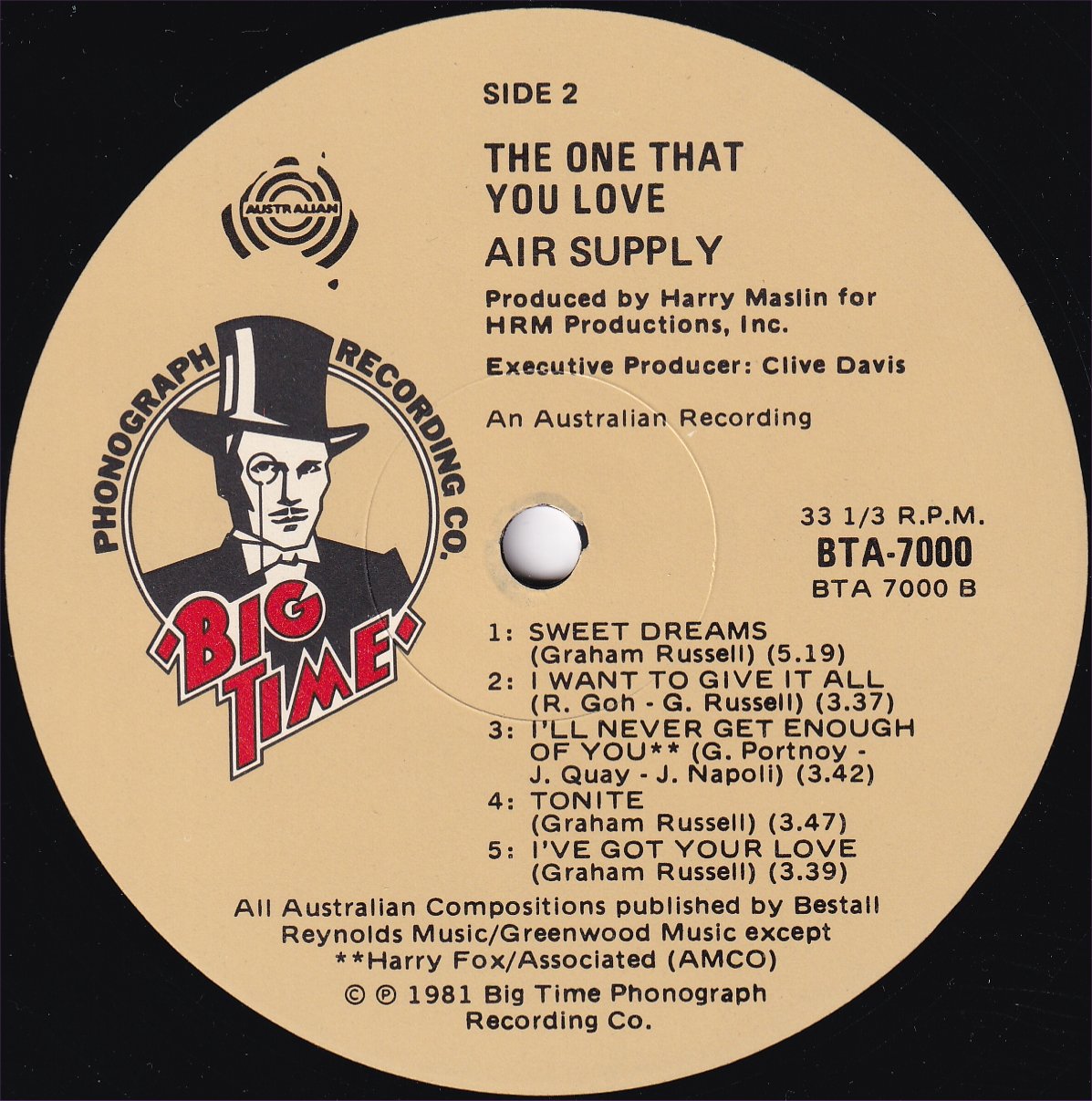
This post consists of FLACs ripped from my pristine vinyl and includes full album artwork for both vinyl and CD releases.  Strangely, my Australian "Big Time" pressing did not come with the Inside Sleeve that contains the lyrics and credits - typical of most Australian Record Companies who were always try to save a dollar!  My scans for this missing sleeve were sourced from Discogs.
I am also including as a bonus track, the edited version of "Sweet Dreams" which was released as their 3rd single from the album (the album version was over 5mins long while the single clocked in close to 4 mins). 
 
Track List:
01 Don't Turn Me Away 3:37
02 Here I Am 3:41
03 Keeping The Love Alive 3:29
04 The One That You Love 4:11
05 This Heart Belongs To Me 4:05
06 Sweet Dreams 5:10
07 I Want To Give It All 3:37
08 I'll Never Get Enough Of You 3:42
09 Tonite 3:39
10 I've Got Your Love 3:32
11 Sweet Dreams (Bonus Single Release)   3:58

Air Supply were:
Graham Russell (guitar/vocals)
Russell Hitchcock (lead vocals)
David Moyse (guitar)
Rex Goh (guitar)
Dave Green (bass)
Ralph Cooper (drums)


Tuesday, December 10, 2024

Widowmaker - Too Late To Cry (1977) + Bonus Track

 (U.K 1975 - 1978)

Widowmaker
was formed in late 1975 by ex-Spooky Tooth and Mott The Hoople guitarist Luther Grosvenor, at the time known as Ariel Bender, as a means of recording songs he had written, something he had been unable to do since Mott The Hoople’s recordings were dominated by Ian Hunter penned tunes. Grosvenor was joined by ex-Lindisfarne drummer Paul Nichols and former Mungo Jerry and Chicken Shack bassist Bob Daisley. The trio became of the nucleus of the new band, with Grosvenor handling all the vocals.

The band decided that a lead vocalist would improve the band’s sound and as a result, Steve Ellis, formerly of Love Affair, was added, after his name was given to Grosvenor by Bobby Tench and Roger Chapman. At first Ellis wasn’t excited at the prospect of joining the band, but with some coaxing he took the job. Adding a keyboard was considered by the quartet, but in the end, guitarist Huw Lloyd-Langton completed the original lineup of the quintet, which took the name Widowmaker, although no one in the band can really remember why, and Grosvenor says he never liked the name.

The band’s first gig was a 24 February 1976 appearance on the BBC’s “Old Grey Whistle” when they performed the Grosvenor/Ellis/Nichols penned “On The Road” and the Grosvenor/Ellis composition “Ain’t Telling You Nothing” both of which appeared on the groups debut LP. Catching the eye and ear of Roger Daltrey, Widowmaker opened for The Who at three gigs in May and June of 1976.

1977 Lineup: Paul Nicholls, Huw Lloyd-Langton,
Ariel Bender, Bob Daisley and John Butler 
The band signed with Don Arden’s Jet Records with Arden becoming their manager. Soon the group entered De Lane Lea Studios in Wembley and began work on their self-produced and self-titled debut LP. Among the album’s ten tracks are five which Grosvenor had a part in writing, including the hot rocking “Running Free.” The band was aided by keyboardist Zoot Money, and backing vocals were supplied by Bobby Tench, Roger Chapman, Julie Driscoll and Sam Brown. With Jet making changes in distribution the album made a late appearance in the US and reached only #196 on the Billboard charts, disappointing to the band and certainly not an indication of the quality of material recorded.

Undeterred the band toured with Jet label mates ELO, as well as Uriah Heep and Nazareth. However, musical differences, home sickness and a falling out with manager Arden resulted in Ellis exiting the band. At the recommendation of Lloyd-Langton lead vocals were taken over by John Butler and the band entered Olympic Studio to record its second LP “Too Late To Cry” with Chris Kimsey and the band coproducing. The album, smoother sounding, but lacking the raw sound of the band’s debut reached only #150 on the Billboard charts in the US. Although containing four guitar driven tracks co-written by Grosvenor, the highlights of the album for me, it had a smoother sound, but didn’t rock as hard as the debut and proved to be the final album by the group.

Widowmaker:  US Tour 1978
Widowmaker toured with Ted Nugent, Aerosmith and Mahogany Rush, among others, in support of “Too Late To Cry” but bassist Daisley departed to become part of Ritchie Blackmore’s Rainbow. In addition, Grosvenor was unhappy, and although the band’s albums were much better than average and the group could have gone on for another year or two at the least, the members decided to call it a day after their 1978 Tour and Widowmaker was no more. After playing bass with Ritchie Blackmore's Rainbow, Daisley went on to play for Ozzy Osbourne, Uriah Heep, and Gary Moore; while Luther Grosvenor eventually went on to reform Spooky Tooth (without Gary Wright). [extracts from Plain And Fancy]

1978 US Tour Advert
Album Review
Initially billed as a supergroup for the late seventies, this tag was always going to be difficult to live up to as none of them exactly had top drawer cv’s. Guitarists Ariel Bender (Luther Grosvenor) and Huw Lloyd Langton had been in Mott The Hoople and Hawkwind respectively, whilst drummer Paul Nichols had been with Lindisfarne. 

Ariel Bender
(aka Luther Grosvenor) 
Bass player Bob Daisley arguably had his glory days to come going on as he did to play with Rainbow, Uriah Heep and Ozzy Osbourne. Original vocalist Steve Ellis had come from the pop rock outfit Love Affair but he didn’t stay around long enough to contribute to this second album and was replaced by Robert Plant wannabe John Butler.

I have never actually heard the debut album so can’t really comment on whether they were going in the right direction or not but ‘Too Late To Cry’ does not sound like an album from a band that were on the verge of setting the world on fire. It’s pretty standard formulaic late seventies rock. Right down to the group photographs, big burly beer drinking blokes all dressed up in sparkly gear stolen from the glam rock wardrobe staring at the camera like cut throats and desperados.

Bob Daisley
The musical content is also fairly predictable. The title track, which opens the album, sounds a little like Thin Lizzy, probably due to the twin guitar sound. It is also one of the better tracks. Other highlights are the Grosvenor penned ‘Here Comes The Queen’ an acoustic Led Zeppelin type track which highlights Butler’s Robert Plant pretentions and ‘The Hustler’ a track which surely has a claim to be the only rock song with a steel drum solo, provided courtesy of Miguel Barradas.

The closing track ‘Sky Blues’ however, is an awesome heavy blues track and is the highlight of the album. Pity they couldn't reproduce this across the whole album.

This post consists of FLACs ripped from my near mint vinyl and includes full album artwork and label scans. I purchased this album after hearing the track "Sky Blues" while pursuing the record shelves of Reading Records in Carlton, Melbourne. Of course "Sky Blues" is the best track on the album, with some other standout tracks like "Mean What You Say" and of course the title track "Too Late To Cry". I have also managed to source another session track called "Talk To Me" which never made the album cut, but is included here as a bonus track for your pleasure.

Track List:
01 Too Late To Cry 3:54
02 The Hustler 4:08
03 What A Way To Fall 3:52
04 Here Comes The Queen 4:09
05 Mean What You Say 3:15
06 Something I Can Do Without 4:12
07 Sign The Papers 5:08
08 Pushin' 'N' Pullin' 4:51
09 Sky Blues 5:32
10 Talk To Me (Bonus Track)  4:14

Widowmaker were:
Lead Vocals – John Butler
Bass Guitar – Bob Daisley
Drums – Paul Nichols
Electric Guitar – Ariel Bender (aka Luther Grosvenor), Huw Lloyd-Langton
Harmonica – John Butler
Keyboards – John Butler


Friday, December 6, 2024

Peter Frampton - Breaking All The Rules (1981) + Bonus Live Track

 (U.K 1966 - Present)

By the early 1980s, Peter Frampton was tired of being called the "romantic rock boy" and decided to make the most rocking, commercial and aggressive album of his career.  1981's 'Breaking All The Rules' broke all the barriers.

'Breaking All The Rules' has been Peter Frampton's lesser known / heard album in part due to the record company clumsiness to properly promote the record and because Frampton indeed broke some rules here; he decided to make a rocking LP instead a Top 20 hit generator.

Of course there's a brilliant sweet melody in the slow, touching 'Going To L.A.' which should have been a hit in the charts, but most the material here rocks, and pretty hard.

For this matter Frampton enlisted a terrific back-up band including the half of Toto; Steve Lukather & Jeff Porcaro.

Lukather trades some killer licks with Frampton (the title track is awesome) but also contributing with his trademark, distinctive rhythm guitar, while Porcaro provide his unique 'groove-touch' all over the recording.

A proof of the guitar driven nature of this album is the opener "Dig What I Say", starting the record in a rocking mood with solos all over it, something unusual for a Frampton release. Here he also uses guitar synth to good effect.  The cover of  "I Don't Wanna Let You Go" is done in an absolutely classic Frampton vein but even here the guitar swirls like never before. Check Porcaro's hi-hat fills here, a master in this game.

Written by the Alessi Bros 'Rise Up' is another tune with a hit potential, there's an elegant midtempo on 'Wasting The Night Away', a rocky version of the classic 'Friday On My Mind' (Originally released by the Easybeats), while 'Lost A Part Of You' is the ballad on the album with some hints to Frampton's hit single "I'm In You".

For the end we have the title track 'Breaking All The Rules', a seven minute tour de force plenty of killer riffs, a melodic verse and a superb Frampton / Lukather duel in an almost hard rocking piece.

Here, Frampton demonstrates all his skills not only as an excellent guitarist but also as a vocalist. The heavy sound is always commanded by Frampton 's guitar and his "warmer" and stronger voice gives a more bluesy tone to the music.

Despite not having sold even half as much as his famous "Comes Alive", "Breaking ..." is, without a doubt, Frampton's best studio album, and the title track, one of his best songs.


Interesting Side Note: 
Frampton released an album only in Brazil called 'Rise Up' in 1980, which had a similar track listing as 'Breaking All The Rules'. Frampton states:  "This album was released in Brazil to promote our tour there in 1980 - the album eventually turned into 'Breaking All the Rules', released the next year." 
However, the 'Rise Up' album featured an almost entirely different lineup of musicians and partially similar track listing.  

While touring Brazil, Frampton suffered a serious setback when all his guitars were thought destroyed in a cargo plane crash that killed four people. Among the instruments he lost was the black Les Paul Custom which he had named "Phenix" (pictured on the cover of Frampton Comes Alive) given to him by Mark Mariana and first used on the night of the recording of the Humble Pie live album Performance, and which he had used all through his early solo career. However, by shear luck, the guitar was recovered and returned to him in December 2011. 

And so 'Rise Up' eventually turned into Breaking All the Rules, released the next year in 1981. These albums were the first he recorded almost completely live. In 1982, following the release of 'The Art of Control', Frampton tried unsuccessfully to split his ties with A&M Records; he re-signed with the label in 2006 and released his Grammy Award–winning album 'Fingerprints'.  But that's another story !

This post consists of FLACS ripped from my vinyl and includes full album artwork for both CD and vinyl, along with label scans. One track that appeared on the Rise Up album (but not Breaking All The Rules) was a live recording of his hit single "I'm In You". I have therefore decided to include a live rendition of this track (taken from Frampton Comes Alive II) as a bonus track.
One thing that attracted me to this album when I first viewed it in the record store was the inclusion of the Easybeat's mega hit "Friday On My Mind", which by the way he has covered admirably. Of course, the killer title track is the highlight, in fact all of Side B is brilliant and the first side is almost as good.  Overall, this album is one of Frampton's best studio albums and should not be passed by.

Track Listing:
01 Dig What I Say 4:10
02 I Don't Wanna Let You Go 4:21
03 Rise Up 3:46
04 Wasting The Night Away 4:12
05 Going To L.A. 5:57
06 You Kill Me 4:13
07 Friday On My Mind  4:18
08 Lost A Part Of You 3:42
09 Breaking All The Rules 7:04
10 I'm In You (Bonus Live)   4:24

The Band:
Vocals – Peter Frampton
Backing Vocals – Arthur Stead, Steve Lukather
Bass Guitar – John Regan
Drums – Jeff Porcaro
Guitar – Peter Frampton, Steve Lukather
Guitar Synthesizer – Peter Frampton
Keyboards – Arthur Stead, Peter Frampton


Monday, December 2, 2024

Peter Frampton - Comes Alive (1976)

 (U.K 1966 - Present)

Peter Frampton's live double epitomizes post-Vietnam escapist sunshine rock. With an estimated l6 million sales, it is second only to Bruce Springsteen's 1985 blockbuster as history's most successful live set. Recorded between March and November 1975 - principally at Frampton's first headlining gig, at Winterland in San Francisco - the album was summed up by Cameron Crowe in Rolling Stone as "much more than a souvenir. It is a testimony to Peter Frampton in his natural habitat." See full review below

Following a template established by Kiss with their Alive! double LP, Frampton's album transformed a leaguer into a major player. The former member of British rockers The Herd and Humble Pie had made three, moderately successful albums: now he enjoyed ten weeks at the top of the Billboard chart.

This ad ran soon before Peter Frampton briefly
                       ruled the world
The 14-song selection provides a fine cross-section of his albums and Humble Pie days. Jaunty "Somethin's Happening" and insistent "Show Me The Way" lay out his stall of echo-rich vocals, jazzy electric and sweet acoustic guitars, melodious harmonies and - "Ooh Baby" - lyrics. The band rock out on the likes of "I Wanna Go To The Sun," but it is the hysteria elicited by the hit anthem "Baby, I Love Your Way" and the talkbox laden "Do You Feel Like We Do" that proves the life-affirming nature of the Frampton sound. The album prompted an invitation to the White House President Gerald Ford. We are not worthy! was Frampton's response.
[extract from 1001 Albums You Must Hear Before You Die, Cassell Illustrated, 2005. p372

Rolling Stone Review, Dec 1975

by Cameron Crowe (Contributing Editor)

It's the classic tale of most inspired performers. Be they actor or musician or both, anyone whose art often burns with the passion of a man possessed is more often than not a soft spoken personality way from their craft.

Twenty-five-year-old Peter Frampton is no miraculous exception. He is a quietly good-natured man who, in his own words, lives for the stage.

Which is not to say that Frampton, in the four years since he left Humble Pie and began a solo career, hasn't made the studio his stage. 'Wind Of Change', his first solo effort, was as strong a debut as an artist could hope for. After lacing five Humble Pie and two Herd albums with his especially versatile acoustic and electric guitar playing, singing and song writing prowess, Frampton had immediately established himself as his own best interpreter.

It was about that same time that Peter took to the road - surely his first home - with his own band. "Performing is the best thing for a musician", he said at the time. "It keeps my music alive and breathing. That's too important to give up. I really don't think I'll stay off the road for very long".

The effect of the stage can be strongly felt on his second album 'Frampton's Camel', which introduced such live staples as "Lines On My Face" and the tour de force "Do You Feel Like We Do"

'Somethin's Happening' and 'Frampton', finely-crafted albums that spanned both breezy and gritty peaks, were next. The latter may well be his best studio work yet. Recorded at Clearwell Castle near Wales with his solid backing unit of Andy Brown and drummer John Siomos, it shows an ever-evolving Frampton playing all guitar and keyboards and more confident and relaxed than ever before.


Which brings us to 'Frampton Comes Alive', the trump he has been holding all along. Two records culled from a series of Peter Frampton concerts, its release finally completes the portrait of a strong young artist. The full range of his live material, both acoustic and electric, is presented here. Even the audience enjoys a major role throughout and, as always, Frampton & Band perform with the earnestness and competence that we've come to respect. Frampton Comes Alive is much more than a souvenir. It is a testimony to Peter Frampton in his natural habitat.


This post consists of FLACs ripped from both CD and Vinyl, and includes artwork for both media. For some reason, A&M chose to release this double LP album on CD with 4 tracks missing. At first I thought it was due to time restrictions for the CD media, however further investigation shows that the full 78min concert would have fitted.  WTF !
So, to rectify this shortcoming, I have included the 4 missing tracks - "All I Want To Be (Is By Your Side)","Doobie Wah","It's A Plain Shame","Penny For Your Thoughts", ripped from my vinyl. 
This live album was the biggest selling album in Australia in 1976, and remains one of my favourite live albums. Frampton really did take the world by storm with this one and his popularity literally 'Came Alive' when it landed.

Track Listing:
01 Something's Happening 5:54
02 Doobie Wah 5:28
03 Show Me The Way 4:42
04 It's A Plain Shame 4:21
05 All I Want To Be (Is By Your Side) 3:27
06 Wind Of Change 2:47
07 Baby, I Love Your Way 4:43
08 I Wanna Go To The Sun 7:02
09 Penny For Your Thoughts 1:23
10 (I'll Give You) Money 5:39
11 Shine On 3:35
12 Jumping Jack Flash 7:45
13 Lines On My Face 7:06
14 Do You Feel Like We Do 14:15


Friday, November 29, 2024

W.O.C.K On Vinyl: The Goodies - Funky Gibbon 'The Best Of' (2000)

Before things get too serious here at Rock On Vinyl, I thought it might be fun to post a song / album at the end of each month, that could be categorized as being either Weird, Obscure, Crazy or just plain Korny.

The Goodies, alias Cambridge graduates Bill Oddie (born 7 July 1947), Graeme Garden (born 18 February 1943) and Tim Brooke-Taylor (born 17 July 1940), come together on the BBC radio show I'M SORRY I'LL READ THAT AGAIN and transferred to the small screen with the greatest of ease. Their madcap antics on a three-person bike called a Trandem made them mainstays of BBC-TV's comedy schedules from 1970 to 1977 with a fanbase ranging in age from six to 60.

They released a string of singles, too, written by Bill Oddie - the smallest and hairiest Goodie, as opposed to loveable upper-class twit Brooke-Taylor or the scholarly Garden, a doctor in real life. All five hits and their double A-sides (where appropriate) are represented here, from "THE INBETWEENIES" / "FATHER CHRISTMAS, DO NOT TOUCH ME" in December 1974 through their most successful effort, the Number 4  "FUNKY GIBBON" to the second Yuletide rib-tickler, ' "MAKE A DRAFT NOISE FOR CHRISTMAS" that closed their chart account in 1975.

The Goodies riding their Trandem 
Their musical career may have been brief and bright - ' We were the sixth best-selling group in England,' Oddie will tell you - but this wacky telly trio will beloved forever.

The ancient martial art of Ecky Thump
The Goodies had many, many moments of sheer comic genius, whether it be Bill's adoption of the ancient martial art of Ecky Thump, Graeme ketchuping himself to death at the OK Tea Rooms or Tim being forced to sneak around in a bin bag to hide his true nature as a... gulp... scout.

The Goodies Scout Troup doing Goodie Deeds

During my teenage years, I was a big fan of the Goodies when it was aired on Australian TV in the early 70's, and have always loved British comedy. BBC shows like The Young Ones, On The Buses, Love Thy Neighbour, Monty Python, It Ain't Half Hot Mum, Dad's Army and of course The Goodies formed a major part of my 'teens' TV viewing and up bringing. 
One aspect of The Goodies that made them quite unique was their additional musical abilities, especially in the case of Bill Oddie who was responsible for writing most of their tunes - including their Theme Song. 

You know, I miss those days when taking the piss out of 'alternative life styles' and 'stupid behaviour' wasn't judged or censored like it is today, and was seen for what it was intended - just silly, harmless fun. I hope you enjoy these goofy GOODIES tunes and they bring a huge smile to your dial.

Ripped from CD in MP3 format (320kps) with full album artwork, this GOODIES  'Best Of' collection certainly ticks the Crazy and Korny boxes for this month's WOCK on vinyl post, and I would like to leave you with their famous trade mark phrase:        

                            'GOODIES.........goodie-goodie-yum-yum'

Track Listing
01 The Goodies Theme  1:59
02 Funky Gibbon  3:25
03 The Inbetweenies  3:16
04 Please Let Us Play  2:55
05 Black Pudding Bertha  2:54
06 Cricklewood  2:56
07 Good Ole Country Music  3:47
08 Nappy Love  3:39
09 Wild Thing * 3:57
10 Rock With A Policeman  3:09
11 Panic  2:47
12 I'm A Teapot  3:12
13 Sick Man Blues  1:57
14 The Last Chance Dance  4:11
15 Father Christmas, Do Not Touch Me  3:18
16 Make A Daft Noise For Christmas  4:07

All tracks written by Oddie except Taylor *        Goodies Link (123Mb)

Sunday, November 24, 2024

REPOST: Sebastian Hardie - More Moments (Compilation)

(Australian 1968-1977, 1998, 2003)
.
By and large, symphonic rock has not flourished in Australia. Sebastian Hardie was the country's first and foremost symphonic rock band. During the mid-1970s, the band enjoyed considerable success with the album 'Four Moments', but since that time has been largely forgotten in the land of Oz. Yet in European, Japanese and American progressive rock circles, the highly revered 'Four Moments' and its follow-up 'Windchase' are considered to be classics of the genre.

Graham Ford formed the Sebastian Hardie Blues Band in 1967. The band played R&B and soul covers and experienced several line-up changes. The line-up included Ford, Dennis Laughlin (vocals; later in the original version of Sherbet), Dave Waddington (vocals), Neil Williamson (organ), John Bellamy (bass), Syd Richmond (drums) and Richard Lillico (drums). The Sebastian Hardie Blues Band became Sebastian Hardie in 1968 with the arrival of singer Jon English and the Plavsic brothers. All three musicians were students at Sydney's Cabramatta High School. The band went semi-professional, working the same suburban dance circuit as The Affair, House of Bricks, The Clik and dozens of other Sydney pop bands.

Throughout 1969, Sebastian Hardie worked as backing band for rock 'n' roll legend Johnny O'Keefe. At the end of 1971, Sebastian Hardie broke up when English accepted the role of Judas Iscariot in the Australian stage production of the rock musical Jesus Christ Superstar. A year later, Ford and the Plavsics re-formed Sebastian Hardie with Steve Dunne (vocals, keyboards). At that point, the band was still playing pop covers on the dance/club circuit, with little indication of future directions. 

Visiting English producer Larry Page (Daniel Boone, Kincade) was impressed enough, however, to produce the band's debut single "All Right Now/The Professional" (September 1973), released by RCA. One month after the single appeared, 19-year-old Mario Millo replaced Ford on lead guitar. Millo had been playing the Sydney dance circuit since 1969 with his band The Clik. Millo played on Sebastian Hardie's second single, "Mermaid on the Sand/Day After Day" (April 1974).

By that stage, Millo had begun to write original, highly orchestrated and inventive material which helped usher in a much-needed change of direction for Sebastian Hardie. The catalyst in the band's transformation from accomplished dance-pop band to fully fledged symphonic rock band was the decision to play a 20-minute arrangement of Mike Oldfield's popular `Tubular Bells'. Polydor Records signed the band on the strength of Millo's new material. The band supported international visitors Lou Reed and Osibisa on their respective Australian tours. At the end of 1974, classically trained musician Toivo Pilt (ex-Forever) replaced Dunne on keyboards and Millo took over lead vocals. Sebastian Hardie upstaged Dutch jazz-rock veterans Focus on their June 1975 Australian tour. With the band's increased profile, the album Four Moments and the single "Rosanna/Openings (edit)" (both August 1975) appeared to strong critical acclaim. The album attained gold status (35000 copies sold) after peaking at #13 on the national album chart; "Rosanna" reached #31.

Featuring seamless, dramatic arrangements and impeccable musicianship, Four Moments revealed the influence of European progressive rock bands like Yes, King Crimson, Genesis and Focus. It contained just three tracks, the side-long, four suite "Four Moments", the sensual, melancholic "Rosanna" and the majestic "Openings". Millo contributed some of his most epic and graceful guitar playing to the instrumental "Openings". Mercury issued Four Moments in the USA and Japan. At the end of 1975, Sebastian Hardie undertook a very successful 63-date Australian concert tour. The band's second album, Windchase, appeared in February 1976 to coincide with another national tour as support to US band Santana. Like its predecessor, Windchase boasted superb playing and well-crafted progressive rock, but it failed to live up to expectations. It produced the single "Life, Love and Music/Hello Phimistar" (February 1976).

In June 1976, the Plavsic brothers left the band amid a flurry of ill-feeling. Millo and Pilt immediately recruited a new rhythm section consisting of  Doug Nethercote (bass; ex-Clockwork Strawberry) and Doug Bligh (drums; by then ex-Stuart & McKay), but a legal wrangle over ownership of the Sebastian Hardie name prevented the band from playing live. Peter Plavsic had registered the name Sebastian Hardie and therefore claimed legal right to its use. Millo argued because it was his music that had established the band's identity he was entitled to the name. The Plavsic brothers emerged as the successful party in the ensuing court case, and Millo was forced to rename his band Windchase. The brothers never did use the Sebastian Hardie name for their new band as intended. They recruited Graham Wardrop (guitar), John Bushell (guitar) and Rick Mellick (keyboards) in order to back rock'n'roll revival duo The Studs.

Windchase entered the studio during January 1977 to record a new album. Nethercote left halfway through the album session to be replaced by journeyman bass player Duncan McGuire (ex-Doug Parkinson In Focus, King Harvest, Friends, Ayers Rock). By the time the album 'Symphinity' appeared in June, McGuire and Bligh had left to be replaced by the returning Nethercote and Ralph Cooper respectively. 'Symphinity' saw the band moving into heavier jazz-fusion territory (akin to Al Di Meola), but it was not a chart success. It produced the singles "Glad to Be Alive/No Scruples" (May 1977) and "Flight Call/Horsemen to Symphinity" (October). Millo took the band on the road, but in the meantime the emergent punk and new wave movement had relegated bands like Windchase to the dinosaur scrap heap. Windchase played its last gig to 60 people in a Melbourne pub during October 1977.

Mario Millo went on to work with Jon English on the highly successful Against the Wind soundtrack, before issuing two fine, but neglected, solo albums, Epic III and Human Games. He then embarked on a successful career in television and movie soundtrack production. In 1994, the organisers of the annual US progressive rock gathering ProgFest invited Sebastian Hardie to appear on the bill. Although Millo, Pilt and the Plavsic brothers had not played together since 1976, they flew to Los Angeles in November for the festival. By all accounts, Sebastian Hardie delivered a brilliant set to which the audience responded with a standing ovation.

With overseas interest in Sebastian Hardie still strong throughout the late 1990s, the Avalon label in Japan and the Musea label in France reissued the band's back catalogue on CD. The Japanese reissues of Four Moments and Windchase included a bonus track apiece, "Day after Day" and "Since You Left Me" respectively. The band's live set from the 1994 US ProgFest also finally saw the light of day on CD, as Live in L. A. The Avalon and Musea labels also issued Mario Millo's highly regarded solo album, Epic III, on CD for the first time.

The full Sebastian Hardie / Windchase calalogue is available in CD from Mario Millo's website, along with his solo ventures.
.
If you are interested in reading interviews conducted with Mario Millo, see The Progressor and an interview conducted with Sebastian Hardie while they supported YES on tour in 2003

This compilation album is a mixture of rare Sebastian Hardie tracks (currently unavailable on any official release to the best of my knowledge). Their first four singles were ripped from Vinyl, the 1998 live track ripped from YouTube and the 2003 Vodaphone live tracks (thanks to WoodyNET) ripped from cassette. Full album artwork is included (adapted from a Rock Legend's vinyl cover). The black & white photos in this posting were sourced from Mario Millo's website (with thanks).

* NOW IN GLORIOUS FLAC FORMAT *
.
Track Listing 
01 - All Right Now (A-Side Single 1973)
02 - The Professional (B-Side Single 1973)
03 - Day After Day (B-Side Single 1974)
04 - Mermaid On The Sand (A-Side Single 1974)
05 - Horsemen To Symphinity (Mario Millo & Men From Mars Live 1998)
06 - Four Moments (Live at Vodaphone Arena 2003)
07 - Rosanna (Live at Vodaphone Arena 2003)
08 - Openings (Live at Vodaphone Arena 2003)
.
Early Band Members:
Jon English - Vocals, rhythm guitar
Graham Ford - lead guitar
Peter Plavsic - bass
Alex Plavsic - drums
.
Later Band Members:
Mario Millo - Guitar, Mandolin, Vocals
Peter Plavsic - Bass Guitar
Alex Plavsic - Drums / Percussion
Toivo Pilt - Keyboards

.
Sebastian Hardie Link (369Mb) New Link 24/11/2024

Thursday, November 21, 2024

Joe Satriani - In Concert Against AIDS Oakland Coliseum Stadium Oakland CA (1989) Bootleg

(U.S 1978 - Present)

Joe Satriani is an American rock guitarist, composer, and songwriter. Early in his career he worked as a guitar instructor, with many of his former students achieving fame, including Steve Vai, Larry LaLonde, Rick Hunolt, Kirk Hammett, Andy Timmons, Charlie Hunter, Kevin Cadogan, and Alex Skolnick. Satriani went on to have a successful solo music career, starting in the mid-1980s. He is a 15-time Grammy Award nominee and has sold over ten million albums, making him the bestselling instrumental rock guitarist of all time.

In 1988, Satriani was recruited by Mick Jagger as lead guitarist for his first solo tour. Satriani briefly toured with Deep Purple, joining shortly after another departure of Ritchie Blackmore from the band in November 1993. He has worked with a range of guitarists during the G3 tour, which he founded in 1995.


Concert Against AIDS
(Oakland Coliseum Stadium - May 27, 1989)

In Concert Against AIDS - also: Grateful Dead, Tower Of Power; Joe Satriani; Los Lobos; John Fogerty; Tracy Chapman


Although not billed as a Day On The Green, this special concert was promoted under this banner. 'Day on the Green' was a recurring concert in Oakland, California, presented by promoter Bill Graham and his company Bill Graham Presents. Held at the Oakland–Alameda County Coliseum, these events began in 1973 and continued into the early 1990s. The last Day on the Green overseen by Graham took place the same month as his death in a helicopter crash in 1991. 

There was a series of Day on the Green shows the following year in the wake of Graham's death and there were other shows in 1994-97 at the Oakland Coliseum Stadium - namely U2, Pink Floyd, and the Rolling Stones.

This post consists of FLACs originating from a Sony TC-D5M/TDK MA-XG Cassette Master (Thanks to Don Pearson) and includes limited artwork. 
There is not much information available for this concert but needless to say Satriani was on fire on the day, playing some of his best guitar licks at lightning speeds.  The concert list is almost identical to his earlier King Biscuit Concert from 1988 (see previous post) and covers all of his classic tracks, however the sound quality on this bootleg is not quite as vibrant as the King Biscuit recording.

Track List
01. Ice 9 (Fades In)
02. Memories
03. Rubina
04. Circles
05. Lords Of Karma
06. Hordes Of Locusts
07. Echo
08. Always With You, Always With Me
09. Surfing With The Alien
10. Satch Boogie