Tuesday, June 7, 2016

Carlos Santana - Blues For Salvador (1987)

(U.S  1965 - Present)
.
Blues For Salvador was released in 1987. Dedicated to his wife, Deborah Santana, the record was released as a solo project, without the Santana band. It won the 1987 Grammy Award for Best Rock Instrumental Performance, his first Grammy ever.

On previous solo albums, Carlos Santana had made noticeable stylistic changes and worked with Jazz, Pop, and even Country musicians. On this, his fourth Carlos Santana release, the line between a "solo" and a "group" project is blurred; this record is really a collection of the Santana Band out takes and stray tracks.

Included are an instrumental version of "Deeper, Dig Deeper" from Freedom, and an alternate take of "Hannibal" from Zebop!, as well as "Now That You Know" from the group's 1985 tour. Interesting to note that "Trane" features jazz drummer Tony Williams on drums.

Carlos explores a somewhat softer more R&B flavour sound. There is a lesser Latin influence here but none the less these delightful sounds do creep up from time to time. This effort is almost exclusively an instrumental, as whatever vocals do exist are used more to emphasize the use of the human voice as a supporting instrument rather than as a dominant force.

The songs themselves are not as catchy as on Supernatural, Abraxas, or Santana 3 but certainly have their captivating moments. The opening number, "Bailando/Aquatic Park" is a definite highlight as is the energetic "Trane". "Bella" has some touching instrumentation as Carlos and Chester Thompson blend quite nicely together. Some of the other pieces lack a strong central melody, however, just the presence of Carlos's guitar makes this release one that can be appreciated.
.
Admittedly there are at least three tracks on Blues For Salvador that have a really outdated 80's pop rock commercial feel for the time. But the rest of the set is purely heaven sent and timeless !

Finishing off the set is the experimental quality with "Blues For Salvador" that was not really felt or expressed with Santana's other pop sounding projects or efforts from the 80's. At times there is a slight underlying new age or ambient feel to some of the instrumentals such as "Mingus".

Nonetheless, the Latin, rock, jazz fusion sound is still there and unmistakably Santana's trademark sound.
.
Interview
"Carlos Santana Opens Up About Blues, Jazz and More in 1988 Guitar World Interview

Here's an interview with Carlos Santana from the June 1988 issue of Guitar World. The original story, which started on page 18, ran with the headline, "Another Kind of Blue: Carlos Santana has embarked on yet another musical adventure, one that has a lot to do with theory, and everything to do with the guitar."

“I know I'm not the kind of person who’s gonna wind up a walking jukebox, like many rock ‘n’ roll artists,” says Carlos Santana. “They just play their hits and that’s it. That doesn’t appeal to me. I don’t wanna just go out and play "Black Magic Woman" and "Oye Como Va" all night because that was part of the seventies, and my watch says it’s 1988. So I wanna get into ’88 and not look back.”

A little over a year ago, I chided Carlos in a Guitar World record review of Freedom. "Scrap the sappy, safe, predictable, slick pop arrangements and get back to playing the guitar, man," is what I said, or words to that effect.

I don't know if he ever saw that review, but he must've been thinking along the same lines himself when he recorded his recent Blues For Salvador, his 22nd LP for Columbia. This album kicks my ass around the block every time I give a listen.

Carlos Santana 1987
Killer guitar on every cut. Eight of the album's nine cuts are instrumental, featuring Carlos' signature singing, stinging guitar lines. For guitar fans, it's a dream come true; easily his most exciting, most scintillating, most inspired display of ax magic in over a decade. Ah, welcome home, Carlos!

And he's not playing the hits, either. No lame pop structures or hook-laden wimp fare like the highly saleable radio hit "Winning" from a few years back. No cheesy vocals anywhere in sight. Sure, sure, it 's good to go gold and bring home the bacon. But I just couldn't deal with that limp radio-play pap with the sounds of Abraxas or Caravanserai still fresh in my ears and the sight of Santana burning up the Woodstock stage on "Soul Sacrifice" still imbedded in my memory banks. That's like munching on Yodels and Ring-Dings after feasting on fine French cuisine.

You drop the needle anywhere on Blues For Salvador and you get the real deal. The man redeems himself for any past lapses. "Bailando/Aquatic Park" revives the memory of "Soul Sacrifice." The lyrical ballad "Bella" is played with a soulful Wes Montgomery tone that allows the nuance of Carlos' expression to shine through beautifully. His adventurous guitar synth work on the mood piece "Mingus" is highly ambitious, if not monumental -- or even characteristic. And the sheer conviction that Carlos displays on the title cut, a duologue with keyboardist Chester Thompson, is positively Herculean.


There's more. He stretches like in days of old on the live jamming vehicle, "Now That You Know," recorded during his band's '85 World Tour. He burns red-hot on the Latin percussion workout of "Hannibal," which segues to a loose, bluesy swing feel at the tag. He cranks out some vicious wah-wah licks, reminiscent of Jimi in all his glory, on the funky "Deeper, Dig Deeper." And he unleashes with a vengeance on "Trane," which is powered by old-time runnin' buddy drummer Tony Williams.

There may not be any displays of two-handed tapping, wang-bar theatrics or scalar pyrotechnics on Blues For Salvador, but nevertheless, it gets my vote for Top Guitar Album Of The Year. It's a strong statement from a national treasure. And it seems that this powerful, expressive album is now serving as the bridge to a leap in a new direction for Carlos Santana, as well.


''I'm planning to do more of this from now on," the once and future guitar hero explained recently. "I have come to the conclusion -- and I don't know why it took me so long, but nevertheless, I'm here now -- that a lot of people tell me they don't get enough guitar on my albums. So I decided to do an album where the guitar would be the singer, playing the melody. And it feels really, really good. I have come to a point where I'm not afraid to be the main vocal in there. I mean, if cats like Herbie Hancock and Wayne Shorter and Joe Zawinul can see that I can cut it, I guess I can cut it. It gives me a certain kind of confidence to be able to play with musicians of that caliber. So it 's easier for me now to embrace this vision of the guitar being the main, primary vocal."

He's referring to recent collaborations with jazz heavyweights Hancock (Monster, Columbia), Zawinul (This Is This, Columbia) and Shorter, whom he's been jamming with a lot lately. Those artists tapped Carlos for his unique quality, his Signature sound, not for his knowledge of scales and chord inversions.

They were after the feeling he projects in his playing, the conviction behind his notes. Yet Carlos admits he's at a point now in his career where he would like to learn a thing or two about theory so that he can make the leap to the next level.

"I have been accused of being a very simplistic, very lyrical player, and that's okay. That just comes from the blues, which is my background. But every day you wake up and transcend. You can't ever rest on your laurels. Every day you wake up is an opportunity to go beyond, and that's why I let my band go right now. For the first time in my life I'm just roaming around, vagabonding.

"I'm just jamming a lot these days with guys like Wayne Shorter and Tony Williams. And it feels good because now I don't have the responsibility of maintaining a group... being a baby-sitter, psychologist and all the things that you have to be to be the leader of a band.

"So it 's a good time for me. I can afford to go out there and really learn ... take some time and just learn some theory or learn how to sing or learn more about harmony and voicings. That's what I need to do right now because I want my vision to be more expanded. I need to know the architectural order of someone like Wayne Shorter. For me, listening to his music makes me feel like a two-year-old, like
I don't know anything about music. And I need to crawl out of the crib and find how that order relates. I can understand the blues, but I need to learn more cycles. So I'm trying to stretch out a bit on the guitar now, make that leap to a new level. I don't know if I'm gonna succeed or fail, but I'm definitely hungry for it..
This post consists of MP3's (320kps) ripped from my CD copy of this album. Full album artwork and select photos are included. Although this is not his best solo release (see 'The Swing Of Delight' or 'Havana Moon') it is still worth a listen. The album grows on you over time. Interesting to see an old buddy of his returns to play on this one - Buddy Miles.
.
Track Listing
1. Bailando/ Aquatic Park (5:47)
2. Bella (4:29)
3. I'm Gone (3:09)
4. 'Trane (3:10)
5. Deeper, Dig Deeper (6:08)
6. Mingus (1:25)
7. Now That You Know (10:25)
8. Hannibal (4:27)
9. Blues for Salvador (5:59)

Line-up / Musicians
Carlos Santana / guitars, vocals
Benny Rietveld / Bass
Armando Peraza / Congas, Bongos
Walfredo Reyes / Drums
Alex Ligertwood / Vocals
Chester Thompson / keyboards, vocals
Alphonso Johnson / bass
Vernon Reid / guitar
Paul Rekow / congas
Greg Walker / Vocals
Armando Peraza / Congas, Bongos
Graham Lear / Drums
Orestes Vilato / percussion
Buddy Miles / percussion
.
Carlos Santana Link (112Mb) New Link 17/12/2023

Saturday, June 4, 2016

Box Tops - The Best Of: Featuring Alex Chilton (1988) + Bonus Single

(U.S 1963 - 1970, 1996 - 2010)
.
In September 1967, one of the most played records on radio was a hot little item by a new band called the Box Tops, the song was "The Letter" and for many who heard it the story starts and finishes there, a mere footnote to musical history. In truth the Box Tops were more than just another one-hit wonder and their story is entwined in the larger history of Southern Soul & Rock music in general.

Memphis, Tennessee had long been one of the hubs of Southern music, the dance hall string bands of the 19th Century gave birth to the first jug bands and from the 1920's recording of ethnic music from Memphis and the surrounding areas became commonplace, Memphis being a natural catchment centre for the South, situated in the middle of a spider's web of highways and rail roads. Most of these recordings were made by Northern record companies on field trips, and even as late as 1950 when Sam Phillips formed the Memphis Recording Service, which in 1952 evolved into Sun Records, his main aim was to record the Southern blues men and the emergent style of Black Rhythm & Blues. When Sun released Elvis Presley's first record in July 1954 they inevitably provided the Southern white musicians with the same opportunity to record in Memphis as they had earlier done with black musicians. With such a musical culture, Memphis in the mid 1960's must have seemed an ideal place to launch a new label.

Chips Moman & Tommy Cogbill had been guitarist and bassist respectively for the session band at Fame studios in Muscle Shoals. With the aid of a $5,000 loan from Atlantic producer Jerry Wexler, they moved to Memphis and started American Group Productions (AGP). AGP were able to enlist the talents of Spooner Oldham, the keyboard player in that same Fame session band, and Dan Penn, who with The Pallbearers had formed the studio band that preceded them at Fame. Dan Penn had been writing hit songs since the age of 14 when he scored with a hit for Conway Twitty, "Is A Bluebird Blue"?

Almost immediately after its inception AGP had a monster no. 1 hit with "The Letter" featuring the vocal talents of the 16-year-old Alex Chilton, whose vocal delivery belied his tender years.
Chilton had grown up in Memphis and had almost joined a local high school band featuring his friends (and later Big Star members) Chris Bell and Richard Rosebrough. Instead he joined another local outfit (whose Stax flavoured soul music was more to his taste) called Ronnie and the DeVilles. By 1967, they had transmogrified into the Box Tops, by which time the line up was Chilton, Gary Talley (guitar), John Evans (organ), Danny Smythe (drums) and Bill Cunningham (bass, and brother of B.B. Cunningham of The Hombres, who had a 1967 hit "Let It Out").

Box Tops Promo Shot - 1968
Jerry Wexler was understandably miffed when he was not offered a deal on 'The Letter for Atlantic, the song being distributed by Bell Records instead. This upset, however, did not prevent him from using the services of AGP for Dusty Springfield's 'Dusty In Memphis' LP.
"The Letter" was followed by a second single, "Neon Rainbow" and the first Box Tops album — The Letter/Neon Rainbow. Despite the reasonably true liner notes claim that the band were not a thrown together, overnight type group, they've been entertaining in the Memphis area for about two years . . . the LP had all the hallmarks of a hastily produced package to capitalise on a big hit, the rear cover photo showing Alex Chilton as the only member not in the apparent band uniform of tie, blazer and plaid trousers, reminding one of the 1950's comedian who joked that Marvin Rainwater had become famous so fast, they didn't have time to change his name.

Amid the collection of predictable cover versions and album fillers was "I Pray For Rain", one of 4 Penn/Oldham songs on the album, complete with studio thunderstorm, it showed that the young Alex Chilton had more than one voice and was capable of competing with the best in a musical field now being referred to as "Blue Eyed Soul". In his book Say It One Time For The Broken Hearted Barney Hoskins suggests that Dan Penn had little to do with the group and as producer his only contact with Chilton was to comment on his diction. This may be so, but in recent years Chilton has spoken of Penn with some respect, especially when introducing one of Penn's lesser known songs that he now performs, "Nobody's Fool".

The next single was their second biggest seller, making no. 2 in the US. The single boasted another two Penn/Oldham compositions, the A side "Cry Like A Baby" and the flip an unexpected gem "The Door You Closed To Me". It should really come as no surprise that a bunch of Southern white boys could produce such a soulful sound - Moman/Penn had composed "Do Right Woman, Do Right Man", and Oldham/Penn had composed "Dark End Of The Street", songs which worked equally well for Aretha Franklin and James Carr as they later did for the decidedly white Flying Burrito Brothers. As Jim Dickinson of the Dixie Flyers pointed out, the Stax rhythm section was 50% white and 50% black. Southern soul music, it seemed, had no racial discrimination, the real irony being perhaps that at the same time in the North, Motown with an almost exclusively black staff, were producing what would eventually become soul records for a middle class white clientèle.

The second Box Tops LP 'Cry Like A Baby' was much stronger than the first, with another 5 Penn/Oldham songs including the title song, "Fields Of Clover" and "727", also the atmospheric "Deep In Kentucky" and a version of "You Keep Me Hanging On" which would not have been out of place in a Quicksilver Messenger Service set. The producers obviously had decided to explore every avenue in an attempt to exploit the full potential of the Box Tops. The liner notes by Paul Revere and The Raiders' Mark Lindsay gives mention to Alex Chilton thereby establishing him as the only band member to have individual recognition.

The 3rd LP 'Non Stop' only had 2 Penn/Oldham songs and had an altogether different feel. Eddie Hinton and Donnie Fritts' "Choo Choo Train" was released as a single coupled with "Fields Of Clover". The folk rocker "Yesterday Where's My Mind", a sub Hey Joe song, has Chilton trying out his best Tim Rose vocal and sounding surprisingly like late period Elvis Presley, who by this time was also using the services of AGP. For the first time one of Chilton's own compositions "I Can Dig It" was used. The liner notes had photos and potted biographies for the first time.
By now the line up had changed, Evans and Smythe had gone, replaced by Rick Alien (from the Gentrys) and Tom Boggs (from Flash and the Board of Directors). It does seem, however, that studio musicians were used on the majority of the Box Tops recordings, in fact Chilton was frequently the only band member to actually record.

Alex Chilton
The 4th and final Box Tops LP 'Dimensions' shows the band looking more in tune with what was happening elsewhere, out were the matching suites, in were open neck shirts and long hair. Gone also were the Penn/Oldham songs, perhaps they had finally lost interest. The first track on the LP provided the band with their 3rd and final Top 20 US hit, charting on 30.8.69 and reaching no. 8. A whole generation can be forgiven for thinking that Bruce Springsteen wrote "Soul Deep", in fact it was written by the same man who had penned "The Letter" and "Neon Rainbow", Wayne Carson Thompson.

The next track was the obligatory Dylan song, "I Shall Be Released" and listening to it one can only wonder why Elvis Presley was never tempted to record his own version. "Sweet Cream Ladies" provided another single, unfortunately not a big hit — perhaps a song extolling the virtues of whoredom had no place in the collections of 1969's pop fans.
The remaining 3 songs are all Chilton compositions and show the fledgling songwriter trying his wings, from the soulful "Together" through the fairly average blues of "I Must Be The Devil" to the delightful "(The) Happy Song", a sing-along with "I Can Dig It" - that in late 1969/early 1970 he would re-record at Ardent studios for a still unreleased solo album.


Alex Chilton left the Box Tops in 1969, according to an interview in the magazine Bucket Full of Brains no. 14, he had only stayed in the group to avoid school. The succession of session men proved bad for his morale so he left for New York, returning to Memphis in 1971.
On his return he joined some fellow Memphians in one of the truly legendary groups - Big Star. Although their records did not shift mega-units they proved to be one of the most influential bands of the 1970's. The 3rd Big Star LP found Chilton in collaboration with Jim Dickinson of the Dixie Flyers, and formerly of the Jesters, one of the last bands to record for Sun, thereby strengthening the links with the past and laying a foundation for the future, Chilton himself becoming an influence on bands such as the Cramps, The Dbs, Panther Burns and the Replacements, who in 1987 even recorded a song called "Alex Chilton".

Alex Chilton now concentrates on his solo career and is recording prolifically. He plays regularly and has developed into something of a repository for popular music, on a good night he will serve up a selection of his own songs and anything from Slim Harpo's "Tee Ni Nee Ni Noo" to the gavotte from Bach's 1st orchestral suite! Oh yes, if he's in the mood he will also offer pretty neat versions of "Soul Deep" and the song which in 1985 he described as "my eternal Nemesis in life", a comment surely made with tongue in cheek as that song is the one that gave him his start - "The Letter". [ Album Liner Notes by Dave Morosoli]

Box Tops - 2001
On March 17, 2010, lead vocalist Alex Chilton died of a heart attack. Box Tops Bill Cunningham and Gary Talley teamed with early friend/producer Terry Manning to perform a tribute to Chilton as The Box Tops at The City Winery in New York City on July 28, 2010.
.
This post consists of MP3's (320kps) ripped from my European vinyl pressing and includes full album artwork. This is a great compilation of Box Top hits but is by no means a full discography of their musical legacy. Even though there are plenty of other 'best of' compilations available on CD for this band, nothing beats the crispy sound of freshly rip vinyl. Also included as a bonus track is the non album B-Side of The Letter called "Happy Times"  
.
Track Listing
01 The Letter
02 Neon Rainbow
03 I Pray For Rain
04 The Door You Closed To Me
05 Cry Like A Baby
06 Deep In Kentucky
07 Fields Of Clover
08 727
09 You Keep Me Hanging On
10 Choo Choo Train
11 I Can Dig It
12 Yesterday Where's My Mind
13 Soul Deep
14 I Shall Be Released
15 Together
16 I Must Be The Devil
17 Sweet Cream Ladies, Forward March
18 (The) Happy Song
19 Happy Times (Bonus B-Side Single)
.
The Box Tops were:
Vocals, Guitar - Alex Chilton
Bass, Harmonica, Trumpet – Rick Allen
Guitar, Bass, Sitar, Banjo – Gary Talley
Organ – John Evans
Organ, Bass – Bill Cunningham
Drums – Danny Smythe, Tom Boggs

Best Of The Box Tops Link (120Mb) New Link 22/01/2026

Tuesday, May 31, 2016

W.O.C.K On Vinyl - Bruce Woodley: The A.N.Z Bank Travelling Man (1971)

.
Before things get too serious here at Rock On Vinyl, I thought it might be fun to post a song / album at the end of each month, that could be categorized as being either Weird, Obscure, Crazy or just plain Korny.
.
Bruce William Woodley, AO, is an Australian singer-songwriter and musician. He was a founding member of the successful pop-folk group the Seekers. The Seekers first disbanded in 1968, and Bruce Woodley consequently chose to pursue a solo career. 

Bruce's first solo venture was a production company called Pennywheel, which saw him release a number of products for children, including a "Build an Alphabet" set of blocks and the 1969 EP and board book, "Friday St. Fantasy". In 1969 Bruce headed off to America to sell the songs he'd been writing, and was to remain there for several years. During this period he collaborated with a number of writers including John Farrar and Australian folk singer Hans Poulsen. Their composition "Boom-Sha-La-La-Lo" became a hit for Poulsen.

Bruce Woodley 1971
In 1971, Bruce released his first solo album, entitled Just Good Friends. In a reaction to the folk stereotype of the Seekers, the original album cover featured two naked models having sex. This was deemed too raunchy for Australia and the cover was replaced by a photo of Woodley. The original cover, however, was allowed in New Zealand, and this version of the album is a collectors item today. 

Bruce also released a solo single around the same time that was called "The ANZ Bank Travelling Man". This single was a promotional advertisement and was given out free to employees of that institution as part of the promotion in 1971. Another interesting fact about this song is that Fredd Bear's Breakfast-A-Go-Go show (which aired on ATV Channel 0 and is now ATV-10) aired Bruce Woodley to promote the single (see YouTube Clip) and Fredd Bear did a comedy dance routine to the instrumental B side (see YouTube Clip). This is believed to be the only performance by former Seekers member Bruce Woodley of his advertising jingle for 'The ANZ Bank Travelling Man." 

The B-Side is a slight reworking/edit of the instrumental version of "The ANZ Bank Travelling Man" by Bruce Woodley (performed by the Geoff Hales Orchestra)

Bruce Woodley Today
Three years later, Bruce contributed to an Australian-themed album put out by Viscount cigarettes, called The Roaring Days Vol. 1. A second volume never eventuated. He also had a hit song called "Love Me Tonight Baby". The album featured Bruce performing the traditional folk song "Eumerella Shore" and some of his own compositions, including "The Bush Girl", which he would later re-record for a double album in 1987, with the Seekers in 1997 and 2000, and with daughter Claire Woodley in 2001.

The year 1987 saw Bruce involved in the preparations for the Australian Bicentenary, and the release of an Australian-themed double album, songbook and cassette tape, featuring covers of traditional songs and some of Bruce's own compositions. The set was called "I Am Australian", after a jingle that he wrote to tie together the various threads of the project, tapping into the need he perceived for a national song in which people could take pride. One of his colleagues on the project was Dobe Newton of The Bushwackers, who helped compose the words of the title song; another was noted folk singer Rose Bygrave. The recordings also featured a children's choir including Claire Woodley. [extract from america.pink]

Here's the hyper-rare clip from Melbourne's legendary children's TV show "Fredd Bear's Breakfast-A-Go-Go". One of two known pieces of surviving original footage of the program, it features former Seeker Bruce Woodley being interviewed by Colin McEwan, and performing his ANZ bank jingle, in what appears suspiciously like some sort of cross-promotional deal between the show and ANZ...


.
So, this month's WOCK On Vinyl is a super rare and Obscure single from the early 70's which deserved greater exposure to the wider public. This is a great track and worthy of a place in the WOCK on Vinyl hall of fame.  This post consists of FLACs ripped from my pristine condition 45, found at my local flee market in amongst a pile of less interesting 45's. Also included are label scans for both sides of the single.
.
The A.N.Z Bank Travelling Man (32Mb)  New Link/Host 9/01/2019
.

Saturday, May 28, 2016

Jimi The Human & Spectre 7 - No Turning Back (1989)

(Australian 1983 - Present)
.
Jimi Hocking (born 7 June 1963) otherwise known as Jimi the Human is an Australian musician. He has been a member of hard rock groups, The Angels(1988) and The Screaming Jets (1994–97, 2010–present). As a solo artist he has fronted various backing bands playing hard rock, electric and acoustic blues by providing lead guitar, vocals, mandolin and keyboards.

But more so, Jimi Hocking is a songwriter, singer and guitarist of the highest calibre, the electric love child of T-Bone Walker, BB King and Jimi Hendrix. He struts the stage with his band, playing his ‘showy’ guitar style while pulling all the classic stunts ... behind the head ... the duck walk ... even the splits!

Jimi is in his element live on stage, whether it be a small cafe or a massive festival. His combination of banter and story-telling, wailing guitar and mandolin with superb songwriting and performance makes Jimi one of the 'must-see' acts in blues today.

Jimi’s affinity with the guitar started as a boy when his father, Kevin Hocking (a well known pianist and composer) realised that Jimi was more interested in Chuck Berry than his piano lessons, and so presented him with a primitive acoustic guitar for Christmas. These humble beginnings led to an ongoing career in music, with Jimi playing electric guitar, acoustic guitar and mandolin.

The mid-1980's was when Jimi cut his teeth, playing hundreds of pub shows fronting bands like The Astroboys and The Astros. In the late-1980’s and early-1990’s Jimi had his own career as a hard rock artist. Known as Jimi the Human he released two recordings ... the Top 20 live album 'No Turning Back' and 'Living in Luxury' in 1993.

The combination of high speed picking and blues bends on these albums left an indelible impression on many guitarists ... including Joe Satriani, Edgar Winter and George Thorogood, all with whom Jimi toured. In fact, when Jimi played a little guitar to blues legend BB King in 1989 (while he visited Australia with U2) BB exclaimed, “I’ve been watching you ... and you're good!”.

Jimi with Spinal Tap in the 80's
Even before the 'Jimi the Human' era, Jimi had a reputation as a gun guitarist, so when misfortune struck seminal Oz rockers The Angels in 1988 when Bob Spencer broke his arm, he was asked to join the band to perform guitar duties on their 'Live Line' concert tour ... which he did with only one rehearsal!

In the mid-1990's Jimi was hired as lead guitarist for the popular Australian rock band 'The Screaming Jets'. For four years Jimi toured with the band and played lead guitar, mandolin and keyboards on their 1995 Top 5 'Self-titled' album, as well as the follow up release 'World Gone Crazy', receiving two gold records for his efforts.

Jimi with the Angels
Even while with the Jets, Jimi was still writing and performing his own material, releasing his solo acoustic album 'Standard Bohemian' in 1998. In 1999, Jimi defied his critics and released his first blues album, ‘Blue Guitar’ … despite pressure to keep to the rock stage, Jimi insisted he would play the music that was close to his heart. The results speak for themselves, with ‘Blue Guitar’ selling as well today as it did when it was released, Jimi's switch from rock to blues has been vindicated many times over since then!

The acoustic album 'Based On Actual Events' was released in 2001, and Jimi also won his third 'CAV' best acoustic performer award. However, not content as a local icon, 2001 was also the year Jimi first headed to New York, for well-received gigs in Manhattan and New Jersey. He was also invited to sit in with artists at Bleecker Street's popular ‘Terra Blues’ club, demonstrating his flawless ability to improvise as well as perform his own material.

Jimi with the Screaming Jets
In 2002, Jimi was busy on the Australian festival circuit, but he also put his ‘Biscuit Boy’ studios through its paces. He recorded, played on and produced Dave Gleeson's (of The Screaming Jets fame) first solo album ‘Wanted Man’, while also chalking up a solo blues album. 'Give Jimi Some Love!’ features original songs, plus a couple of blues classics given Jimi's unique touch.

2003 and 2004 saw Jimi on the road, travelling many miles throughout Australia and the USA. He also released a compilation of his 'rock' days titled 'The Spectre 7 Years' - a whole bunch of re-recorded, re-mastered tracks plus some great live material from the era. Jimi also took out the coveted MBAS 'Blues Performer of the Year' for 2004.

Certainly 2005 was a remarkable year for Jimi. Crowned winner of the Solo/Duo section of the International Blues Challenge in Memphis, USA, Jimi subsequently embarked on a comprehensive US tour, appearing at festivals and clubs to great reviews. Meanwhile his blues albums were added to play lists in the USA, Europe and London.

2006 began with the release of ‘The Ultimate Bootleg (vs2)’. Jimi's 10th album was a re-make of his first independent acoustic album, featuring all new recordings of original songs and bonus tracks. 2006 also marked the 20th anniversary of Jimi's first indie release, 'The Astros' self-titled (and vinyl) EP, which still sounds so fresh, it's like you're in the same room as the band!
2007 saw Jimi release 'Blue Mandolin', his first album of mandolin-based tunes. Jimi's unique style of 'blues mando' made an instant impact on the local scene, with Jimi performing mandolin tunes in a number of guises: solo, trio, ensemble, even as a part of his electric blues shows! See the Video page for a clip of 'Skinny White Boy', a song considered by many to be Jimi's signature tune, and visit YouTube for heaps of live bootleg videos by fans.

Mercury was in retrograde during 2008, which for Gemini's meant not much new was supposed to happen! Even so Jimi continued tracking his latest blues album, and spent the rest of the year on the road, with memorable appearances with his mandolin at the Port Fairy and Woodford Folk Festivals, to name but a couple. He was also named Producer of the Year for his work on 'Blue Mandolin' and best Male Blues Artist at the VicTas Blues Awards. A slow year indeed!

In 2009 Jimi finally settled on tracks for his long awaited 12th studio album 'Electric Mojo Machine', an album that saw Jimi fall in love all over again with his Les Paul Gold Top, the guitar it all started on. Somehow he managed to get it recorded (and re-recorded!), mixed and released by late in the year - all this while averaging a dozen live sets of blues a week! He also appeared at a swag of festivals including Woodford in QLD, Queenscliff in VIC and, a bit further from home, the Himalayan Blues Festival in Kathmandu!

2010 and Jimi is on the road with his Blues Machine promoting the 'Mojo' album, and back with bandmates The Screaming Jets for some rockin' shows, including a tour support to Jimi's all time favourite rockers, Status Quo.

2011 is another year on the road for Jimi, visiting festivals all over Australia and taking his Blues Machine to India and Nepal. In January the band recorded a live show at the Nighthawk Blues Cafe and, with David Briggs at the helm, 'Live In The Moment' became Jimi's 15th record and his first live album in 20 years.

If all that ain't enough, Jimi has also written music for film and TV, and recorded and played for many other artists in a career now spanning 25 years. He continues to write, record and perform with astonishing enthusiasm ... but he wouldn't have it any other way, after all, "the blues is for life!"  [Extract from Jimi Hocking's Website]
.
Considered by many to be my ultimate rock statement, 'No Turning Back' was recorded live to a full house at Melbourne's legendary Corner Hotel ... sweaty blues-based pub rock with head-turning solo's!!  If you like screaming Les Pauls through Marshalls cranked to 11, then this one is for you.
The band is really tight and they had a great groove and a raw edge.

This post consists of a MP3's (320kps) taken from the CD release (thanks to Tom at Midoztouch2 for the rip) and includes full album artwork for both CD and LP. 
This album definitely has an Angels feel to it with a hint of punk thrown in (see their cover of the Sex Pistols "Holidays In The Sun"). Another great track is their cover of Quo's "Down Down". This relatively unknown release should not be dismissed - its damn good !
Note: If you are looking for another CD release of Jimi's Spectre 7 material, there is a CD floating around called 'The Spectre 7 Years' (see cover below) which would be well worth picking up.
.
Track Listing
01 The Wizard 4.51
02 Out On The Town 2.43
03 Down, Down 6.54
04 Streetwise 3.35
05 Runaway Guitar + Edge Of Insanity 6.05
06 Whites Of My Eyes 3.17
07 The Question 4.01
08 Quicksand 4.01
09 In The Dark 3.41
10 Robot Man 2.47
11 No Turning Back 5.05
12 Holidays In The Sun 3.28
.
The Band:
Jimi Hocking (Guitar, Vocals)
Josie Jason (Guitar)
Didi Kies (Bass)
Christian Muehike (Drums)
.
No Turning Back (115Mb)  New Link 23/12/2023
.

Tuesday, May 24, 2016

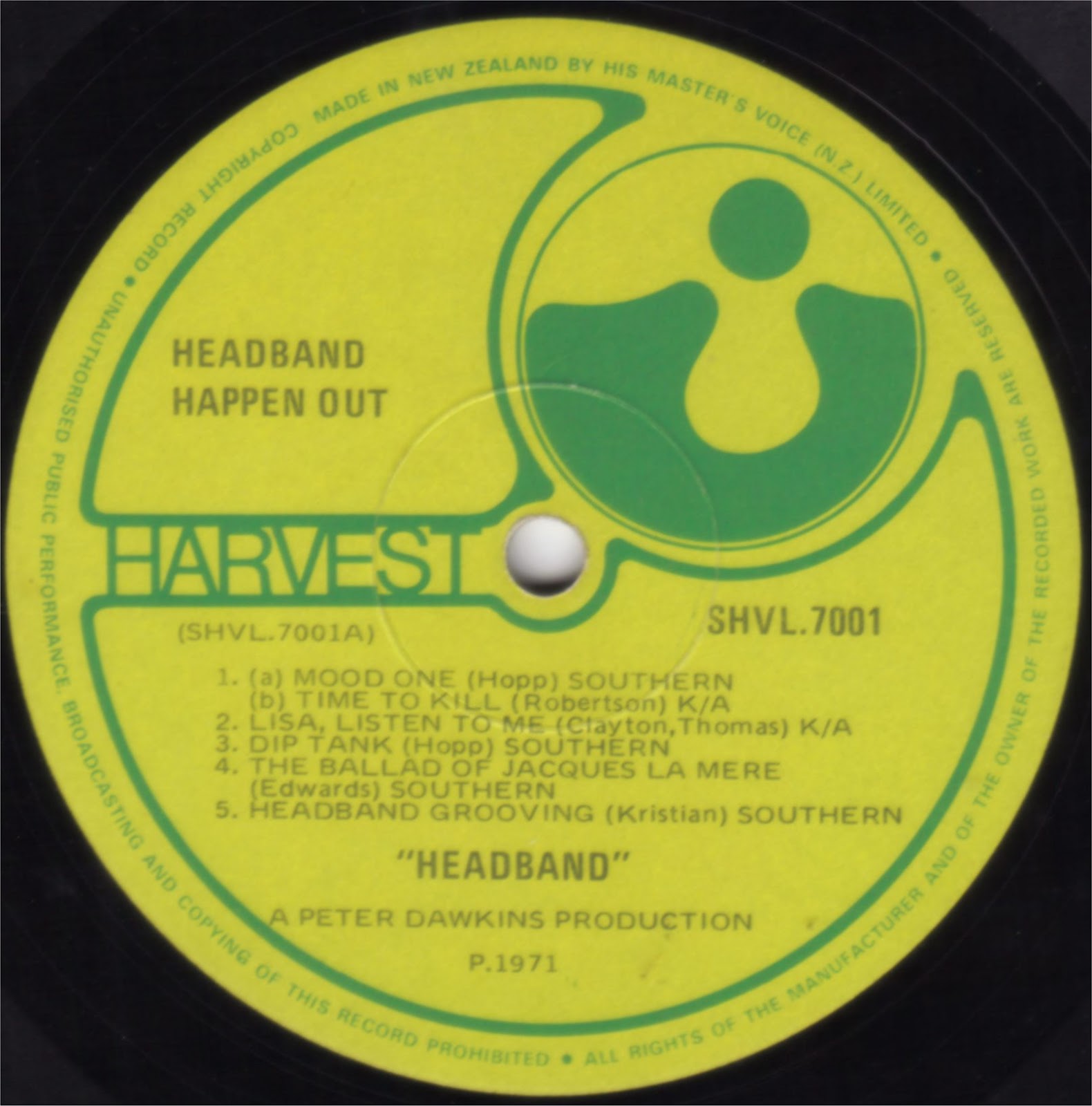
Headband - Happen Out (1971)

(New Zealand 1970 - 1973, 1975)
.
In the early sixties, singer Tommy Adderley enjoyed a  couple of minor hits and became a popular television performer. He then spent two years in Australia, returning home a seasoned cabaret performer. With a genuine love of the blues, he had always dreamed of forming a group similar to John Mayall and the Bluesbreakers.

In 1970, Adderley, inspired by the then current line-up of John Mayall's Bluesbreakers, formed a group to try an emulate their sound. His own Bluesbreakers was an unusual line-up, including an electric violin, but no drums. This was the sound Adderley had in mind. It didn't take too many rehearsals, however, before Tommy realised that this drumless unit wasn't working out, so Jimmy Hill was brought in on drums. At this point, the group was renamed Headband.

L to R: Kristian, Craig, Hopp, Hill and Adderley (1971)
Headband debuted at Molly Hatchetts nightclub in February 1971. This club closed shortly after, so Adderley purchased the old Bo-Peep club in Durham Lane in Auckland. He refurbished it and re-opened it as Grannys in June 1971. This gave Headband a permanent venue at which to play. It also became the venue at which great bands like Dragon and Ragnarok made their debuts.

In late 1971 Jack Stradwick (formerly with Action) left and he was replaced by Billy Kristian, who along with Jimmy Hill had previously played in Ray Columbus's Invaders. With this line-up, an album called "Happen Out" was recorded for HMV coming out in 1972, and featured a large proportion of original material. A single was taken from it, "Ballad of Jacques Le Mere"/"The Error Of My Ways". It reached number 14 on the national charts. Two further singles came from the album, "Good Morning Mr Rock'n'Roll"/"Dip Tank" and "Love Is Bigger Than The Whole Wide World"/"The Loving Tree", with the latter reaching number 12 in September 1972. the Adderley-written ‘Good Morning Mr Rock ‘n’ Roll‘, became the Headband’s most widely known song, getting to No.1 on the Radio Hauraki Hit List. Another single "Time"/"Paranoia" failed to sell.

L to R: Hill, Stradwick, Hopp, Craig and Quinnell - Adderley is seated (1970)
The debut album also featured the longest track recorded in New Zealand to date, the 15 minute ‘The Laws Must Change’, about the marijuana prohibition. “Tight and gutsy,” the Auckland Star was quoted as saying.

Headband at Ali Babas
Headband did a Universities tour during 1972, but apart from that they seldom performed outside Auckland. The group finally disbanded in 1973, with Adderley concentrating on his nightclub. But after numerous run-ins with the law, he was forced to close the venue in 1976.

Tommy resurrected Headband for a national tour, single and album in 1975. He had a new line-up featuring himself, Hopp and Hill, plus bassist Neil Edwards and keyboards player Len Whittle. The album was called "Rock Garden" with a single "I Get High (On Music)"/"Hey Little Schoolgirl" coming from it. Nothing more came from the group after this.

In 2000, a new CD was released called "The Headband Collection", which was simply a compilation of both albums, with no new material surfacing.
.
This post consists of FLACs  ripped from my prized vinyl, which I picked up at the market only just recently.  And what a find, the vinyl is in pretty good condition and the cover is not bad for its age. I've seen this album for sale on eBay for $250+  and my copy cost me a buck!
Gotta say I was a pretty happy camper that day.  I really like this album, and every track is stand out material, but the best track would have to be "The Laws Must Change".  The use of violin on top of some great guitar and vocals makes this Kiwi Blues and Psychedelic release an absolute must for the record collector.
.
Track Listing
01 - Mood One-Time To Kill
02 - Lisa, Listen To Me
03 - Dip Tank
04 - The Ballad Of Jacques La Mere
05 - Headband Grooving
06 - Good Morning Mr. Rock And Roll
07 - Love Is Bigger Than The Whole Wide World
08 - Mood Two-The Laws Must Change
.
Line-Up:
Tommy Adderley (Harmonica / Vocals)
Alan Quinnell (Guitar)
Ronnie Craig (Guitar)
Jack Stradwick, Billy Kristian (Bass)
Dick Hopp (Electric Violin / Flute)
Jimmy Hill (Drums)
.

Headband FLAC Link (333Mb)
.

.

Thursday, May 19, 2016

Bon Jovi - In These Arms Unauthorised (1994) Ex.Bootleg

(U.S 1983 - Present)
.
Bon Jovi is an American rock band from Sayreville, New Jersey. Formed in 1983, Bon Jovi consists of lead singer and namesake Jon Bon Jovi, pianist and keyboardist David Bryan, and drummer Tico Torres. The band's lineup has remained mostly static during its history, with the only exceptions being the 1994 dismissal of bass player Alec John Such, who was unofficially replaced by Hugh McDonald, and the departure of long time guitarist and co-songwriter Richie Sambora in 2013. In 1986, Bon Jovi achieved widespread global recognition with their third album, Slippery When Wet. The band's fourth album, New Jersey was equally successful in 1988. After touring and recording non-stop during the late 1980s, the band went on hiatus following the New Jersey Tour in 1990, during which time Jon Bon Jovi and Richie Sambora both released successful solo albums. In 1992, the band returned with the album 'Keep the Faith'.
.
Their 'I'll Sleep When I'm Dead' Tour ran during the second half of 1993 and it is from this tour that the featured bootleg recording was taken.. (Note: The front cover says "Live in New Jersey, USA 1993" but the track listing is the same as the second half of their set list for the concerts at Milton Keynes National Bowl, England, UK on Sept 18/19 1993, as reported by bootlegzone.com).
The tour was an extension of the 'Keep the Faith Tour' which was in promotion of the 1992 multi-platinum album 'Keep the Faith'. The tour returned to Europe, Asia and North America and also visited countries such as Australia and Argentina, which were not visited during the initial Keep the Faith tour earlier in the year.
.
Milton Keynes Bowl
Concert Review
(Bon Jovi at Milton Keynes Bowl - September 18th 1993)
Support Acts: Billy Idol / Little Angels / Manic Street Preachers

Another excellent concert from Bon Jovi on their I'll Sleep When I'm Dead Tour in support of their Keep The Faith album. Recorded live for Radio 1 in the UK hence this is a great bootleg of the gig. As is normal with Bon Jovi set lists change regularly and on the second night an extra 4 song encore was played...as recorded on this bootleg. Bon Jovi are so consistent live that I can honestly say that I have never seen a bad show. Old time pros in 1993 after being together a decade and coming through the aftermath of the Slippery / Jersey mammoth success

The Manic Street Preachers opened the day and as big a fan as I am of theirs today wasn't their crowd and they were unfortunately largely ignored. As mentioned elsewhere I was and still am a big fan of The Little Angels who were one of the support bands and were as usual fabulous. Not so impressed with Billy idol who for every great song (Rebel Yell, White Wedding, Mony Mony etc) there were twice as many duds. When he really rocks then he is capable of great things but too much dross in there as well.
Review sourced from storiesfromthemoshpit.com

Ticket: September 18th 1993
Ticket Price: £20.00

Full Concert Setlist
I Believe
Wild in the Streets
You Give Love a Bad Name
Born to Be My Baby
Can't Help Falling in Love
(Elvis Presley cover)
Bed of Roses
Keep the Faith
I'd Die for You
Dry County
Lay Your Hands on Me
I'll Sleep When I'm Dead
Play Video
Bad Medicine
Shout
(The Isley Brothers cover)
Help!
(The Beatles cover)
Wanted Dead or Alive
In These Arms
Livin' on a Prayer
I'll Be There for You
With a Little Help From My Friends


Souvenir Coke Cans (Concert Sponsors)
Feature Article
'Jon Bon Jovi says he hasn’t spoken to former bandmate Richie Sambora in ‘Over Three Years’
Bon Jovi is one of those bands that many of us find to be a guilty pleasure, much like Journey. Their music is cheesy, goofy, a bit over-dramatic, and sounds incredibly dated, yet remains iconic and will undoubtedly live on through classic rock radio and Spotify playlists into the future. Throughout rock history, there have been iconic pairings of lead singers with guitar players that have gone on to help define these bands. Guns N’ Roses has Slash and Axl, Aerosmith has Steven Tyler and Joe Perry, The Rolling Stones have Mick Jagger and Keith Richards, and Led Zeppelin had Jimmy Page and Robert Plant. Much in the same vein, Bon Jovi had Jon Bon Jovi and Richie Sambora.

Ritchie Sambora and Jon Bon Jovi
According to Billboard, Bon Jovi are preparing their first post - Richie Sambora album to be release later this year. The reasons for Sambora’s departure in 2013 still aren’t even entirely clear, with Sambora making statements in the past about how tough life on the road was for him, but Jon Bon Jovi claims he hasn't even spoken with Sambora since then. He just stopped showing up.

“I haven’t seen him in over three years. He just didn't show up for work anymore. And that’s the truth of the matter,” Bon Jovi said. “And, you know, life goes on.”
No doubt Bon Jovi will still see success in a post-Sambora world, but the legendary pairing is going to be what fans will clamour for. Oh well, there can be a big reunion tour somewhere down the line if these two can somehow meet in the middle. Then they’ll be… halfway there. Until then, fans will be livin’ on a prayer in hopes of the two making up. Have hope, though; if Axl Rose and Slash could reconcile, that means that anything — literally anything — is possible. [as reported on uproxx.com By: Dave Walsh 05.11.16]
.
This post consists of MP3's (320kps) ripped from my Australian Grapefruit Bootleg CD. The quality of the recording is close to a 10/10 and is one of the best bootlegs I've heard in the Unauthorised Series.
Full album artwork along with alternative bootleg covers released for this Radio Broadcast are included. Other titles for this concert are "Long Way Home", "I'll Sleep When I'm Dead" and "Live At Milton Keynes". The first half of the concert was released by Grapefruit under the title Bed Of Roses, which unfortunately I don't own - but I'm still looking !
Hope you enjoy this 'boot' which features great audience participation and Bon Jovi firing on all cylinders.
.

Track Listing
01 - I'll Sleep When I'm Dead [w/ Jumpin' Jack Flash] (08:23)
02 - Bad Medicine [w/ Shout] (10:55)
03 - Help! (03:11)
04 - Wanted Dead Or Alive [w/ Little Wing] (10:26)
05 - In These Arms [w/ Livin' On A Prayer] (14:46)
06 - I'll Be There For You (09:54)
.
The band:
Jon Bon Jovi – lead vocals, guitar
Richie Sambora – guitars, backing vocals, talkbox
Alec John Such – bass, backing vocals
Tico Torres – drums, percussion
David Bryan– keyboards, piano, backing vocals
.
Bon Jovi Link (135Mb)  New Link 16/01/2025